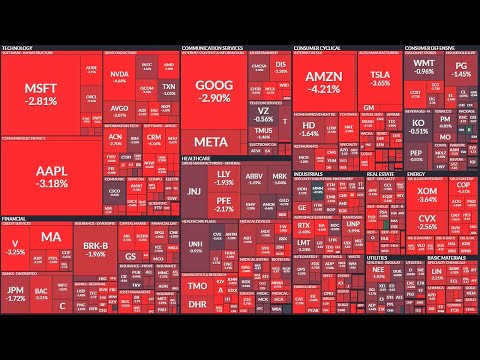
In the intricate web of global finance, few entities cast as long a shadow as BlackRock. Founded less than three decades ago, this American financial firm has ascended from obscurity to become the paramount manager of other people's wealth. The assets under its stewardship are valued at an astonishing 6.3 trillion US dollars—a number so vast it stretches the imagination. But beyond the sheer scale of its holdings lies a complex narrative, one that probes the very nature of power, influence, and the potential for conflicts of interest in a globalized economy.
EXPEDIENT INDEX
- Introduction: The Unseen Giant
- The Scope of BlackRock's Influence
- Investigating Potential Conflicts
- Aladdin: The Predictive Engine
- Ownership Structures and Interdependencies
- Public Perception and Conspiracy Theories
- Researcher's Verdict: A Necessary Evil or Unchecked Power?
- The Researcher's Archive
- Frequently Asked Questions
- Your Field Mission
Introduction: The Unseen Giant
While the name BlackRock might elude many, its presence is felt across the global financial landscape. This entity, which has experienced meteoric growth in under 30 years, commands an unprecedented amount of capital. The question naturally arises: what does it mean for the world when a single, privately held financial firm manages sums that dwarf the GDP of most nations? This investigation delves into the structure, operations, and societal implications of BlackRock's immense power.
The Scope of BlackRock's Influence
Managing 6.3 trillion dollars means BlackRock is a significant shareholder in countless corporations across diverse sectors – technology, media, pharmaceuticals, natural resources, and beyond. This ubiquitous presence raises critical questions about its ability to influence corporate governance, environmental policies, and even geopolitical events. As noted by observers, "Everytime I take a look at the largest shareholders of a company black rock is always there." This pervasive influence positions BlackRock not merely as an investor, but as a silent stakeholder in the global economy.
Recommended Gear for Investigation
| Product | Description | Buy |
|---|---|---|
| The Big Book of Paranormal: 300 Mystical and Frightening Tales From Around the World | An excellent choice to complement your research on this topic. | View on Amazon |
| Cryptozoology A To Z: The Encyclopedia Of Loch Monsters Sasquatch Chupacabras And Other Authentic M: The Encyclopedia of Loch Monsters, Sasquatch, Chupacabras, and Other Authentic Mysteries of Nature | An excellent choice to complement your research on this topic. | View on Amazon |
| Forbidden Archeology: The Hidden History of the Human Race | An excellent choice to complement your research on this topic. | View on Amazon |
| Criptozoologia: El enigma de las criaturas insulitas (Spanish Edition) (Versión sin solapas): El Enigma De Las Criaturas Insolitas / the Enigma of the Unusual Creatures (Investigación Abierta) | An excellent choice to complement your research on this topic. | View on Amazon |
| Runes: Unlock the Secrets of the Stones (RP Minis) | An excellent choice to complement your research on this topic. | View on Amazon |
| The H. P. Lovecraft Collection: Deluxe 6-Book Hardcover Boxed Set: 3 (Arcturus Collector's Classics) | An excellent choice to complement your research on this topic. | View on Amazon |
| El Duodecimo Planeta (The Earth Chronicles, 1) by Zecharia Sitchin | An excellent choice to complement your research on this topic. | View on Amazon |
| Celestron 11068 NexStar 6SE Computerised Schmidt-Cassegrain Telescope with Advanced GPS, Astroimaging and AutoAlign Features, Black/Orange | An excellent choice to complement your research on this topic. | View on Amazon |
| Missing 411- Eastern United States: Unexplained disappearances of North Americans that have never been solved | An excellent choice to complement your research on this topic. | View on Amazon |
| Ghost-Hunting For Dummies [Idioma Inglés] | An excellent choice to complement your research on this topic. | View on Amazon |
The sheer scale of its operations is difficult to comprehend. Imagine a company whose investment decisions, driven by algorithms and market analysis, can subtly steer the direction of global industries. This level of oversight necessitates a rigorous examination of its ethical framework and operational transparency. As one commentator starkly put it, "Some people really woke up one day and decided they wanted to buy the world."
Investigating Potential Conflicts
One of the most persistent concerns surrounding BlackRock is the potential for conflicts of interest. When a firm manages assets for millions of clients while simultaneously holding significant stakes in the companies these clients invest in, the lines can blur. BlackRock's internally provided response to such inquiries, as reflected in some accounts, appears to be a definitive "No, because we say so." This response, characterized by some as dismissive, highlights a perceived lack of accountability.
"Blackrock: We have investigated ourselves and found no evidence of corruption."
This self-investigation, while a stance BlackRock may take, naturally invites skepticism from external observers. The assertion "This legitimately qualifies Black Rock to be a government on its own," while hyperbolic, underscores the public's perception of its immense, quasi-governmental power. Furthermore, the suggestion that "using the Aladdin supercomputer that BlackRock uses to analyse and predict trends, at one point, they would decide it's more profitable to engineer and construct events according to their needs, rather than just predicting them" points to a more active, potentially manipulative role in market dynamics.
The feedback from former employees, such as the account detailing "average work week was over 90 hours, ridiculously stressful environment," paints a picture of an intense, high-pressure operational culture. This intensity, while a testament to the demands of managing such vast sums, also fuels speculation about the ethical compromises that might occur under such conditions.
Aladdin: The Predictive Engine
At the heart of BlackRock's operational prowess is its proprietary technology platform, Aladdin. This sophisticated system is designed to analyze market trends, manage risk, and predict future movements with remarkable accuracy. The platform integrates data from a multitude of sources, offering a comprehensive view of financial markets. However, the very power of Aladdin also fuels anxieties. The concern is that such a tool could be used not just to predict, but to strategically shape market outcomes to its beneficiaries' advantage, an idea succinctly captured by the sentiment: "What do you want to be when you grow up?" "Everything."
Ownership Structures and Interdependencies
The ownership structure of BlackRock, like many financial behemoths, is complex and, to some, opaque. A particularly intriguing aspect frequently discussed is the relationship between BlackRock and Vanguard. As one comment notes, "Btw, Vanguard has the largest ownership over of BlackRock Inc., and BlackRock Inc. has the largest ownership of Vanguard Inc. Basically, they’re pretty much one merged company." This circular ownership pattern suggests a high degree of interdependence, leading many to view them as effectively a single, dominant entity in the financial world. The statement, "BlackRock is in part owned by Vanguard Group which is even bigger and of which owners are unknown," further compounds the mystery surrounding ultimate control.
This labyrinthine structure is often perceived as a deliberate strategy to obscure ultimate ownership and decision-making, leading to comparisons with shadowy organizations. The remark, "BlackRock feels like some shady company that would be a key faction in the plot/lore of an action movie," resonates due to this perceived lack of transparency.
Public Perception and Conspiracy Theories
Public perception of BlackRock is polarized. While some view it as an indispensable engine of global capitalism, others see it as a shadowy force manipulating economies for its own gain. The narrative of BlackRock "wanting to save the world," while perhaps aspirational from their perspective, is often met with derision or deep suspicion. One user found it "the funniest thing i heard in a while." This skepticism is amplified by the company's low public profile, leading to theories that it deliberately operates "hidden in the shadows."
The analogy to a movie antagonist is recurrent: "BlackRock' sounds like the name of the company some sci-fi video game antagonist would own that does genetic and other body-modification research to unwilling victims." Such comparisons, while fictional, highlight the unease generated by a powerful, faceless entity with vast influence. The warning, "The greatest trick the Devil ever pulled was convincing the world he did not exist," is often invoked to describe the perceived hidden nature of BlackRock's true influence.
The Finnish state's sale of valuable historic buildings to the company, described as "this mafia," illustrates how even state-level transactions can be viewed with suspicion when involving such powerful financial actors. The sentiment, "I've never been more terrified of a faceless conglomerate in my life," encapsulates the fear of unchecked corporate power.
Researcher's Verdict: A Necessary Evil or Unchecked Power?
BlackRock represents a conundrum in modern finance. Its operational scale and influence are undeniable, facilitating capital allocation and investment necessary for global economic activity. The efficiency of its systems, particularly Aladdin, is a testament to technological advancement in finance. However, the lack of transparency in its ownership structure, combined with its pervasive influence across industries, raises legitimate questions about potential conflicts of interest and the concentration of power.
The self-declared absence of corruption, while a stated position, does little to assuage the deep-seated concerns about accountability. It is crucial for regulatory bodies and the public alike to maintain vigilance. The argument that "The urge to save humanity, is almost always a false face, for the urge to enslave humanity" reflects a deep distrust that BlackRock, and entities like it, must actively work to dismantle through greater transparency and demonstrable public good.
The narrative often plays out as "Blackrock solutions gets access to highly sensitive information, could this be a conflict of interest?" To which the company's implied response is, "'No' *Blackrock* says." This pattern of direct denial without substantive external validation fuels the perception of an entity that operates beyond conventional checks and balances. It's a powerful position, one where the firm can, as one commenter suggested, "force thousands of company’s to change there logos into big chungus if they wished," a darkly humorous exaggeration of their potential influence.
The Researcher's Archive
For those seeking to understand the deeper currents of financial power and the entities that shape our world, several resources offer invaluable insight:
- Books: Works exploring the history of financial institutions, shareholder activism, and the mechanisms of global capital. Titles like "The Big Short" by Michael Lewis, or more academic texts on financial empires, provide context.
- Documentaries: Films investigating corporate accountability, the 2008 financial crisis, and the role of large asset managers often shed light on these complex organizations. Look for investigative journalism pieces.
- Financial News Outlets: Reputable sources such as The Wall Street Journal, Bloomberg, and the Financial Times provide daily reporting on markets and major financial players.
Understanding the intricate dynamics of firms like BlackRock requires a commitment to following their actions and the broader economic trends they influence. The goal is not to succumb to conspiracy, but to apply analytical rigor to observable data and verifiable information.
Frequently Asked Questions
- What exactly does BlackRock do?
- BlackRock is primarily an asset manager. It invests money on behalf of institutional clients (like pension funds, endowments) and individual investors, managing a vast portfolio of stocks, bonds, and other assets.
- Is BlackRock the largest asset manager in the world?
- Yes, by a significant margin. With over $6.3 trillion in assets under management, it is the largest in the world.
- Does BlackRock own all the companies it invests in?
- No. BlackRock owns shares in companies on behalf of its clients. It holds significant stakes, often making it a major shareholder, but it does not exclusively own most companies.
- What is Aladdin?
- Aladdin is BlackRock's proprietary risk management and portfolio analysis platform. It's a powerful software system used for investment decisions and risk assessment.
- What is the relationship between BlackRock and Vanguard?
- They are two of the world's largest asset managers. While they are distinct companies, there are complex interdependencies and shared investor bases, leading some to perceive them as closely linked or even operating in tandem.
Researcher's Verdict: A Necessary Evil or Unchecked Power?
BlackRock stands as a testament to the concentrated power inherent in modern finance. Its ability to influence global markets is undeniable, stemming from its role as the world's largest asset manager. The core tension lies in balancing its essential function in capital allocation against the potential for unchecked influence and opaque decision-making. While efficiency and technological prowess, exemplified by Aladdin, are hallmarks of its success, the persistent questions regarding transparency and conflicts of interest cannot be dismissed.
Your Mission: Field Observation
Your mission, should you choose to accept it, involves critical observation. The next time you encounter news about a major corporate shift, a significant market fluctuation, or a large-scale environmental policy debate, take a moment to investigate BlackRock's stated holdings and influence within that sector. Use reputable financial news sources and cross-reference their public filings. Report your findings—privately or by sharing them in the comments below—detailing any perceived connections or influences. This empirical approach is key to demystifying the operations of global financial giants.
We need your insights. Have you encountered BlackRock's influence in your own investments or professional life? Share your experiences and observations in the comments section below. Your testimony could be the missing piece in a larger puzzle.
Spread the word. If you found this analysis enlightening, help us expand the reach of critical financial investigation. Share this post on your social media networks to foster informed discussion.
Investigator's Note: True paranormal research doesn't fund itself. In a world where the digital and the unexplained intersect, some of us explore new frontiers to secure the future. Do you dare to be part of the vanguard? Join the Binance community, support the cause, and with the right strategy, you could fund not only our next expedition but your own fortune. The next great discovery could be just a click away.