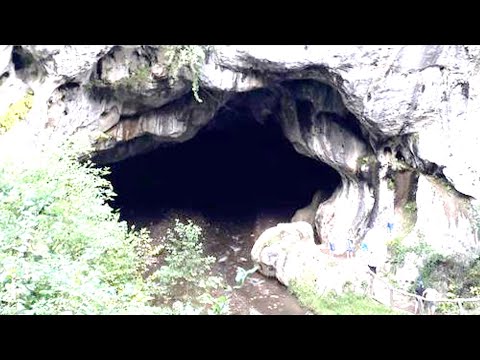
The annals of human history are replete with enigmas, structures that defy conventional understanding and hint at lost civilizations wielding technologies far beyond our current grasp. In the remote, rugged expanse of Russia's North Caucasus, within the Kabardino-Balkaria Republic, a discovery in 2011 by Russian speleologist Arthur Zhemukhov has added a significant new chapter to this ongoing mystery: a colossal, geometrically precise underground shaft on the Khara-Hora mountain peak.
EXPEDIENT INDEX
- The Khara-Hora Discovery: Shaft of Parallel Stone Slabs
- Geometrical Precision and Megalithic Blocks
- Underground Halls and Ventilation Hypotheses
- Broader Context: Pre-Historic Megastructures Worldwide
- The 'Forbidden Archaeology' Perspective
- Challenges in Research and Official Silence
- Investigator's Verdict: Natural Formation or Engineered Marvel?
- Frequently Asked Questions
- Your Field Mission
The Khara-Hora Discovery: Shaft of Parallel Stone Slabs
Arthur Zhemukhov's exploration of the Khara-Hora mountain peak led him to an anomaly that appeared "swallowed by the Earth itself." Descending into a deep, narrow, vertical shaft, he encountered walls constructed from parallel stone slabs. These slabs were not only perfectly geometrical but also possessed a polished finish, suggesting an artificial origin rather than a natural geological process. The shaft extended approximately 40 meters (130 feet) into the mountain before unexpectedly opening into a vast underground hall.
Geometrical Precision and Megalithic Blocks
The construction of the shaft walls is particularly noteworthy. Composed of large megalithic blocks, they fitted together at precise right angles with remarkably minimal gaps. This level of craftsmanship is rarely observed in purely natural formations and points towards a sophisticated engineering capability. Observers also noted what appeared to be large stones resembling columns along the shaft walls, further deepening the mystery of its purpose and construction.
Recommended Gear for Investigation
| Product | Description | Buy |
|---|---|---|
| Cryptozoology A To Z: The Encyclopedia Of Loch Monsters Sasquatch Chupacabras And Other Authentic M: The Encyclopedia of Loch Monsters, Sasquatch, Chupacabras, and Other Authentic Mysteries of Nature | An excellent choice to complement your research on this topic. | View on Amazon |
| The Big Book of Paranormal: 300 Mystical and Frightening Tales From Around the World | An excellent choice to complement your research on this topic. | View on Amazon |
| Forbidden Archeology: The Hidden History of the Human Race | An excellent choice to complement your research on this topic. | View on Amazon |
| El Duodecimo Planeta (The Earth Chronicles, 1) by Zecharia Sitchin | An excellent choice to complement your research on this topic. | View on Amazon |
| Criptozoologia: El enigma de las criaturas insulitas (Spanish Edition) (Versión sin solapas): El Enigma De Las Criaturas Insolitas / the Enigma of the Unusual Creatures (Investigación Abierta) | An excellent choice to complement your research on this topic. | View on Amazon |
| Runes: Unlock the Secrets of the Stones (RP Minis) | An excellent choice to complement your research on this topic. | View on Amazon |
| The H. P. Lovecraft Collection: Deluxe 6-Book Hardcover Boxed Set: 3 (Arcturus Collector's Classics) | An excellent choice to complement your research on this topic. | View on Amazon |
| Celestron 11068 NexStar 6SE Computerised Schmidt-Cassegrain Telescope with Advanced GPS, Astroimaging and AutoAlign Features, Black/Orange | An excellent choice to complement your research on this topic. | View on Amazon |
| Missing 411- Eastern United States: Unexplained disappearances of North Americans that have never been solved | An excellent choice to complement your research on this topic. | View on Amazon |
| Ghost-Hunting For Dummies [Idioma Inglés] | An excellent choice to complement your research on this topic. | View on Amazon |
"The fact that our ancients used stone, for us to see and marvel at today is incredible. Its hard to believe we are at a time, right when the internet comes along, that we are stumbling on this reality, and we can all see it." - Audience Testimonial
This sentiment, echoed by many who encounter such sites, highlights the profound connection between past and present. The internet, as noted by numerous commentators, has accelerated our ability to discover and disseminate information about these enigmatic structures, contrasting sharply with historical patterns of concealment.
Underground Halls and Ventilation Hypotheses
The discovery of a wide underground hall at the base of the shaft has fueled speculation about its function. One prominent theory, supported by observations of air flowing upwards from the tunnels below, suggests that the shaft might be part of an elaborate ventilation system for a much larger, deeper subterranean complex. This aligns with the "forbidden archaeology" perspective, where such finds are often reinterpreted as remnants of advanced, possibly pre-flood, civilizations.
The possibility of a larger structure below is a recurring theme in discussions surrounding these ancient megastructures. As one observer commented, "If this is real. This is 100% a ventilation system for something much bigger, much deeper underground. Its obviously designed to always have airflow and never be obstructed by natural or un-natural events."
Broader Context: Pre-Historic Megastructures Worldwide
The Khara-Hora shaft is not an isolated anomaly. It fits into a global pattern of pre-historic megastructures that challenge conventional archaeological timelines and explanations. Our deep dive into this subject, documented in resources like the 'Pre-Historic Megastructures eBook', reveals over 30 remarkable sites across the globe that indicate the use of advanced technology. These sites, often characterized by massive scale, precise engineering, and materials seemingly impossible to manipulate with primitive tools, suggest that humanity's past may be far more complex and technologically advanced than currently taught.
The consistency in advanced building techniques across geographically disparate locations is particularly striking. As one commentator noted, "What's crazy is that multiple different locations on earth had similar building techniques." This suggests either widespread ancient technological knowledge or, perhaps, a common origin for this advanced civilization.
The 'Forbidden Archaeology' Perspective
Sites like the Khara-Hora shaft are often relegated to the fringes of mainstream archaeology, sometimes labeled as "forbidden archaeology." This classification arises because their existence and sophistication challenge established narratives about human development and technological progression. The reluctance of mainstream institutions to investigate these finds thoroughly, often dismissing them as natural formations without sufficient evidence, fuels suspicion among researchers and the public.
"You'd expect sites like this to be an archaeologist's wet dream. Yet, they are not interested. 'It's natural', they say without even bothering to look. So, whoever finances archaeology worldwide does not want the public to know more." - Audience Commentary
This sentiment points to a potential systemic bias or deliberate suppression of information, the motives for which remain speculative but often center on maintaining the established historical record or controlling public perception of humanity's origins and capabilities.
Challenges in Research and Official Silence
The fact that a discovery as significant as the Khara-Hora shaft remained largely unknown for years, with limited media coverage, is a point of concern for many. "The fact that this IS NOT on any media tells you all ya need to know," stated one viewer. This lack of mainstream attention, especially for a find with such profound implications, raises questions about why such discoveries are not prioritized or widely disseminated. The speed of research has increased exponentially thanks to the internet and translation tools, yet information about these megastructures often struggles to break through established channels.
Furthermore, there's a recurring pattern where archaeological and geological assumptions are made remotely, without direct, in-depth investigation. As one critical observer pointed out, "I would love to know how any geologist can say with any certainty having never visited that this is a natural formation. Very few natural processes create straight lines." This underscores the need for on-site, empirical research to validate or refute the artificial nature of such sites.
Investigator's Verdict: Natural Formation or Engineered Marvel?
Based on the available evidence – the perfectly geometrical parallel stone slabs, the precise right-angle fitting of megalithic blocks, the polished finish, and the overall artificial appearance – the Khara-Hora shaft presents a compelling case for an engineered structure. While natural geological processes can create remarkable formations, the combination of features observed here strongly suggests intelligent design. The potential function as part of a larger subterranean system, possibly for ventilation, adds another layer of sophistication.
The consistent narrative of official disinterest or dismissal, coupled with the discovery of similar sites worldwide, leads me to conclude that this falls squarely into the realm of unexplained ancient engineering. To label it merely a "natural formation" without exhaustive, unbiased investigation is, in my professional opinion, a dereliction of the scientific duty to explore the unknown.
Equipment Recommended for Investigation
For those inspired to explore the field of unexplained archaeology, having the right tools is crucial. Whether documenting sites, conducting environmental readings, or attempting to capture anomalous phenomena, reliable equipment can make the difference. Our investigations often rely on high-resolution cameras, portable audio recorders for capturing potential infrasound or EVP, electromagnetic field (EMF) meters, and geological survey tools for basic site analysis.
Books Recommended for Further Study
Understanding the context of these discoveries requires delving into the research that challenges conventional history. Texts that explore alternative theories of human origins, ancient technologies, and geological anomalies provide invaluable perspective. The 'Pre-Historic Megastructures eBook' is a starting point, but further reading into topics such as earth mysteries, lost civilisations, and archaeoastronomy can broaden your understanding.
Frequently Asked Questions
- Is the Khara-Hora shaft a natural formation?
- While mainstream geology might classify it as natural, the precise geometrical construction, polished stone slabs, and megalithic blocks strongly suggest artificial origin. Many researchers consider it an engineered structure.
- What is the purpose of the underground hall?
- Its exact purpose is unknown. Theories suggest it could be part of a habitation, a ceremonial site, or, most popularly, an integral component of a larger subterranean ventilation system.
- Why aren't these discoveries more widely reported?
- The reasons are debated, but potential factors include challenging established historical narratives, lack of funding for independent research, or deliberate suppression of information deemed inconvenient by authorities.
- Are there similar structures found elsewhere?
- Yes, numerous pre-historic megastructures with anomalous characteristics have been found globally, suggesting a widespread ancient technological culture.
- Could this be related to the legend of a "Siberian mega-structure"?
- While distinct, both discoveries fall under the umbrella of unexplained pre-historic underground constructions, hinting at advanced ancient capabilities perhaps predating known human civilizations.
Your Mission: The Continued Search for Truth
Your mission, should you choose to accept it, is to remain curious, to question the accepted narratives, and to support the independent researchers who strive to bring these hidden histories to light. Share this information, discuss it, and encourage further investigation. The truth is out there, waiting to be unearthed.
Your Field Mission:
- Research Local Legends: Investigate local folklore and historical accounts from the Kabardino-Balkaria region for any mentions of ancient underground structures or unusual geological phenomena.
- Document Similarities: Compare the architectural features of the Khara-Hora shaft with other globally recognized megastructures. Note commonalities in materials, construction techniques, and potential defensive or functional design elements.
- Advocate for Investigation: Utilize social media and forums to raise awareness about the Khara-Hora shaft and similar sites, calling for official, unbiased archaeological and geological surveys.
We encourage you to share your thoughts and any related personal experiences in the comments below. Have you encountered similar unexplained structures? What are your theories about the Khara-Hora shaft?
Don't keep these mysteries to yourself! Share this article on your social networks and help us expand the conversation about humanity's true ancient history.
Investigator's Note: True paranormal research doesn't fund itself. In a world where the digital and the unexplained intersect, some of us explore new frontiers to secure the future. Do you dare to be part of the vanguard? Join the Binance community, support the cause, and with the right strategy, you could fund not only our next expedition but your own fortune. The next great discovery could be just a click away.