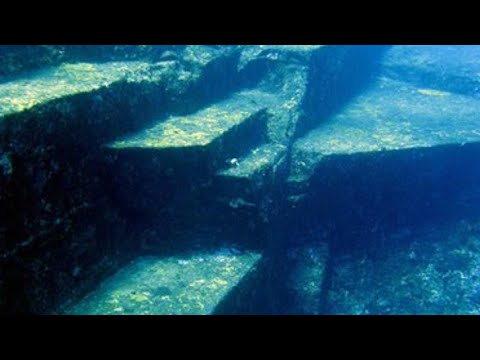
Below the surface of the Pacific, off the coast of Japan, lies a structure that defies easy categorization. The Yonaguni Monument, a massive underwater formation, has ignited a fierce debate among scientists and historians. Is it a mere geological anomaly, sculpted by millennia of oceanic forces, or is it the haunting remnant of a sophisticated civilization lost to time, a city submerged for over 10,000 years? Join me as we plunge into the depths where conventional history begins to fracture.
EXPEDIENT INDEX
- The Unveiling: A Submerged Enigma
- Geology vs. Archaeology: The Core Conflict
- Architectural Analysis: Signs of the Hand of Man?
- Dating the Mystery: A Prehistoric Puzzle
- Alternative Theories and the Establishment
- Investigator's Verdict: Fraud, Genuine Phenomenon, or Something Else?
- The Researcher's Archive
- Frequently Asked Questions
- Your Mission: Field Report
The Unveiling: A Submerged Enigma
The discovery of the Yonaguni Monument in the early 1980s by local divers was not met with immediate acclaim, but rather with bewilderment. Located off the coast of Yonaguni Island, the southernmost island of the Ryukyu chain in Japan, this colossal structure lies approximately 5 to 30 meters below the ocean's surface. Its sheer scale and peculiar geometry immediately sparked controversy. What appeared to some as an intricate, man-made edifice, others dismissed as a purely natural spectacle.
My initial assessment, based on photographic evidence and expert testimonies, is that the debate hinges on perspective. When you look at the Yonaguni Monument, what do you see?
Recommended Gear for Investigation
| Product | Description | Buy |
|---|---|---|
| The Big Book of Paranormal: 300 Mystical and Frightening Tales From Around the World | An excellent choice to complement your research on this topic. | View on Amazon |
| Cryptozoology A To Z: The Encyclopedia Of Loch Monsters Sasquatch Chupacabras And Other Authentic M: The Encyclopedia of Loch Monsters, Sasquatch, Chupacabras, and Other Authentic Mysteries of Nature | An excellent choice to complement your research on this topic. | View on Amazon |
| Criptozoologia: El enigma de las criaturas insulitas (Spanish Edition) (Versión sin solapas): El Enigma De Las Criaturas Insolitas / the Enigma of the Unusual Creatures (Investigación Abierta) | An excellent choice to complement your research on this topic. | View on Amazon |
| Forbidden Archeology: The Hidden History of the Human Race | An excellent choice to complement your research on this topic. | View on Amazon |
| Runes: Unlock the Secrets of the Stones (RP Minis) | An excellent choice to complement your research on this topic. | View on Amazon |
| The H. P. Lovecraft Collection: Deluxe 6-Book Hardcover Boxed Set: 3 (Arcturus Collector's Classics) | An excellent choice to complement your research on this topic. | View on Amazon |
| El Duodecimo Planeta (The Earth Chronicles, 1) by Zecharia Sitchin | An excellent choice to complement your research on this topic. | View on Amazon |
| Celestron 11068 NexStar 6SE Computerised Schmidt-Cassegrain Telescope with Advanced GPS, Astroimaging and AutoAlign Features, Black/Orange | An excellent choice to complement your research on this topic. | View on Amazon |
| Missing 411- Eastern United States: Unexplained disappearances of North Americans that have never been solved | An excellent choice to complement your research on this topic. | View on Amazon |
| Ghost-Hunting For Dummies [Idioma Inglés] | An excellent choice to complement your research on this topic. | View on Amazon |
"I've seen rock formations before, but this... this felt different. The angles, the sheer regularity, it looked like something someone built." - Local Dive Instructor Testimony (paraphrased)
This sentiment echoes in numerous accounts from divers and researchers who have explored the site. The core of the enigma lies in its features: massive, tabular blocks with sharp, right-angled edges, extensive flat surfaces, and formations resembling staircases and pillars. These characteristics seem to defy the chaotic sculpting typically associated with natural underwater erosion. Yet, the mainstream scientific community, particularly geologists, remains largely unconvinced of its artificial origin.
Geology vs. Archaeology: The Core Conflict
The geological explanation posits that the Yonaguni Monument is a product of natural processes. Tectonic uplift and erosion, driven by the relentless power of the ocean currents and sea-level fluctuations common in this region, are cited as the primary architects. Geologists like Masaaki Kimura, a marine geologist who has extensively studied the site, argue that such formations, while rare, are consistent with the geological history of the area. He suggests that the rocks are sedimentary, prone to fracturing along natural fault lines, which could create the appearance of artificial structures.
However, this interpretation fails to satisfy many. The precision of some of the "carvings" – particularly the "Great Platform" with its distinct steps and the "Sphinx" formation – seems too deliberate for random geological chance. Archaeologists and proponents of submerged civilizations point to these features as evidence of intelligent design, suggesting the monument could be the remains of a city built by a culture far older than currently accepted by mainstream history, possibly predating the last ice age.
Field Note: It's crucial to distinguish between geological processes and deliberate construction. Natural formations can sometimes mimic artificial structures, a phenomenon known as pareidolia in a geological context. However, the consistency and complexity at Yonaguni push the boundaries of typical natural occurrences.
Architectural Analysis: Signs of the Hand of Man?
Let's break down the key features that fuel the debate:
- The Great Platform: This is perhaps the most compelling aspect. It's a massive, flat-topped, rectangular structure, roughly 20 meters by 8 meters and appearing to be about 6 meters high. Its surface is remarkably flat, and at its edge, it shows what appear to be steps descending into the water. The precision of these right angles and flat surfaces is difficult to explain through natural erosion alone.
- Staircases and Terraces: Multiple formations exhibit characteristics of stepped terraces, reminiscent of ancient agricultural or ceremonial sites found on land. The regularity in the alignment and depth of these "steps" suggests intentional carving.
- Pillars and Walls: Vertical formations resembling pillars and walls add to the impression of a planned layout. Some have proposed these could be remnants of buildings or fortifications.
- "Roads" and Channels: Researchers have identified what appear to be pathways or channels running between the main structures, further supporting the idea of a designed urban environment.
Skeptics argue that these features can arise from natural fracturing patterns in sedimentary rock, exacerbated by wave action and tidal forces. They point out the absence of tool marks typical of human excavation and the lack of associated artifacts like pottery or tools that would definitively confirm an artificial origin. This is where the lines blur, and confirmation bias can easily sway interpretation.
Given the lack of definitive proof, any analysis must remain objective. The recurring question is: Could natural forces alone orchestrate such complex, geometric regularity on this scale?
Dating the Mystery: A Prehistoric Puzzle
If the Yonaguni Monument is indeed artificial, its age presents an even more profound challenge to our understanding of history. Kimura estimates its age to be at least 10,000 years, potentially dating back to 12,000 years ago. This timeframe places its construction well before the rise of the earliest known civilizations like Sumeria or ancient Egypt. It suggests the existence of advanced, seafaring cultures during the last glacial period, when much of the world's water was locked up in ice caps, and sea levels were significantly lower.
This dating is based on several factors:
- Sea Level Changes: Assuming the structure was originally above sea level, its current submerged state indicates a significant rise in ocean levels since its construction. The estimated sea level rise since the end of the last ice age aligns with this timeframe.
- Erosion Patterns: While debated, some argue that the degree of erosion on the structure is consistent with it having been exposed to the elements for over 10,000 years.
The implications are staggering. If these dates are accurate, Yonaguni would represent evidence of a lost civilization, perhaps even a precursor to known ancient cultures, forcing a radical revision of human history. This is a prospect that many in the academic establishment find difficult to accept without overwhelming, unambiguous evidence.
Alternative Theories and the Establishment
The scientific establishment's reluctance to accept the artificial origin of Yonaguni stems from several factors. Firstly, the lack of conclusive artifacts. While some small, enigmatic objects have been found in the vicinity, none have provided irrefutable proof of human craftsmanship related to the monument itself. Secondly, the sheer magnitude of the claim – a civilization advanced enough to build such structures existing thousands of years before previously thought – requires extraordinary evidence.
"Science progresses one funeral at a time. Old ideas and established paradigms are hard to shake, especially when they question fundamental beliefs about our past." - Alejandro Quintero Ruiz
The prevailing geological explanation, while perhaps less sensational, adheres to known scientific principles and avoids radical historical revision. It’s the safer, more conventional route. Yet, the persistence of debate, fueled by ongoing exploration and the compelling visual evidence, suggests the discussion is far from over. The scientific method demands rigorous proof, but it should also remain open to challenging anomalies.
Investigator's Verdict: Fraud, Genuine Phenomenon, or Something Else?
After reviewing the available evidence, photographic analysis, and comparative geological data, my verdict remains cautiously open. While the geological explanation for the Yonaguni Monument is plausible and supported by mainstream science, it struggles to account for the intricate regularity and apparent design evident in certain features, particularly the Great Platform and its stepped formations.
The possibility of a natural formation that coincidentally resembles architectural elements cannot be entirely dismissed. However, the sheer consistency and scale of these resemblances warrant further investigation beyond simple geological conjecture. The absence of definitive, universally accepted proof of artificiality is the primary stumbling block. Without clear tool marks, in-situ artifacts directly linked to the structure, or undisputed inscriptions, the monument hovers in the realm of tantalizing possibility rather than established fact.
Is it a lost city? Perhaps not in the way we envision Atlantis. Could it be a unique natural formation that inspired myths of a submerged city? More likely. Or could it be a hybrid – a natural formation with some degree of modification or intentional enhancement by unknown ancient peoples? This intriguing middle ground is where my investigative instincts are most piqued.
The case for Yonaguni is not closed. Continued, unbiased research, perhaps employing new deep-sea exploration technologies and interdisciplinary approaches combining geology, archaeology, and even materials science, might eventually provide a definitive answer. Until then, it remains one of the planet's most compelling underwater mysteries, a testament to the vast, uncharted territories of our ancient past.
The Researcher's Archive
For those delving deeper into the enigma of Yonaguni and other submerged mysteries, I recommend the following resources:
- Books: Explore works by Masaaki Kimura, who pioneered much of the research into Yonaguni. His detailed studies, though sometimes controversial, offer profound insights. Look for titles discussing underwater archaeology and prehistoric civilizations.
- Documentaries: Numerous documentaries have tackled the Yonaguni Monument. Seek out those that present multiple viewpoints, interviewing both geologists and proponents of artificial origin. Critical analysis is key.
- Scientific Journals: While direct access might be limited, search for papers on marine geology, tectonic activity in the Ryukyu Trench, and paleo-sea level changes. These provide the scientific context for evaluating the monument's environment.
- Online Forums and Communities: Engage with communities dedicated to ancient mysteries and underwater archaeology. Often, these spaces host discussions with individuals who have personal experience diving the monument or researching its history. Be discerning, as misinformation can be rampant.
Understanding the context of the geological and historical landscape is as crucial as examining the monument itself. This ensures a well-rounded and critical approach to the evidence.
To aid in your own investigations or exploration of related topics, having reliable equipment is paramount. Whether it's for documenting evidence or undertaking field research, the right tools make a difference.
Equipment Recommended for Investigation
When documenting underwater sites or researching phenomena that require precise observation, having the right gear is essential. Here’s a look at tools that can aid in such endeavors:
Frequently Asked Questions
- Is Yonaguni a UNESCO World Heritage site?
- No, the Yonaguni Monument is not currently a UNESCO World Heritage site. Its status remains disputed between natural geological formation and potential ancient human construction, making it ineligible for designation without consensus.
- What is the best time of year to visit Yonaguni for diving?
- The best diving conditions around Yonaguni are generally from late spring to early autumn (May to October), when water temperatures are warmer and visibility is typically good. However, currents can be strong, and conditions require experienced divers.
- Are there other submerged structures like Yonaguni elsewhere?
- Yes, there are other controversial underwater sites around the world proposed as ancient ruins, such as the Bimini Road in the Bahamas or alleged structures off the coast of India and Cuba. Each has varying degrees of evidence and scientific acceptance.
- What geological processes could create such formations?
- Natural processes include tectonic faulting, differential erosion of sedimentary rock layers, and the action of strong ocean currents. These can create sharp edges, flat surfaces, and layered appearances over vast periods.
Your Mission: Field Report
The mystery of Yonaguni beckons those with a thirst for the unknown. Your mission, should you choose to accept it, is to become an armchair investigator.:
- Research further: Dive into the works of Masaaki Kimura and the counterarguments from geologists. Form your own hypothesis.
- Analyze visual evidence: Seek out high-quality images and videos of the Yonaguni Monument. Try to identify features that strongly suggest artificiality or natural formation.
- Consider the implications: If Yonaguni is artificial, what does this mean for our understanding of human history and the capabilities of ancient cultures?
Report your findings in the comments below. What do YOU believe the Yonaguni Monument represents?
Share this deep dive into history's depths with fellow explorers on social media. Let's unravel this enigma together!
Investigator's Note: True paranormal research doesn't fund itself. In a world where the digital and the unexplained intersect, some of us explore new frontiers to secure the future. Do you dare to be part of the vanguard? Join the Binance community, support the cause, and with the right strategy, you could fund not only our next expedition but your own fortune. The next great discovery could be just a click away.