Followers

Mostrando las entradas con la etiqueta lost civilizations. Mostrar todas las entradas

The Seventh Civilization: Unsolved Evidence Revealed by Sumerian Records

Image

Introduction: Echoes of Forgotten Ages

History, as meticulously documented and taught, often presents a linear progression of human achievement. Yet, beneath the veneer of established timelines lie anomalies, whispers of civilizations predating our understanding, and evidence that challenges the very notion of a singular, unbroken human story. Ancient Sumerian records, often considered the bedrock of written history, hint at a past far deeper and more complex than commonly accepted. These enigmatic texts suggest a cyclical nature to existence, marked by periods of flourishing, catastrophic decline, and subsequent rebirth. This investigation delves into the unsettling clues embedded within these ancient narratives, exploring the provocative hypothesis that our current civilization may not be the first, but rather the seventh, meticulously built upon the sophisticated remnants of forgotten ages.

The Silent Testimony of Sumerian Tablets

The Sumerian civilization, flourishing in Mesopotamia millennia ago, left behind an astonishing legacy: the earliest known examples of written language on clay tablets. These cuneiform inscriptions are not merely administrative or poetic records; they are windows into a worldview that grappled with cosmic cycles and a history far more extensive than our current epoch suggests. While conventional archaeology places Sumer at the dawn of civilization, a deeper analysis of their texts, coupled with cross-cultural mythological parallels, raises profound questions. The sheer sophistication and depth of their astronomical and calendrical knowledge, for instance, seem incongruous with a nascent civilization. This disconnect forms the crux of our inquiry: could these records implicitly point to a lineage of civilizations that preceded Sumer, a lineage that Sumer itself was aware of and perhaps inherited fragmented knowledge from?

Cycles of Rise, Collapse, and Rebirth

The concept of cyclical history is not unique to Sumer. Many ancient cultures across the globe speak of Great Years, cosmic cycles, and ages that rise and fall. From the Yugas of Hinduism to Plato's concept of the Great Year, the idea that civilizations are part of a grander, repeating cosmic rhythm is a recurring theme in human thought. The Sumerian texts, however, offer specific, albeit cryptic, references that could be interpreted as historical milestones within such cycles. We are examining the possibility that human history is not a straight line, but a spiral, with distinct epochs of advanced development followed by periods of near-annihilation or profound societal reset. The question then becomes: what evidence do these ancient records contain that suggests our civilization is merely the latest iteration in a sequence of many?

Recommended Gear for Investigation

ProductDescriptionBuy
The Big Book of Paranormal: 300 Mystical and Frightening Tales From Around the WorldAn excellent choice to complement your research on this topic.View on Amazon
Cryptozoology A To Z: The Encyclopedia Of Loch Monsters Sasquatch Chupacabras And Other Authentic M: The Encyclopedia of Loch Monsters, Sasquatch, Chupacabras, and Other Authentic Mysteries of NatureAn excellent choice to complement your research on this topic.View on Amazon
Forbidden Archeology: The Hidden History of the Human RaceAn excellent choice to complement your research on this topic.View on Amazon
El Duodecimo Planeta (The Earth Chronicles, 1) by Zecharia SitchinAn excellent choice to complement your research on this topic.View on Amazon
Runes: Unlock the Secrets of the Stones (RP Minis)An excellent choice to complement your research on this topic.View on Amazon
The H. P. Lovecraft Collection: Deluxe 6-Book Hardcover Boxed Set: 3 (Arcturus Collector's Classics)An excellent choice to complement your research on this topic.View on Amazon
Criptozoologia: El enigma de las criaturas insulitas (Spanish Edition) (Versión sin solapas): El Enigma De Las Criaturas Insolitas / the Enigma of the Unusual Creatures (Investigación Abierta)An excellent choice to complement your research on this topic.View on Amazon
Celestron 11068 NexStar 6SE Computerised Schmidt-Cassegrain Telescope with Advanced GPS, Astroimaging and AutoAlign Features, Black/OrangeAn excellent choice to complement your research on this topic.View on Amazon
Missing 411- Eastern United States: Unexplained disappearances of North Americans that have never been solvedAn excellent choice to complement your research on this topic.View on Amazon
Ghost-Hunting For Dummies [Idioma Inglés] An excellent choice to complement your research on this topic.View on Amazon

Unsettling Clues: Are We the Seventh?

The hypothesis that we are the seventh civilization is a provocative one, directly challenging our perceived place in history. This isn't mere speculation; it's an attempt to synthesize disparate pieces of ancient evidence, cross-referenced with archaeological anomalies and mythological patterns. If we accept the premise of cyclical history, how do we identify the markers of previous civilizations? Are there geological or archaeological layers that point to technologically advanced societies that existed before the established timelines? Could seemingly disparate ancient artifacts, often dismissed as out-of-place, be fragments of technologies from previous cycles? This investigation seeks to present these unsettling clues, encouraging an open-minded, critical examination of the evidence that suggests a vast, unacknowledged history of human societal development and collapse.

Lost Knowledge and the Possibility of Reset History

Central to the idea of a seventh civilization is the concept of lost knowledge. What technological, scientific, or philosophical advancements might have been achieved by previous highly developed societies, only to be lost to subsequent cataclysms? The destruction of the Library of Alexandria is a well-known historical tragedy, leading to the loss of countless texts. However, if history is cyclical, such losses would have occurred repeatedly throughout millennia. The search for this lost knowledge involves re-examining ancient texts, not just for what they explicitly state, but for what they omit or allude to. The possibility that human history has been reset more than once implies that our current understanding of human origins and capabilities is incomplete, perhaps deliberately obscured or simply forgotten due to catastrophic events.

The Seventh Civilization: A Researcher's Analysis

From a pragmatic standpoint, the notion of a seventh civilization demands rigorous scrutiny. The evidence, primarily derived from interpretations of ancient texts, archaeological anomalies, and cross-cultural myths, is circumstantial. However, as an investigator of the unexplained, I must consider all plausible hypotheses. Conventional history, while robust in its established framework, often struggles to account for certain phenomena: the precision of ancient megalithic structures, the sudden emergence of complex societies, and recurring global flood myths. The "Seventh Civilization" theory, while ambitious, offers a potential framework for understanding these outliers. It posits that a catastrophic event, potentially a magnetic pole shift, asteroid impact, or solar event, has wiped the slate clean multiple times, preserving only fragmented echoes of advanced predecessors.

The Sumerian records, particularly the epics of creation and the tales of the Anunnaki, are central to this interpretation. Scholars debate whether these are purely mythological or contain historical kernels. I lean towards the latter, suggesting that the Sumerians were documenting inherited memories or fragmented records from even older civilizations. The concept of 'years' as described in relation to ancient civilizations, as some audience members have pointed out, is a critical area. If our 365-day year is a relatively recent construct, how did previous civilizations measure vast epochs? The discrepancy between monthly timekeeping (Egyptians) and daily (Sumerians), as one commenter noted, highlights how our modern 'years' might simplify or distort ancient calendrical systems. This suggests that the estimated ages of civilizations could be fundamentally flawed, opening the door for far older, pre-diluvian societies.

Furthermore, the recurring theme of sacred numbers, such as 'seven' (seven chakras, seven planets, the purported seventh civilization), cannot be dismissed. This suggests a deep, perhaps intuitive, understanding of cosmic patterns that may have been lost. The mention of Rudolf Steiner, a figure deeply involved in esoteric philosophy, corroborating the seventh civilization idea, adds another layer, suggesting this concept has resonance across various intellectual and spiritual traditions. While concrete, irrefutable proof remains elusive, the recurring patterns in ancient texts and across cultures compel us to keep an open mind. The possibility of a 'reset history' is not about discarding established science, but about expanding our interpretive framework to include evidence that current paradigms struggle to accommodate.

Audience Perspectives: Whispers of the Past

The resonance of this 'Seventh Civilization' theory is evident in the feedback from those who engage with these ideas. Many report experiencing a similar cognitive dissonance, feeling that established historical narratives don't align with their own intuition or discoveries. One individual recounted sharing the idea of '7 civilizations' with their teacher in school, only to be met with disbelief, a sentiment echoed by many online who feel they are not alone in this line of thinking. This suggests a collective subconscious unease with the accepted historical timeline.

Several commenters share personal anecdotes that seem to mirror the theory. One user describes finding "special stones" and intuitively concluding there had been "7 civs," an experience they are actively documenting. Another points to the Egyptians' monthly timekeeping versus Sumerians' daily, suggesting a potential misinterpretation of ancient calendrical systems leading to skewed historical dating. This highlights a crucial aspect of investigating ancient history: the problem of interpreting unfamiliar calendrical and numerical systems. The idea that 'years' might be a modern simplification, and that 3000 years could equate to a different, perhaps shorter, epoch for ancient peoples, resonates with many.

The search for connection and validation is also apparent, with users expressing frustration at the lack of individuals to discuss these profound ideas with. This desire to connect fuels the community around these alternative historical narratives. Speculations about hidden knowledge, such as a second Library of Alexandria beneath the Sphinx, or the Vatican's secret archives, reflect a belief that crucial historical data is being suppressed or intentionally hidden. The recurring mention of the number seven, from chakras to planets, is not lost on the audience, who see it as further evidence of a deeper, recurring pattern in cosmic and human history.

Frequently Asked Questions

  1. What are the Sumerian records?

    The Sumerian records are a vast collection of ancient texts written on clay tablets in cuneiform script, primarily from ancient Mesopotamia. They cover a wide range of topics including myths, laws, administrative details, and astronomical observations, offering some of the earliest insights into human civilization.

  2. What is the "Seventh Civilization" theory?

    The "Seventh Civilization" theory proposes that human history is cyclical, with multiple advanced civilizations rising and falling over vast periods. According to this hypothesis, our current civilization is the seventh in a sequence, built upon the ruins and fragmented knowledge of its predecessors.

  3. Is there scientific evidence for the Seventh Civilization theory?

    Direct scientific evidence is scarce and highly debated. Proponents often cite interpretations of ancient texts (like Sumerian records), archaeological anomalies, and recurring patterns in mythology as suggestive rather than definitive proof. Mainstream archaeology and history do not currently support this theory.

  4. Why is the number seven significant in this theory?

    The number seven appears frequently in contexts related to cycles, divinity, and completion across many ancient cultures (e.g., seven chakras, seven planets believed in antiquity, seven days of creation in some traditions). Its recurrence in various mythologies and spiritual systems is seen by some as an indication of a fundamental cosmic or historical pattern, lending credence to the idea of seven major cycles of civilization.

  5. How can I learn more about ancient Sumerian history?

    You can explore academic resources on Mesopotamian history, visit museum exhibits featuring Sumerian artifacts, and read scholarly works on ancient civilizations. For alternative perspectives, investigate books and documentaries that delve into the more speculative interpretations of Sumerian texts and their potential implications for human history.

The Researcher's Archive

To deepen your understanding of ancient civilizations, lost knowledge, and cyclical history, consult the following resources:

  • Books: "The 12th Planet" by Zecharia Sitchin offers a controversial but influential interpretation of Sumerian texts regarding the Anunnaki. For a more grounded historical perspective, consult works on Mesopotamian archaeology and history by scholars like Samuel Noah Kramer.
  • Documentaries: Search for documentaries exploring ancient mysteries, the history of Sumer, and theories of lost civilizations. Look for titles that critically examine archaeological evidence and historical narratives.
  • Academic Journals: For rigorous, peer-reviewed research, explore journals focused on archaeology, ancient history, and anthropology. While they may not directly address the "Seventh Civilization," they provide essential foundational knowledge.

Your Field Mission

Your Mission: Document the Echoes.

The pursuit of hidden history requires more than passive consumption. Your mission, should you choose to accept it, is to become an active investigator. Begin by critically examining local folklore and historical accounts in your region. Are there unrecorded events, unexplained structures, or oral traditions that hint at a past not captured by official records? Document any anomalies you encounter, however small. Take photographs, record interviews with elders, and research local historical societies. Remember, the most profound discoveries often begin with a single, persistent question and the courage to seek answers beyond the accepted narrative. Share your documented findings responsibly; the collective effort of many independent investigations may one day piece together a more complete picture of our shared, enigmatic past.


Alejandro Quintero Ruiz, Investigador Paranormal

For those venturing into the field of paranormal or historical investigation, the right equipment can make a significant difference. Understanding and documenting phenomena often requires specialized tools.


Call to Action:

What are your thoughts on the cyclical nature of history and the possibility of a "Seventh Civilization"? Have you encountered any personal experiences or local legends that resonate with these ideas? Share your insights and theories in the comments below. If you found this investigation compelling, please share it across your social networks to help spread awareness and encourage further discussion. Don't forget to subscribe for more deep dives into the unexplained!

Investigator's Note: True paranormal research doesn't fund itself. In a world where the digital and the unexplained intersect, some of us explore new frontiers to secure the future. Do you dare to be part of the vanguard? Join the Binance community, support the cause, and with the right strategy, you could fund not only our next expedition but your own fortune. The next great discovery could be just a click away.

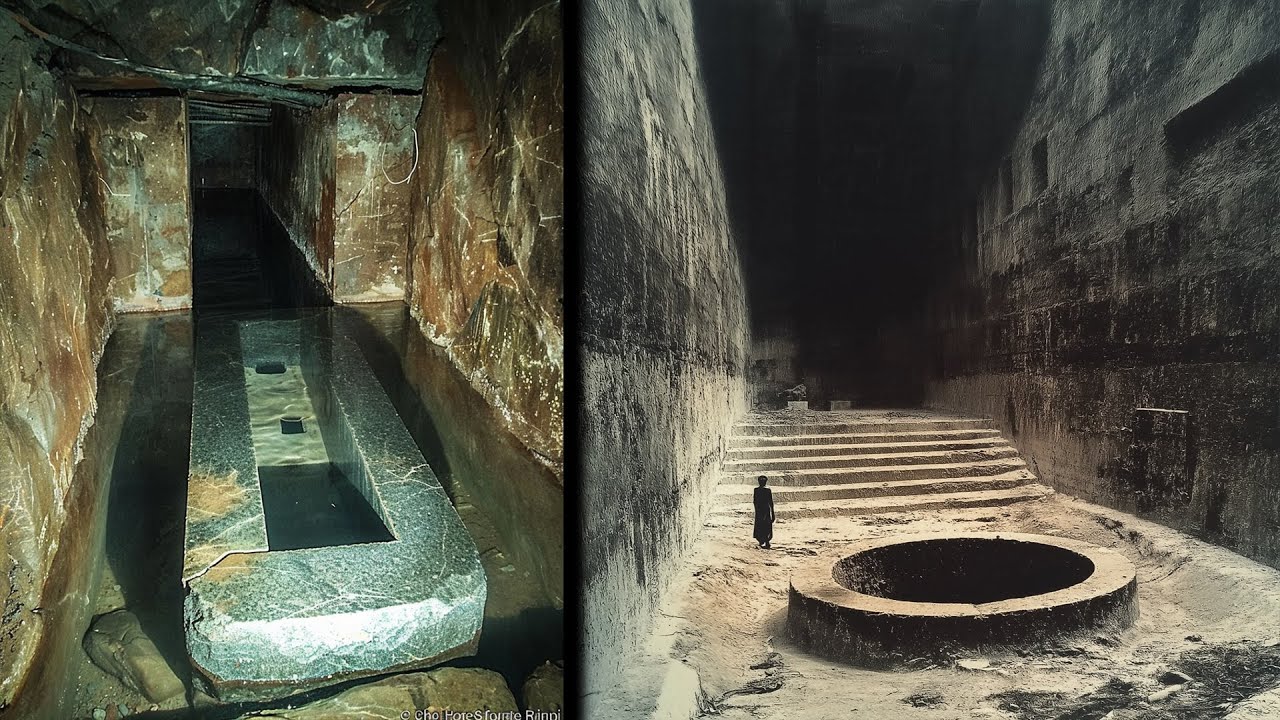
Pre-Egyptian Megastructures: Challenging the Narrative of the Great Flood

Image

The sands of time often obscure the grandest achievements of humanity, leaving us with fragmented histories and prevailing narratives that rarely tell the whole story. In the realm of ancient civilizations, particularly those predating the dynastic Egyptians, a compelling body of evidence suggests a technological prowess and sophistication far beyond our current understanding. This investigation delves into the enigmatic world of pre-Egyptian megastructures, colossal edifices that challenge conventional timelines and hint at a lost era of advanced knowledge.

The Osireion and Beyond: Evidence of a Lost Civilization

The concept of an advanced civilization flourishing before the established dynastic periods of ancient Egypt is not merely speculative; it is a hypothesis supported by enigmatic sites like the Osireion, Zawyet el Aryan, and the Serapeum of Saqqara. These locations present architectural and engineering feats that defy conventional explanations. The precision with which massive stone blocks were quarried, transported, and fitted together suggests a profound understanding of physics, mathematics, and engineering, far surpassing the tools and techniques typically attributed to the era.

Some theorists propose that these structures weren't merely monuments but served advanced purposes, possibly as power plants or sophisticated astronomical observatories. The granite sarcophagi in the Serapeum, for instance, exhibit a mechanical precision that leads many to question their function as mere burial chambers. As one commenter aptly put it, quote-style, ">I don't believe for a minute that the Serapeum of Saqqara boxes are burial chambers nor sarcophagi. Admittedly, it's just a gut feeling on my part, but it feels like there's something more going on here than burial chambers. It's too plain and undecorated and just looks utilitarian more than anything else." This sentiment is echoed by many who find the conventional narrative of tombs for dead pharaohs, constructed with rudimentary tools, insufficient to explain the monumental scale and precision of these ancient wonders.

Recommended Gear for Investigation

ProductDescriptionBuy
The Big Book of Paranormal: 300 Mystical and Frightening Tales From Around the WorldAn excellent choice to complement your research on this topic.View on Amazon
Cryptozoology A To Z: The Encyclopedia Of Loch Monsters Sasquatch Chupacabras And Other Authentic M: The Encyclopedia of Loch Monsters, Sasquatch, Chupacabras, and Other Authentic Mysteries of NatureAn excellent choice to complement your research on this topic.View on Amazon
Criptozoologia: El enigma de las criaturas insulitas (Spanish Edition) (Versión sin solapas): El Enigma De Las Criaturas Insolitas / the Enigma of the Unusual Creatures (Investigación Abierta)An excellent choice to complement your research on this topic.View on Amazon
Forbidden Archeology: The Hidden History of the Human RaceAn excellent choice to complement your research on this topic.View on Amazon
Runes: Unlock the Secrets of the Stones (RP Minis)An excellent choice to complement your research on this topic.View on Amazon
The H. P. Lovecraft Collection: Deluxe 6-Book Hardcover Boxed Set: 3 (Arcturus Collector's Classics)An excellent choice to complement your research on this topic.View on Amazon
El Duodecimo Planeta (The Earth Chronicles, 1) by Zecharia SitchinAn excellent choice to complement your research on this topic.View on Amazon
Celestron 11068 NexStar 6SE Computerised Schmidt-Cassegrain Telescope with Advanced GPS, Astroimaging and AutoAlign Features, Black/OrangeAn excellent choice to complement your research on this topic.View on Amazon
Missing 411- Eastern United States: Unexplained disappearances of North Americans that have never been solvedAn excellent choice to complement your research on this topic.View on Amazon
Ghost-Hunting For Dummies [Idioma Inglés] An excellent choice to complement your research on this topic.View on Amazon

Architectural Anomalies: Precision and Power

The construction of sites like the Great Pyramid of Giza showcases an almost unbelievable level of accuracy. Its alignment with the cardinal directions is remarkable, and the precision in cutting and fitting colossal stone blocks, some weighing many tons, has long puzzled archaeologists and engineers. The use of copper chisels and primitive tools, as commonly taught, seems increasingly improbable when faced with the evidence. The sheer scale of these projects implies not only advanced engineering but also a highly organized society capable of mobilizing vast resources and labor forces.

A carpenter with decades of experience starkly pointed this out: quote-style, ">I've been a carpenter for 30 plus years, and I've cut many different materials in those years. I assure anyone watching this piece, the people who've tried convincing us these materials were cut with coper chisels only puts on full display their total lack of real world experience cutting anything othere than paper!! This was not done with a chisel period full stop!" This practical perspective underscores the disconnect between the proposed methods and the tangible reality of the structures themselves. The granite, rich in quartz, further fuels speculation. As noted by another observer, quote-style, ">Granite is full of quartz. Quartz produces electricity when subjected to pressure. We might have finally understood how the machine was powered." This points towards potential energy generation, transforming these ancient sites from simple tombs into complex machines of antiquity.

Astronomical Alignments: Celestial Blueprints

The deliberate alignment of ancient structures with celestial bodies is a recurring theme across various cultures. The hypothesized alignment of the Giza pyramids with Orion's Belt is perhaps the most famous example, suggesting a sophisticated understanding of astronomy and cosmology. This knowledge would have been crucial for timekeeping, agricultural cycles, and possibly even spiritual practices. The ability to map the stars with such precision and translate that knowledge into monumental architecture implies a civilization with deep scientific insights.

The concept that these structures were meticulously planned, not as mere religious sites but as functional devices, is gaining traction. The idea of the pyramids as power plants, as suggested by some viewers, aligns with the theory of advanced technological understanding. This perspective challenges the traditional view of ancient Egyptians as solely builders of tombs, pushing us toward a more complex picture of their capabilities and knowledge base. The precision in architectural design isn't just about aesthetics; it's about function, as suggested by the idea that "The title of the video should really be 'Pre-Egyptian Engineering and Electrical Generation - The Great Pyramids' or something that reflected the content better."

Technological Implications: Beyond Hammers and Chisels

The prevailing narrative often asserts that these megastructures were built using simple tools like hammers and chisels. However, the sheer number of colossal blocks, the precision of their cuts, and the immense weight involved make this explanation difficult to accept for many. Theories involving advanced technology, sound manipulation, or unknown energy sources are frequently discussed in communities dedicated to exploring these anomalies. The possibility of a civilization possessing technology comparable to, or even exceeding, our own cannot be dismissed lightly.

The notion that "the narrative we were taught in school is totally incorrect at every level" resonates with many who question established historical accounts. This skepticism is a crucial driver for exploring alternative hypotheses. The structures' internal designs, often described as looking like "a machine," further bolster the idea that their purpose extended far beyond religious or funerary rites. The resonance experienced within these structures, like the echoing snap of fingers described by a visitor, suggests acoustic properties that might have played a functional role, perhaps in energy generation or communication.

The Great Flood Theory: A Precursor to Modern Civilizations?

Many theories posit that these advanced civilizations existed before a cataclysmic event, such as the Great Flood, which reshaped the planet and wiped out much of human knowledge. According to this perspective, the remnants of these ancient societies, including their monumental structures, are the only tangible evidence left of their existence. The incredible longevity attributed to people before the flood, often cited as 600-900 years, would have allowed for the development and transmission of sophisticated knowledge over many generations, supporting the construction of such massive projects.

This theory suggests that our current understanding of history is incomplete, missing a crucial chapter of advanced human civilization. The Sahara Desert, for instance, was not always arid; evidence points to a time when it was a lush jungle, capable of supporting large populations and complex societies. This environmental context is vital for understanding how such civilizations could have thrived and undertaken ambitious building projects. The question, quote-style, ">Why is it that people just can't say 'we simply do not know'?" highlights the frustration with historical certainties that seem to ignore abundant anomalies.

Expert Analysis and Skepticism: Bridging the Divide

While fringe theories abound, the rigorous work of engineers and researchers outside the traditional Egyptological circles has begun to shed new light on these ancient marvels. Their methodologies, focusing on physics, engineering principles, and a willingness to consider unconventional explanations, often provide more compelling insights than explanations rooted in dogma. The observation that quote-style, ">The work of engineers taking an interest in the great pyramid has done more to advance archeology on the topic than so called Egyptologists" points to a potential schism in how these ancient sites are studied.

Skepticism is a vital tool in any investigation, but it should not become a barrier to considering all available evidence. The persistent anomalies presented by these megastructures demand further inquiry. As one viewer noted, quote-style, ">This channel challenges my skepticism and makes me intrigued and full of questions." This intellectual curiosity is precisely what drives paranormal and historical research forward, pushing the boundaries of accepted knowledge and encouraging a re-evaluation of our past.

Investigator's Verdict: Re-evaluating History

The evidence surrounding pre-Egyptian megastructures strongly suggests that our current historical timeline and understanding of ancient capabilities are incomplete. The precision engineering, astronomical knowledge, and sheer scale of these constructions point towards a civilization possessing advanced technology and a profound understanding of the natural world. While definitive answers remain elusive, the persistent anomalies compel us to question established narratives and remain open to the possibility of lost chapters in human history.

For those seeking to delve deeper into the mysteries of ancient civilizations and unexplained phenomena, a curated selection of resources can illuminate the path. Understanding the methodologies and findings of various researchers is crucial for forming a comprehensive perspective.

The eBook "Pre-Historic Megastructures" by Universe Inside You is a prime example, offering a detailed look at over 30 remarkable sites. Such comprehensive works are invaluable for anyone serious about investigating these topics. Furthermore, documentaries and academic papers that challenge conventional thinking often spark critical debate and encourage further research into areas often overlooked by mainstream academia. Exploring the mysteries of ancient civilizations is a journey that benefits from diverse sources and perspectives.

Frequently Asked Questions

Q1: What is the main argument against the pyramids being tombs?

A1: The primary arguments include the incredible precision of construction, the lack of significant burial artifacts in many chambers, the use of vastly superior materials and techniques implied by the stonework, and alternative theories suggesting functions like power generation or astronomical observation.

Q2: How could such advanced technology have existed so long ago?

A2: Theories propose a highly advanced pre-diluvian civilization that either predates known history or existed concurrently with early civilizations, possessing knowledge lost to time. Some also suggest extraterrestrial influence, though evidence for this remains speculative.

Q3: What is the significance of astronomical alignments in these structures?

A3: These alignments suggest a deep understanding of celestial mechanics, used for timekeeping, navigation, agricultural planning, and possibly spiritual or energetic purposes. They indicate a level of scientific sophistication far beyond what is typically attributed to ancient peoples.

Q4: Could water have played a role in constructing these megastructures?

A4: Some theories suggest advanced hydraulic engineering, possibly involving water rams or other devices, to move massive stones or even generate power. The presence of ancient water systems and the historical existence of lush environments in currently arid regions support these ideas.

Q5: Why is it difficult to find definitive proof of these advanced ancient civilizations?

A5: Cataclysmic events like the Great Flood could have destroyed much evidence. Furthermore, prevailing historical narratives may resist or suppress findings that contradict established timelines and theories, making it challenging for alternative interpretations to gain mainstream acceptance.

Your Mission: Field Assignment

The greatest mystery is not always in the monumental structures themselves, but in our willingness to question the accepted truth. Your mission, should you choose to accept it, is to examine your own assumptions about history. Seek out the anomalies, question the narratives, and explore the evidence with an open, analytical mind. The past is not as settled as it appears; it is a landscape ripe for re-investigation.

What are your thoughts on these pre-Egyptian megastructures? Have you encountered similar anomalies in your own research or travels? Share your experiences and theories in the comments below. Your insights are crucial to piecing together this historical puzzle.

If this investigation has sparked your curiosity, help us spread the word. Share this post on your social media channels and join the conversation. Let's challenge the ordinary and uncover the extraordinary together.

For more in-depth analysis and exclusive content, follow us on our social media platforms and subscribe to our channels. Stay vigilant.

Investigator's Note: True paranormal research doesn't fund itself. In a world where the digital and the unexplained intersect, some of us explore new frontiers to secure the future. Do you dare to be part of the vanguard? Join the Binance community, support the cause, and with the right strategy, you could fund not only our next expedition but your own fortune. The next great discovery could be just a click away.

Yonaguni: The 12,000-Year-Old Underwater City Mystery

Image

Below the surface of the Pacific, off the coast of Japan, lies a structure that defies easy categorization. The Yonaguni Monument, a massive underwater formation, has ignited a fierce debate among scientists and historians. Is it a mere geological anomaly, sculpted by millennia of oceanic forces, or is it the haunting remnant of a sophisticated civilization lost to time, a city submerged for over 10,000 years? Join me as we plunge into the depths where conventional history begins to fracture.

The Unveiling: A Submerged Enigma

The discovery of the Yonaguni Monument in the early 1980s by local divers was not met with immediate acclaim, but rather with bewilderment. Located off the coast of Yonaguni Island, the southernmost island of the Ryukyu chain in Japan, this colossal structure lies approximately 5 to 30 meters below the ocean's surface. Its sheer scale and peculiar geometry immediately sparked controversy. What appeared to some as an intricate, man-made edifice, others dismissed as a purely natural spectacle.

My initial assessment, based on photographic evidence and expert testimonies, is that the debate hinges on perspective. When you look at the Yonaguni Monument, what do you see?

Recommended Gear for Investigation

ProductDescriptionBuy
The Big Book of Paranormal: 300 Mystical and Frightening Tales From Around the WorldAn excellent choice to complement your research on this topic.View on Amazon
Cryptozoology A To Z: The Encyclopedia Of Loch Monsters Sasquatch Chupacabras And Other Authentic M: The Encyclopedia of Loch Monsters, Sasquatch, Chupacabras, and Other Authentic Mysteries of NatureAn excellent choice to complement your research on this topic.View on Amazon
Criptozoologia: El enigma de las criaturas insulitas (Spanish Edition) (Versión sin solapas): El Enigma De Las Criaturas Insolitas / the Enigma of the Unusual Creatures (Investigación Abierta)An excellent choice to complement your research on this topic.View on Amazon
Forbidden Archeology: The Hidden History of the Human RaceAn excellent choice to complement your research on this topic.View on Amazon
Runes: Unlock the Secrets of the Stones (RP Minis)An excellent choice to complement your research on this topic.View on Amazon
The H. P. Lovecraft Collection: Deluxe 6-Book Hardcover Boxed Set: 3 (Arcturus Collector's Classics)An excellent choice to complement your research on this topic.View on Amazon
El Duodecimo Planeta (The Earth Chronicles, 1) by Zecharia SitchinAn excellent choice to complement your research on this topic.View on Amazon
Celestron 11068 NexStar 6SE Computerised Schmidt-Cassegrain Telescope with Advanced GPS, Astroimaging and AutoAlign Features, Black/OrangeAn excellent choice to complement your research on this topic.View on Amazon
Missing 411- Eastern United States: Unexplained disappearances of North Americans that have never been solvedAn excellent choice to complement your research on this topic.View on Amazon
Ghost-Hunting For Dummies [Idioma Inglés] An excellent choice to complement your research on this topic.View on Amazon
"I've seen rock formations before, but this... this felt different. The angles, the sheer regularity, it looked like something someone built." - Local Dive Instructor Testimony (paraphrased)

This sentiment echoes in numerous accounts from divers and researchers who have explored the site. The core of the enigma lies in its features: massive, tabular blocks with sharp, right-angled edges, extensive flat surfaces, and formations resembling staircases and pillars. These characteristics seem to defy the chaotic sculpting typically associated with natural underwater erosion. Yet, the mainstream scientific community, particularly geologists, remains largely unconvinced of its artificial origin.

Geology vs. Archaeology: The Core Conflict

The geological explanation posits that the Yonaguni Monument is a product of natural processes. Tectonic uplift and erosion, driven by the relentless power of the ocean currents and sea-level fluctuations common in this region, are cited as the primary architects. Geologists like Masaaki Kimura, a marine geologist who has extensively studied the site, argue that such formations, while rare, are consistent with the geological history of the area. He suggests that the rocks are sedimentary, prone to fracturing along natural fault lines, which could create the appearance of artificial structures.

However, this interpretation fails to satisfy many. The precision of some of the "carvings" – particularly the "Great Platform" with its distinct steps and the "Sphinx" formation – seems too deliberate for random geological chance. Archaeologists and proponents of submerged civilizations point to these features as evidence of intelligent design, suggesting the monument could be the remains of a city built by a culture far older than currently accepted by mainstream history, possibly predating the last ice age.

Field Note: It's crucial to distinguish between geological processes and deliberate construction. Natural formations can sometimes mimic artificial structures, a phenomenon known as pareidolia in a geological context. However, the consistency and complexity at Yonaguni push the boundaries of typical natural occurrences.

Architectural Analysis: Signs of the Hand of Man?

Let's break down the key features that fuel the debate:

  • The Great Platform: This is perhaps the most compelling aspect. It's a massive, flat-topped, rectangular structure, roughly 20 meters by 8 meters and appearing to be about 6 meters high. Its surface is remarkably flat, and at its edge, it shows what appear to be steps descending into the water. The precision of these right angles and flat surfaces is difficult to explain through natural erosion alone.
  • Staircases and Terraces: Multiple formations exhibit characteristics of stepped terraces, reminiscent of ancient agricultural or ceremonial sites found on land. The regularity in the alignment and depth of these "steps" suggests intentional carving.
  • Pillars and Walls: Vertical formations resembling pillars and walls add to the impression of a planned layout. Some have proposed these could be remnants of buildings or fortifications.
  • "Roads" and Channels: Researchers have identified what appear to be pathways or channels running between the main structures, further supporting the idea of a designed urban environment.

Skeptics argue that these features can arise from natural fracturing patterns in sedimentary rock, exacerbated by wave action and tidal forces. They point out the absence of tool marks typical of human excavation and the lack of associated artifacts like pottery or tools that would definitively confirm an artificial origin. This is where the lines blur, and confirmation bias can easily sway interpretation.

Given the lack of definitive proof, any analysis must remain objective. The recurring question is: Could natural forces alone orchestrate such complex, geometric regularity on this scale?

Dating the Mystery: A Prehistoric Puzzle

If the Yonaguni Monument is indeed artificial, its age presents an even more profound challenge to our understanding of history. Kimura estimates its age to be at least 10,000 years, potentially dating back to 12,000 years ago. This timeframe places its construction well before the rise of the earliest known civilizations like Sumeria or ancient Egypt. It suggests the existence of advanced, seafaring cultures during the last glacial period, when much of the world's water was locked up in ice caps, and sea levels were significantly lower.

This dating is based on several factors:

  • Sea Level Changes: Assuming the structure was originally above sea level, its current submerged state indicates a significant rise in ocean levels since its construction. The estimated sea level rise since the end of the last ice age aligns with this timeframe.
  • Erosion Patterns: While debated, some argue that the degree of erosion on the structure is consistent with it having been exposed to the elements for over 10,000 years.

The implications are staggering. If these dates are accurate, Yonaguni would represent evidence of a lost civilization, perhaps even a precursor to known ancient cultures, forcing a radical revision of human history. This is a prospect that many in the academic establishment find difficult to accept without overwhelming, unambiguous evidence.

Alternative Theories and the Establishment

The scientific establishment's reluctance to accept the artificial origin of Yonaguni stems from several factors. Firstly, the lack of conclusive artifacts. While some small, enigmatic objects have been found in the vicinity, none have provided irrefutable proof of human craftsmanship related to the monument itself. Secondly, the sheer magnitude of the claim – a civilization advanced enough to build such structures existing thousands of years before previously thought – requires extraordinary evidence.

"Science progresses one funeral at a time. Old ideas and established paradigms are hard to shake, especially when they question fundamental beliefs about our past." - Alejandro Quintero Ruiz

The prevailing geological explanation, while perhaps less sensational, adheres to known scientific principles and avoids radical historical revision. It’s the safer, more conventional route. Yet, the persistence of debate, fueled by ongoing exploration and the compelling visual evidence, suggests the discussion is far from over. The scientific method demands rigorous proof, but it should also remain open to challenging anomalies.

Investigator's Verdict: Fraud, Genuine Phenomenon, or Something Else?

After reviewing the available evidence, photographic analysis, and comparative geological data, my verdict remains cautiously open. While the geological explanation for the Yonaguni Monument is plausible and supported by mainstream science, it struggles to account for the intricate regularity and apparent design evident in certain features, particularly the Great Platform and its stepped formations.

The possibility of a natural formation that coincidentally resembles architectural elements cannot be entirely dismissed. However, the sheer consistency and scale of these resemblances warrant further investigation beyond simple geological conjecture. The absence of definitive, universally accepted proof of artificiality is the primary stumbling block. Without clear tool marks, in-situ artifacts directly linked to the structure, or undisputed inscriptions, the monument hovers in the realm of tantalizing possibility rather than established fact.

Is it a lost city? Perhaps not in the way we envision Atlantis. Could it be a unique natural formation that inspired myths of a submerged city? More likely. Or could it be a hybrid – a natural formation with some degree of modification or intentional enhancement by unknown ancient peoples? This intriguing middle ground is where my investigative instincts are most piqued.

The case for Yonaguni is not closed. Continued, unbiased research, perhaps employing new deep-sea exploration technologies and interdisciplinary approaches combining geology, archaeology, and even materials science, might eventually provide a definitive answer. Until then, it remains one of the planet's most compelling underwater mysteries, a testament to the vast, uncharted territories of our ancient past.

The Researcher's Archive

For those delving deeper into the enigma of Yonaguni and other submerged mysteries, I recommend the following resources:

  • Books: Explore works by Masaaki Kimura, who pioneered much of the research into Yonaguni. His detailed studies, though sometimes controversial, offer profound insights. Look for titles discussing underwater archaeology and prehistoric civilizations.
  • Documentaries: Numerous documentaries have tackled the Yonaguni Monument. Seek out those that present multiple viewpoints, interviewing both geologists and proponents of artificial origin. Critical analysis is key.
  • Scientific Journals: While direct access might be limited, search for papers on marine geology, tectonic activity in the Ryukyu Trench, and paleo-sea level changes. These provide the scientific context for evaluating the monument's environment.
  • Online Forums and Communities: Engage with communities dedicated to ancient mysteries and underwater archaeology. Often, these spaces host discussions with individuals who have personal experience diving the monument or researching its history. Be discerning, as misinformation can be rampant.

Understanding the context of the geological and historical landscape is as crucial as examining the monument itself. This ensures a well-rounded and critical approach to the evidence.

To aid in your own investigations or exploration of related topics, having reliable equipment is paramount. Whether it's for documenting evidence or undertaking field research, the right tools make a difference.

Equipment Recommended for Investigation

When documenting underwater sites or researching phenomena that require precise observation, having the right gear is essential. Here’s a look at tools that can aid in such endeavors:

Frequently Asked Questions

Is Yonaguni a UNESCO World Heritage site?
No, the Yonaguni Monument is not currently a UNESCO World Heritage site. Its status remains disputed between natural geological formation and potential ancient human construction, making it ineligible for designation without consensus.
What is the best time of year to visit Yonaguni for diving?
The best diving conditions around Yonaguni are generally from late spring to early autumn (May to October), when water temperatures are warmer and visibility is typically good. However, currents can be strong, and conditions require experienced divers.
Are there other submerged structures like Yonaguni elsewhere?
Yes, there are other controversial underwater sites around the world proposed as ancient ruins, such as the Bimini Road in the Bahamas or alleged structures off the coast of India and Cuba. Each has varying degrees of evidence and scientific acceptance.
What geological processes could create such formations?
Natural processes include tectonic faulting, differential erosion of sedimentary rock layers, and the action of strong ocean currents. These can create sharp edges, flat surfaces, and layered appearances over vast periods.

Your Mission: Field Report

The mystery of Yonaguni beckons those with a thirst for the unknown. Your mission, should you choose to accept it, is to become an armchair investigator.:

  1. Research further: Dive into the works of Masaaki Kimura and the counterarguments from geologists. Form your own hypothesis.
  2. Analyze visual evidence: Seek out high-quality images and videos of the Yonaguni Monument. Try to identify features that strongly suggest artificiality or natural formation.
  3. Consider the implications: If Yonaguni is artificial, what does this mean for our understanding of human history and the capabilities of ancient cultures?

Report your findings in the comments below. What do YOU believe the Yonaguni Monument represents?

Share this deep dive into history's depths with fellow explorers on social media. Let's unravel this enigma together!

Investigator's Note: True paranormal research doesn't fund itself. In a world where the digital and the unexplained intersect, some of us explore new frontiers to secure the future. Do you dare to be part of the vanguard? Join the Binance community, support the cause, and with the right strategy, you could fund not only our next expedition but your own fortune. The next great discovery could be just a click away.

Corvo Island: The Lost Statue of Atlantis?

Image

In the 15th century, Portuguese explorers charting the vast Atlantic stumbled upon Corvo, the northernmost island of the Azores archipelago. High atop a windswept volcanic cliff, they discovered an anomaly that defied expectation: a colossal statue, meticulously carved from a single block of stone. This imposing figure depicted a man, clad in a distinctive Moorish-style cloak, astride a saddle-less horse. One hand clutched the horse’s mane, while the other, index finger extended, pointed resolutely towards the boundless ocean.

Beneath this enigmatic effigy, peculiar inscriptions were etched into the rock face. Intrigued, sailors meticulously lowered themselves down the perilous cliff, tethered by ropes, to meticulously copy the ancient script. Alas, the markings were too eroded by time and the elements to decipher.

King Manuel I, recognizing the potential significance of this find, commissioned a detailed drawing and dispatched a team to transport the statue to Lisbon. Tragically, it was damaged during transit – a head, an arm, a foot, and the horse's head reportedly languished in the royal treasury for days before inexplicably vanishing. The drawing itself was also lost to history, yet its existence and the statue's details were preserved through the accounts of several writers, most notably the chronicler Damião de Góis, who documented the discovery and its features in 1567.

Recommended Gear for Investigation

ProductDescriptionBuy
Forbidden Archeology: The Hidden History of the Human RaceAn excellent choice to complement your research on this topic.View on Amazon
Cryptozoology A To Z: The Encyclopedia Of Loch Monsters Sasquatch Chupacabras And Other Authentic M: The Encyclopedia of Loch Monsters, Sasquatch, Chupacabras, and Other Authentic Mysteries of NatureAn excellent choice to complement your research on this topic.View on Amazon
The Big Book of Paranormal: 300 Mystical and Frightening Tales From Around the WorldAn excellent choice to complement your research on this topic.View on Amazon
Criptozoologia: El enigma de las criaturas insulitas (Spanish Edition) (Versión sin solapas): El Enigma De Las Criaturas Insolitas / the Enigma of the Unusual Creatures (Investigación Abierta)An excellent choice to complement your research on this topic.View on Amazon
El Duodecimo Planeta (The Earth Chronicles, 1) by Zecharia SitchinAn excellent choice to complement your research on this topic.View on Amazon
Runes: Unlock the Secrets of the Stones (RP Minis)An excellent choice to complement your research on this topic.View on Amazon
The H. P. Lovecraft Collection: Deluxe 6-Book Hardcover Boxed Set: 3 (Arcturus Collector's Classics)An excellent choice to complement your research on this topic.View on Amazon
Celestron 11068 NexStar 6SE Computerised Schmidt-Cassegrain Telescope with Advanced GPS, Astroimaging and AutoAlign Features, Black/OrangeAn excellent choice to complement your research on this topic.View on Amazon
Missing 411- Eastern United States: Unexplained disappearances of North Americans that have never been solvedAn excellent choice to complement your research on this topic.View on Amazon
Ghost-Hunting For Dummies [Idioma Inglés] An excellent choice to complement your research on this topic.View on Amazon

The Corvo Enigma: A Fragment of Lost History

The statue on Corvo represents a tantalizing, albeit fleeting, connection to a possible advanced civilization predating known history. Its discovery by Portuguese explorers in the 1400s suggests a presence on the islands long before European settlement. The unique iconography – the Moorish cloak, the horse without a saddle, the pointing finger towards the west – all hint at a narrative or cultural significance lost to time. Damião de Góis’s account, though brief, provides the most concrete evidence that this was not a natural geological formation but a deliberate artifact.

The subsequent loss of both the statue and its associated records is a recurring theme in the study of ancient mysteries. It fuels speculation: was the destruction accidental, or a deliberate act to suppress knowledge? Some viewers suggest that "many wars now are just to wipe out history," a grim possibility when considering the fate of artifacts and knowledge throughout human conflict. The sheer audacity of attempting to move such a monumental carving speaks to the resources and ambition of its creators, prompting comparisons to other lost wonders.

One recurring sentiment from those who've engaged with this content is the profound fascination with such finds: "This is literally my favorite kind of content in the world. It makes the History channel look like a highschool production in terms of research." This highlights a yearning for in-depth, rigorously researched content that delves into the truly unexplained.

Echoes in the Atlantic: The Azores and Ancient Civilizations

The Azores themselves hold a unique place in discussions of ancient seafaring and lost lands. As geological formations, their volcanic origins are well-understood. However, their strategic location in the mid-Atlantic has led to numerous theories about ancient maritime capabilities. Some viewers share personal connections: "My Azorian grandmother used to tell me stories…" and "my grandmother is from the Azores.. and we have swedish DNA that we knew nothing about…" These anecdotes, while anecdotal, weave a tapestry of possibility, suggesting a complex history of visitation and settlement that predates conventional timelines.

The mention of the Vikings potentially leaving sheep on the islands, as noted by some accounts, adds another layer to this narrative. "IIRC, the Portuguese found domestic sheep on one island, despite no known records of Europeans having found the islands. Some speculate Vikings left them there as a restocking stop along their way." This hints at extensive Norse exploration, potentially far beyond what is currently accepted in mainstream history.

The very existence of the Corvo statue, however lost, implies a people with the means and will to create enduring monuments and possibly navigate vast distances. This aligns with speculative theories about civilizations like Atlantis, which are often posited to have possessed advanced maritime technology.

Plato's Atlantis: Myth, Allegory, or Distorted Memory?

The legend of Atlantis, as recounted by Plato, remains one of the most enduring and debated mysteries of the ancient world. Plato's dialogues, particularly "Timaeus" and "Critias," describe a powerful island civilization located beyond the Pillars of Hercules, which ultimately sank into the sea. While many scholars view Atlantis as a philosophical allegory designed to illustrate Plato's ideals of an advanced, yet ultimately hubristic, society, others maintain that it was based on a distorted echo of a real historical event or civilization.

"The dialogues DO NOT MENTION PLATO. Not even once. The claimed chain of storytelling is Egyptian priests -> Solon -> Critias' grandfather -> Critias. The dialogue is called Critias because..... Critias is the one telling the story! All that being said, all of Plato's philosophical dialogues are constructed like this..."

This critical observation highlights the academic debate surrounding the literal interpretation of Plato's account. The user correctly points out that the narrative's structure is typical of Plato's philosophical parables. The possibility remains that if there's any historical kernel, it might stem from Minoan folklore, perhaps related to the Thera eruption, which later became integrated into wider Hellenic culture.

The idea that an ancient civilization, even with only steam power and gunpowder, could appear godlike to less advanced societies is a valid point raised by viewers: "An ancient civilization even with just steam power and gunpowder would have seemed like Gods to people using stone/bronze equipment. No aliens or magical powers needed." This perspective seeks rational explanations for perceived ancient technological marvels, moving away from extraterrestrial or supernatural interpretations.

The destruction of knowledge, exemplified by the burning of the Library of Alexandria, also plays into this narrative. "And what was lost when the library of Alexandria was burned?" is a poignant question that resonates with the loss of the Corvo statue and its associated documentation. It underscores the fragility of historical records and the ease with which entire histories can be obliterated.

The Richat Structure: A Contender for Atlantis?

Among the most compelling modern theories regarding the location of Atlantis is the Richat Structure in West Africa, often referred to as the "Eye of the Sahara." Proponents argue that its distinct circular geological formation, coupled with evidence of a former waterways system, closely matches Plato's descriptions. Jimmy at Bright Insight, a popular channel exploring such theories, makes a "convincing argument for the Richat Structure in West Africa being the site of Atlantis."

The alignment of the Richat Structure with Plato’s account is seen as significant. The circularity, the potential for ancient port infrastructure, and evidence of dramatic geological changes in the region all lend credence to this hypothesis. It's a theory that appeals to those seeking a tangible, geographically identifiable location for the legendary lost city. "The Richat imo is the most likely. The circular structures and the former waterway that ran around it are about as close to the description as we have found. Also the evidence of a massive flood exists. All in line."

This geological interpretation offers a counterpoint to more esoteric theories, grounding the search for Atlantis in observable, albeit ancient, geographical features. It resonates with a desire for empirical evidence and scientific plausibility in historical investigations.

The Younger Dryas Impact: A Cataclysmic Past

The Younger Dryas period, a sudden and dramatic cooling event that occurred approximately 12,900 to 11,700 years ago, is increasingly implicated in theories about cataclysmic events that could have wiped out advanced civilizations. Some researchers propose that a cosmic impact or a rapid influx of meltwater from retreating ice sheets dramatically altered global sea levels and climate, leading to widespread destruction.

Regarding Atlantis, one theory posits: "I think Atlantis was lost during the Younger Dryas event, either hit by fallout like all the Carolina Bays suggest or wiped out by fallout tsunami." This hypothesis connects the potential demise of advanced cultures with known geological and climate shifts. The scale of destruction described by Plato – the sinking of an entire continent in "one day and one night" – could plausibly be linked to such a large-scale, rapid environmental catastrophe.

The significant rise in sea levels following the end of the Younger Dryas, as mentioned by another commenter: "When the Younger Dryas ended, the last 1 million cubic miles of ice sheet melted and drained into the ocean raising the sea level to roughly today's level," further supports the idea that coastal civilizations could have been inundated. This geological evidence provides a potential mechanism for the submergence of landmasses, lending a degree of scientific plausibility to ancient flood myths and lost continent narratives.

This era also sparks other intriguing questions, such as: "The 'Out of Africa' theory has been easily disapproven but they still cling to that theory, why?" This reflects a broader skepticism about established historical and anthropological narratives when confronted with alternative interpretations of ancient evidence.

Investigator's Verdict: A Glimmer of Truth in the Ruins?

The Corvo Island statue, despite its disappearance, serves as a powerful reminder of the vast unknowns that lie buried beneath the sands of time. While definitive proof of Atlantis remains elusive, the persistence of such artifacts and the enduring power of the legend suggest that there may be a kernel of historical truth obscured by myth and the ravages of millennia. The Portuguese explorers' discovery points to a sophisticated presence in the Atlantic long before conventional history accounts for it.

The recurring theme of lost knowledge and destroyed evidence – from Corvo to Alexandria – is not merely coincidental. It speaks to the precariousness of civilization and the potential for intentional erasure of history. As one commenter aptly put it: "They were very good at archaeology. I think many wars now are just to wipe out history." While dramatic, this sentiment captures the frustration of encountering deliberate obfuscation or accidental destruction of crucial historical clues.

The Investigator's Archive

To delve deeper into the mysteries of lost civilizations and ancient enigmas, I recommend the following resources:

Books:

  • Plato's "Timaeus" and "Critias" - The foundational texts for the Atlantis legend.
  • "Earth's Shifting Crust: Earthquakes, Volcanism, Age, and Contour" by Charles Hapgood - Explores ancient maps and theories of crustal displacement.
  • "Forbidden Archeology: The Hidden History of the Human Race" by Michael A. Cremo and Richard L. Thompson - Challenges conventional timelines of human existence.

Documentaries & Channels:

  • "Atlantis: The Evidence" (Various productions) - Explore documentaries that focus on geological and archaeological evidence.
  • Bright Insight (YouTube) - For compelling arguments on the Richat Structure and other ancient mysteries.
  • UnchartedX (YouTube) - Features extensive research into ancient civilizations and megalithic sites.

Field Protocol: Deciphering Ancient Inscriptions

  1. Documentation is Key: Before attempting any decipherment, meticulously photograph and record the inscription from multiple angles and under varying light conditions. Use high-resolution imagery.
  2. Contextual Analysis: Consider the location, surrounding artifacts, and known historical periods associated with the site. Does the style of carving or the material align with any known ancient cultures?
  3. Comparative Linguistics: Research known ancient languages and scripts from the region and era. Look for similarities in symbols, letter forms, or grammatical structures.
  4. Symbolic Interpretation: Many ancient inscriptions contain symbolic or allegorical elements. Research common symbols and their meanings within relevant cultural contexts.
  5. Consult Experts: If possible, consult with epigraphers, archaeologists, or linguists specializing in ancient scripts. Their expertise can be invaluable.
  6. Look for Patterns: Even if a full translation is impossible, identifying recurring symbols, patterns, or potential names can provide clues.
  7. Cross-Reference Accounts: If historical records mention specific inscriptions (like the Corvo statue), cross-reference your findings with those descriptions.

Frequently Asked Questions

Q1: Was the Corvo statue definitively proven to be related to Atlantis?
A1: No. While its discovery and subsequent loss are intriguing, there is no definitive proof linking the Corvo statue directly to the legend of Atlantis. It remains a tantalizing artifact whose purpose and origin are lost to time.

Q2: If Atlantis existed, why is there so little physical evidence?
A2: Theories range from a cataclysmic event that destroyed all traces, to the possibility that Atlantis was a metaphorical representation. Furthermore, the vast majority of Earth's surface, especially the ocean floor, remains unexplored, and much historical evidence may have been lost or deliberately destroyed over millennia.

Q3: Are there other potential locations for Atlantis besides the Richat Structure?
A3: Yes, numerous locations have been proposed over the centuries, including Santorini (Thera), parts of the Atlantic Ocean, the Caribbean, and even Antarctica. Each theory is based on interpretations of Plato's texts and varying degrees of geological or archaeological evidence.

Q4: Why do some people believe ancient civilizations were visited by extraterrestrials?
A4: This belief often stems from the perceived advanced knowledge and monumental constructions of ancient cultures, which some find difficult to explain with the technology available at the time. This leads to speculation about external, non-human intervention, though more grounded theories focus on forgotten human ingenuity and lost technological advancements.

Your Mission: Document the Lost

Your mission, should you choose to accept it, is to become a custodian of lost narratives. Seek out local legends, historical anomalies in your own region, or even family stories that hint at forgotten pasts. Document them rigorously – photograph, record interviews, and research any available historical context. The truth is often hidden in plain sight, waiting for a keen eye and a methodical approach. Share your findings responsibly, contributing to the collective understanding of our deep and mysterious history.

What are your thoughts on the Corvo statue and the legend of Atlantis? Have you encountered any similar lost artifacts or local legends in your travels? Share your experiences and theories in the comments below! Your insights are crucial to our ongoing investigation into the unexplained.

Don't keep these revelations to yourself! Share this investigation on social media and help us uncover more hidden truths. The more eyes on the evidence, the closer we get to understanding our true history.

```

Investigator's Note: True paranormal research doesn't fund itself. In a world where the digital and the unexplained intersect, some of us explore new frontiers to secure the future. Do you dare to be part of the vanguard? Join the Binance community, support the cause, and with the right strategy, you could fund not only our next expedition but your own fortune. The next great discovery could be just a click away.