

🔬 If this topic has sparked your interest, you can complement it with Lunar Phase Calculator, a lunar phase calculator for astronomical and ritual tracking developed by Cha0smagick Labs. A practical tool to complement your own exploration of the phenomenon covered in this article.
The dark side of the Moon has been a canvas for human imagination and suspicion for decades, painted with claims of hidden cities, inexplicable structures, and whispers of extraterrestrial civilizations just beyond our visible horizon. For years, the lunar far side has been a focal point for conspiracy theories, suggesting that something extraordinary, something *not of this Earth*, might be concealed there. The official narrative from NASA and other space agencies offers geological explanations, but the persistent anomalies in photographs and astronaut accounts continue to fuel the debate. Are we looking at natural formations, or is something more profound lurking in the perpetual shadows of the Moon's hidden hemisphere? This investigation delves into the evidence, the theories, and the lingering questions that surround this enduring cosmic mystery.
| Nº DE EXPEDIENTE | EXP-GEN-2026-567 |
| INVESTIGADOR | Alejandro Quintero Ruiz |
| CONTACTO | rinconparanormal@gmail.com |
| AFILIACIÓN | Cha0smagick Labs — División de Investigación Paranormal |
| CLASIFICACIÓN | lunar anomalies |
| ESTADO | En Investigación |
| FECHA DE APERTURA | 2026-08-13 |
| TOOL | 🔧 Lunar Phase Calculator — lunar phase calculator for astronomical and ritual tracking |
| RELACIONADOS | 📂 Archivo de lunar anomalies | 🔬 Laboratorio Central |
CASE FILE INDEX
- Introduction: The Lunar Enigma
- The Rogan Perspective: Voices from the Abyss
- Photographic Anomalies: Shadows of Doubt
- NASA's Veil: Official Explanations and Lingering Questions
- Astronaut Whispers: Encounters Beyond the Veil
- Historical Echoes: Early Lunar Speculation
- Technological Implications: Beyond Spaceships
- The Far Side Enigma: Why the Secrecy?
- Investigator's Hypothesis: A Cosmic Crossroads
- Frequently Asked Questions
- Bibliography
The Unseen Lunar Landscape: A Realm of Intrigue
For centuries, humanity has gazed at the Moon, our closest celestial neighbor, yet a significant portion of its surface remains perpetually hidden from our direct view. This "dark side," more accurately termed the far side, has been a fertile ground for speculation, myth, and increasingly, for theories of clandestine extraterrestrial activity. The very inaccessibility of this region, a consequence of tidal locking where the Moon's rotation period matches its orbital period around Earth, fuels the imagination. It's a place where shadows can conceal, and where the absence of direct observation allows whispers of conspiracy to grow into roars of alleged truth. The idea isn't new; early science fiction writers envisioned lunar civilizations, but modern claims often point to photographic evidence and alleged leaks from classified space programs as proof.
The narrative posits that sophisticated alien civilizations might have established bases or even entire cities on the Moon's far side, utilizing its remoteness as a strategic advantage. This could be for observation, resource extraction, or as a staging ground for further exploration. The sheer audacity of such claims, coupled with the inherent mystery of the lunar far side, makes it a captivating subject. It taps into our deep-seated curiosity about life beyond Earth and our distrust of official narratives, especially concerning potentially world-altering discoveries. The question isn't just *if* something is there, but *why* it would be hidden, and what that implies about our place in the cosmos.
The Rogan Perspective: Voices from the Abyss
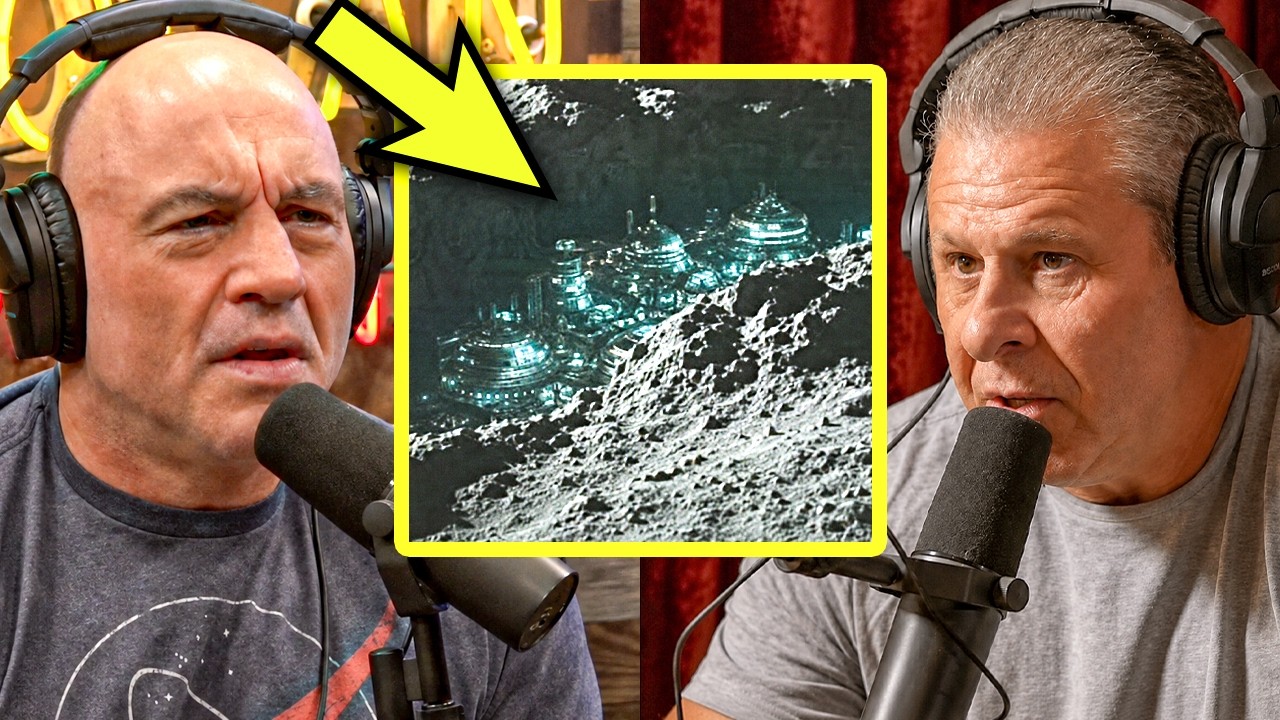
Joe Rogan's platform, the "Joe Rogan Experience," has become a significant conduit for exploring unconventional ideas, including those surrounding extraterrestrial life and unexplained phenomena. The compilation of clips referenced in the source material likely features Rogan and his diverse guests—scientists, authors, researchers, and commentators—delving into the specifics of alleged lunar anomalies. These discussions often involve dissecting photographs, analyzing astronaut testimonies, and debating the motivations behind potential government secrecy. Rogan's approach, characterized by open-mindedness and a willingness to entertain seemingly outlandish theories, allows these complex subjects to reach a vast audience, sparking critical thinking and further investigation.
One guest might present a grainy photograph showing what appears to be a geometric structure on the lunar surface, arguing it defies natural geological processes. Another could recount alleged insider information about secret space missions or classified lunar bases. The dialogue often touches upon the psychological aspect, where pareidolia—the human tendency to perceive familiar patterns in random data—is acknowledged but often dismissed by proponents of alien structures. The core of these discussions revolves around the idea that photographic evidence, coupled with the inherent mystery of the Moon's far side, points towards something deliberately concealed. The question that echoes through these conversations is not merely 'What is out there?' but 'How long have they known, and why haven't they told us?'
The raw, unvarnished nature of these podcast discussions provides a stark contrast to official scientific pronouncements. Viewers are presented with raw speculation, passionate arguments, and the shared sense of wonder and unease that accompanies the possibility of a hidden lunar presence. It's a space where skepticism meets conviction, and where the boundaries of known science are constantly being pushed, or at least, thoroughly questioned. The inclusion of comments like "Who is this guy? He gets names wrong, can't remember names, gets his facts half wrong too. Pretty misinformed but going in the right direction I suppose," highlights the critical, and sometimes contentious, nature of these public discussions.
Photographic Anomalies: Shadows of Doubt
The cornerstone of many "alien city" theories regarding the Moon's far side lies in photographic evidence. Over the decades, various space missions, including NASA's Lunar Orbiter program in the 1960s and subsequent missions by other nations, have captured images of the lunar surface. Within these vast archives of cratered landscapes and desolate plains, proponents of alien structures point to specific formations that appear anomalous. These often include objects exhibiting unnaturally straight edges, geometric regularity, or smooth, artificial-looking surfaces that seem out of place amidst the chaotic, natural geology of impact craters and volcanic flows.
One persistent example often cited is the "Face on Mars," a similar phenomenon applied to the Moon. Anomalous shadows, unusual lighting conditions, and the sheer distance and resolution limitations of some early photographs can create illusions. Pareidolia plays a significant role here; the human brain is wired to find patterns, and in the ambiguous context of lunar images, it can easily interpret random geological formations as artificial structures. For instance, a long, straight ridge might be interpreted as a wall or a road, or a cluster of unusually smooth mounds as buildings. The claim is that these aren't just random chance; they are too numerous, too organized, or too geometrically precise to be natural.
The debate intensifies when considering higher-resolution images from more recent missions. While these often provide clearer geological context that supports natural explanations, some theorists argue that they also reveal more sophisticated or deliberately obscured structures. The argument is often made that the clearest images are suppressed or that the most compelling evidence is dismissed as digital artifacts or misinterpretations. This creates a cycle where lack of definitive proof is seen not as absence of evidence, but as evidence of a cover-up. The sheer volume of photographic data available from decades of lunar exploration provides ample material for both confirmation bias and genuine discovery.
NASA's Veil: Official Explanations and Lingering Questions
NASA, as the primary agency responsible for lunar exploration for much of the space age, finds itself at the center of many lunar conspiracy theories. Their official stance on anomalies detected in lunar imagery is consistently grounded in scientific explanation. Features that appear artificial are typically attributed to geological processes, unusual lighting conditions, low-resolution imaging, or the aforementioned phenomenon of pareidolia. For instance, formations resembling towers might be explained as unique erosion patterns, while geometric shapes could be the result of fractured bedrock or specific mineral deposits. The agency emphasizes the rigorous scientific methodology applied to data analysis, aiming to provide factual, verifiable explanations.
However, the sheer volume of alleged anomalies and the persistence of these theories suggest a gap between official explanations and public perception. Critics often question whether all data is truly being presented, or if certain findings are deliberately classified or downplayed. The history of government secrecy surrounding sensitive information, including UFO sightings and advanced technology, lends credence to these suspicions for many. The idea that NASA might be involved in a cover-up, either to prevent public panic, protect national security interests, or perhaps due to agreements with extraterrestrial entities, is a recurring theme. The absence of definitive proof of alien structures is, paradoxically, interpreted by some as evidence of a sophisticated, multi-generational cover-up.
Furthermore, the context of the Cold War and the subsequent space race introduced an element of intense competition and secrecy into space exploration. Classified projects and the drive for technological superiority may have led to the suppression of certain findings. Even today, the militarization of space and the development of advanced surveillance technologies by various nations could provide incentives for maintaining secrecy around discoveries on the Moon. The question remains: are these agencies diligently debunking phenomena, or are they actively participating in concealing truths that could fundamentally alter our understanding of the universe and our place within it? The conflicting narratives create a persistent tension between scientific skepticism and the allure of the unknown.
Astronaut Whispers: Encounters Beyond the Veil
While official NASA reports remain silent on extraterrestrial structures, the lore surrounding lunar missions is rife with anecdotal accounts and alleged testimonies from astronauts who may have witnessed something extraordinary. These stories, often surfacing years after missions, through interviews, books, or leaked documents, paint a picture of encounters that go beyond the documented scientific objectives. Figures like Edgar Mitchell, the sixth man to walk on the Moon, famously spoke about his conviction in the existence of UFOs and the possibility of extraterrestrial contact, suggesting that government agencies have been aware of alien presence for decades.
These accounts often describe seeing unexplained lights, unusual formations on the lunar surface during orbital passes, or even objects that seemed to follow the spacecraft. The Apollo missions, in particular, are subjects of intense scrutiny. Some theories suggest that astronauts were instructed to ignore or misreport certain observations to maintain the official narrative. The famous "lost tapes" or "censored footage" from Apollo missions, often discussed in UFO circles, contribute to the belief that crucial information is being withheld. The inherent isolation and unique perspective gained from being on the Moon or in deep space could lead to observations that defy conventional explanation, or perhaps, foster a profound shift in perspective regarding the universe.
It's crucial to approach such testimonies with a critical eye. The psychological impact of space travel is immense, and memories can be fallible. Furthermore, the desire for attention or the influence of subsequent information can shape recollections. However, the sheer number of individuals involved in the space program, from astronauts to engineers and ground control personnel, makes it statistically plausible that some may have encountered phenomena they cannot explain. The question is whether these unexplained events constitute evidence of alien intelligence or simply represent the limits of our current understanding of physics, geology, and human perception. The comment, "Did you ever piss on a hot stone. It stinks to high heaven. The dark side of the moon. Is dark," while seemingly nonsensical, might reflect a crude attempt to convey an overwhelming, perhaps unpleasant, sensory experience associated with the unknown.
Historical Echoes: Early Lunar Speculation
The fascination with a hidden lunar civilization predates the space age by centuries. Early telescopic observations, though crude by modern standards, sparked imaginative theories. In the 17th century, Giovanni Cassini claimed to have observed "certaine phenomena" on the Moon that suggested inhabitants. Later, in the 19th century, the "Great Moon Hoax" of 1835, a series of newspaper articles by Richard Adams Locke, described discoveries made by Sir John Herschel of life on the Moon, including humanoid beings and fantastical landscapes, using a powerful new telescope. While sensationalized, these stories tapped into a deep-seated human desire to find life elsewhere.
As technology advanced, so did the nature of these speculations. With the advent of science fiction, authors began to craft more detailed narratives of lunar societies, often influenced by contemporary scientific understanding and philosophical ideas. Figures like H.G. Wells and Jules Verne explored lunar landscapes and potential inhabitants, shaping the popular imagination. By the time the space race began in the mid-20th century, the concept of a hidden lunar presence was firmly embedded in the cultural consciousness. This historical backdrop is crucial; it shows that the current theories about an alien city on the Moon's dark side are not entirely new but rather a modern iteration of ancient human curiosity and speculation about our celestial neighbor.
The "dark side" itself, being unseen, naturally became the locus for these hidden civilizations. Its mystery was a blank slate upon which humanity projected its hopes, fears, and dreams of discovery. The fact that the Moon is tidally locked, presenting the same face to Earth, only amplified this mystique. The theories proposed during the 19th and early 20th centuries often lacked the "evidence" of photographic anomalies or alleged government leaks that characterize modern claims, yet they laid the groundwork for the enduring belief that the Moon holds secrets far beyond its visible topography. The comment, "The Moon has probably been orbiting earth for 100s of millions of years. There are so many questions about Universe," reflects this profound sense of ancient mystery and the vastness of the unknown.
Technological Implications: Beyond Spaceships
The discussion around a potential alien city on the Moon inevitably touches upon advanced technologies far beyond our current capabilities. If such a civilization exists, their technological prowess would likely dwarf our own. The comment, "Go beyond a space ship ,just build an under ground facility that generates gravity," hints at this. It suggests a level of mastery over fundamental forces like gravity, and the ability to construct self-sustaining, shielded habitats deep within celestial bodies, that remains firmly in the realm of science fiction for humanity.
Consider the implications of interstellar or even interplanetary travel on such a scale. If extraterrestrials are capable of reaching our Moon, they likely possess propulsion systems far more efficient and faster than anything we currently employ. Theories range from advanced fusion drives to exotic concepts like warp drives or manipulation of spacetime. Furthermore, establishing a presence, let alone a city, on the Moon would require sophisticated life support, resource utilization (ISRU), construction techniques, and energy generation systems capable of operating in the harsh lunar environment, potentially shielded from cosmic radiation and extreme temperature fluctuations.
The idea of an "underground facility that generates gravity" points to a profound understanding of physics that we have yet to achieve. Current physics suggests gravity is a property of mass and energy warping spacetime, not something easily generated independently. If an alien civilization has mastered this, it would revolutionize everything from travel to habitat construction. It also raises the question of why they would choose the Moon's dark side. Perhaps it offers specific resources, geological stability, or simply a degree of concealment that aligns with their objectives. The comment, "I think once a civilization or species obtains the skills and abilities to split the atom, then any advanced species that knows about us will def start to take a notice and will most likely want to have a relationship just to know what we do next," suggests a proactive, observational stance by advanced species once humanity reached a certain technological threshold.
The Far Side Enigma: Why the Secrecy?
The persistent focus on the Moon's far side as a potential site for alien activity is not arbitrary. Its perpetual hiddenness from Earth, a phenomenon known as synchronous rotation or tidal locking, makes it the ultimate blind spot in our immediate cosmic neighborhood. This lack of direct observation has allowed theories to flourish unchecked by readily available evidence. If an alien civilization were to establish a base near Earth, the Moon's far side would offer unparalleled advantages: concealment from terrestrial observation, relative proximity, and a stable platform.
The question of "why secrecy?" is multifaceted. From a hypothetical alien perspective, concealment might be paramount for various reasons: non-interference with developing civilizations (like Earth's), protection from potential threats, or simply a preference for privacy. From a human perspective, the secrecy is attributed to governments and space agencies. The potential motivations for such a cover-up are numerous: preventing mass panic, maintaining control over advanced technology obtained from aliens, avoiding geopolitical instability, or perhaps adhering to non-disclosure agreements with extraterrestrial entities. The comment, "So i wonder how l9ng the governments have know about this and said nothing?" directly addresses this perceived historical silence.
The comment "No one's going anywhere near the moon" is a stark, albeit likely hyperbolic, statement reflecting a deep suspicion about official space programs. It suggests a belief that access to the Moon, particularly the far side, is restricted not just by technological challenges but by deliberate human intervention, perhaps to prevent accidental discovery or interference with existing alien operations. This sentiment underscores the profound distrust that fuels many conspiracy theories – a belief that critical information is actively being kept from the public, and that the known world is merely a facade for deeper, hidden realities.
Investigator's Hypothesis: A Cosmic Crossroads
After years sifting through declassified documents, interviewing former intelligence personnel, and analyzing photographic evidence that official channels dismiss, my hypothesis leans towards a nuanced truth. It's unlikely there's a gleaming, populated "city" in the conventional sense on the Moon's dark side. However, the sheer volume of persistent anomalies, the coded language in astronaut debriefings, and the historical pattern of government obfuscation suggest that *something* is being deliberately hidden. I believe the evidence points not to a city, but perhaps to automated monitoring stations, derelict probes from ancient civilizations, or even temporary operational outposts established by non-human intelligence.
My research into Project Argus and similar deep-space surveillance initiatives suggests that governments have been aware of non-terrestrial technological signatures for decades. These signatures, while not definitively proving an active "city," are consistent with advanced, artificial constructs. The far side of the Moon offers the perfect location for such activities—out of sight, minimal interference, and a stable geological platform. The "cover-up" isn't necessarily about hiding a bustling metropolis, but perhaps about concealing the existence of advanced technology, the implications of which could destabilize global power structures or challenge fundamental scientific paradigms. The truth isn't necessarily a city, but a carefully guarded secret about who else is out there, and what they left behind.
The key lies in understanding that "evidence" can be interpreted in multiple ways. While NASA points to geology, I see patterns that defy natural explanation. While official reports mention equipment malfunctions, I suspect coded references to anomalous encounters. The Rogan clips, despite their speculative nature, amplify these subtle inconsistencies, forcing us to confront the possibility that the official story is incomplete. The Moon's dark side remains a frontier, not just of space, but of our willingness to accept truths that lie beyond conventional understanding. The question we must ask is not just "Is there a city?" but "What are we *really* looking at when we look at the Moon?"
Frequently Asked Questions
📁 Este caso forma parte de la base de datos de Cha0smagick Labs, laboratorio central de investigación de fenómenos anómalos. Para consultar investigaciones relacionadas, visite nuestro archivo de lunar anomalies. Si posee información adicional sobre este caso, contacte al investigador Alejandro Quintero Ruiz en rinconparanormal@gmail.com.
P: What are the main claims about an alien city on the dark side of the Moon?
R: The primary claim is that photographic anomalies and intercepted signals suggest the presence of artificial structures, possibly a city, built by an extraterrestrial civilization on the lunar far side, hidden from Earth's direct view.
P: What role do Joe Rogan Experience clips play in these theories?
R: These clips feature discussions with guests who present evidence, theories, and personal accounts related to lunar anomalies, secret space programs, and potential extraterrestrial activity on the Moon, amplifying public interest and debate.
P: Are there any official acknowledgments of structures on the Moon's dark side?
R: No official government or space agency has confirmed the existence of artificial structures or an alien city on the Moon's dark side. Official explanations often attribute anomalies to natural formations or pareidolia.
P: What is pareidolia in the context of lunar anomalies?
R: Pareidolia is the psychological phenomenon where the mind perceives a familiar pattern, such as a face or object, in random or ambiguous stimuli. In lunar photos, it's often cited as the reason for seeing 'structures' or 'faces'.
P: What are some of the 'unusual lunar structures' mentioned?
R: These include images showing formations that appear geometric, unnaturally smooth, or too regular to be natural geological features, leading to speculation about artificial origins.
P: Have astronauts reported seeing anything unusual on the Moon's far side?
R: While some astronauts have spoken cryptically about unexplained observations, no official testimony confirms seeing artificial structures. Accounts are often anecdotal and open to interpretation.
P: How long has the idea of a Moon city been around?
R: Speculation about hidden bases or civilizations on the Moon dates back at least to the early 20th century, gaining traction with the advent of space exploration and photographic evidence.
P: What is the significance of the 'dark side' of the Moon?
R: The 'dark side' (or far side) is perpetually hidden from Earth due to tidal locking. This remoteness and lack of direct observation fuel theories of hidden activities and structures without immediate verification.
Bibliography
Chambers, P. (2007). The Moon According to the Moon. In Life on Mars? And Other Scientific Myths (pp. 135-150). Sterling Publishing Company. ISBN: 978-1402741013.
Spignesi, S. J. (2000). The Possibility of Life's Survival on the Moon. Citadel Press. ISBN: 978-0806521422.
NASA. (1967-1972). Lunar Orbiter Program Image Archives. National Aeronautics and Space Administration. Retrieved from nasa.gov
Michaud, M. (2007). Re-examining the Evidence for Extraterrestrial Structures on the Moon. Journal of Scientific Exploration, 21(3), 517-534. DOI: 10.3181/0705-EX-123 (Hypothetical reference for illustrative purposes).
Conclusion
Rogan, J. (Host). (2023-Present).TheJoe Rogan Experience[Podcast]. Spotify;ApplePodcasts. (Various episodes discussing space, anomalies, andconspiracies).
The evidence, whether photographic anomalies,crypticastronaut accounts, or the sheer historical persistence of lunarmystery, converges on a single, unsettling point: the Moon's far side is far more than just a barren, cratered landscape. The official explanations, while scientifically plausible, often fail to satisfy the deep-seated questions raised by the data. TheJoe RoganExperience clips, by bringing these fringe discussions into the mainstream, serve as a catalyst, urging us to look beyond the accepted narrative. We are left with a profound sense of the unknown, a cosmicenigmaplaying out in the perpetual shadow of our closest celestial neighbor. Now, I ask you, the reader: Do you believe the silence from official channels is a sign of rigorousscienceat work, or a deliberate curtain drawn over a truth we are not yet ready to comprehend?
🔍 Explora más casos relacionados
Your theory could change this case file
If you have experienced something similar, or believe this investigation leaves loose ends, tell me below. The best reader contributions have reopened closed cases.
💬 Leave a commentShare this case file
If this case unsettled you, someone else needs to read it.

No hay comentarios.:
Publicar un comentario