Followers

Mostrando las entradas con la etiqueta space anomaly. Mostrar todas las entradas

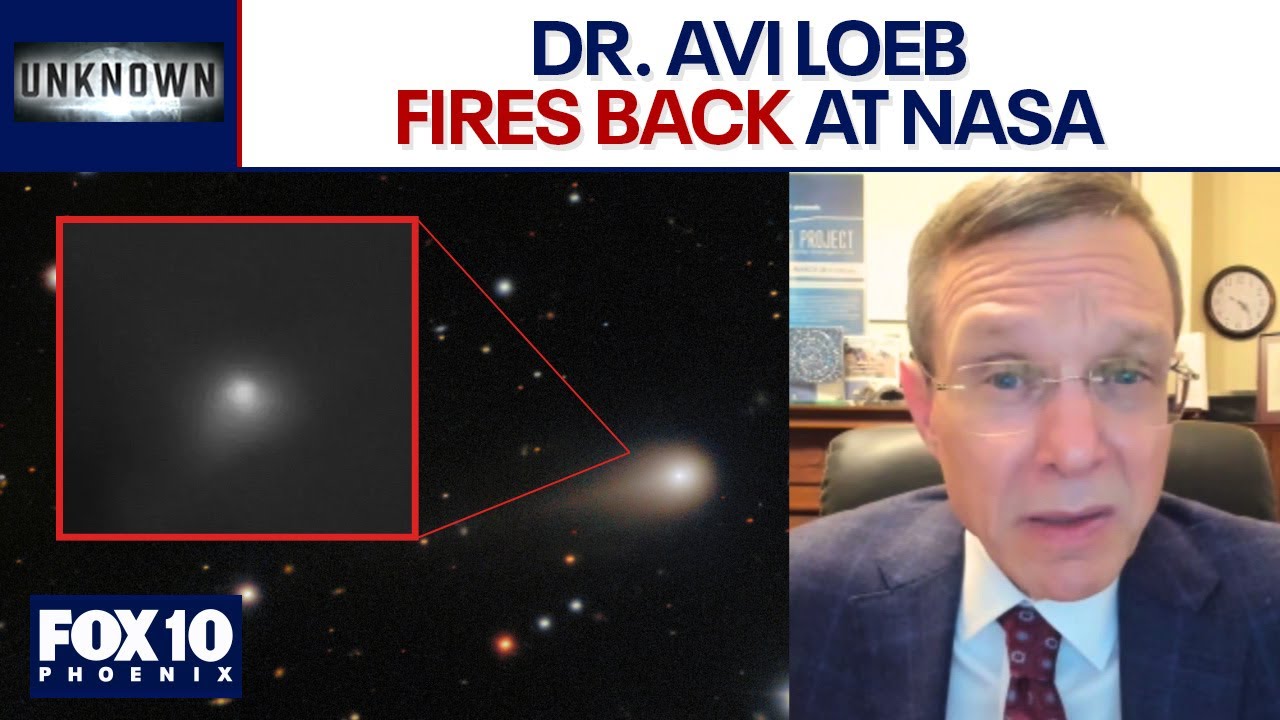
Avi Loeb: NASA's 3I/Atlas Images Raise More Questions Than Answers

Image

The scientific community, a realm typically driven by empirical evidence and a relentless pursuit of truth, often finds itself at a crossroads when confronted with phenomena that defy conventional explanation. The recent analysis by NASA of the interstellar object 3I/ATLAS presents such a juncture. Dr. Avi Loeb, a distinguished astrophysicist from Harvard, has voiced significant concerns, not only about the physical properties of the object but also about the perceived reluctance of the scientific establishment to engage with potentially paradigm-shifting implications. This dossier delves into the anomalies presented by 3I/ATLAS and the critical examination of NASA's response, framed by the broader context of our search for extraterrestrial intelligence.

Unraveling the Mysteries of 3I/ATLAS

The interstellar object 3I/ATLAS, a visitor from beyond our solar system, has ignited a firestorm of debate due to its peculiar characteristics, which deviate significantly from those expected of a typical comet or asteroid. Dr. Avi Loeb, a prominent figure in the study of interstellar objects, has meticulously outlined a dozen significant puzzles that NASA's latest analysis, according to him, has failed to adequately address. These enigmas include the object's disproportionately large mass when compared to its predecessor, 'Oumuamua, and its unusual behavior – specifically, jets that do not appear to be shedding material in the typical manner of a comet undergoing sublimation.

These anomalies are not mere academic curiosities; they strike at the core of our understanding of celestial mechanics and the potential diversity of objects traversing interstellar space. The very nature of 3I/ATLAS challenges established models, forcing scientists to consider possibilities previously relegated to the realm of speculation. The mass anomaly, in particular, suggests an object far denser or more substantial than anticipated for an object of its observed size, hinting at an unusual composition or even an artificial origin.

Recommended Gear for Investigation

ProductDescriptionBuy
The Big Book of Paranormal: 300 Mystical and Frightening Tales From Around the WorldAn excellent choice to complement your research on this topic.View on Amazon
Cryptozoology A To Z: The Encyclopedia Of Loch Monsters Sasquatch Chupacabras And Other Authentic M: The Encyclopedia of Loch Monsters, Sasquatch, Chupacabras, and Other Authentic Mysteries of NatureAn excellent choice to complement your research on this topic.View on Amazon
Forbidden Archeology: The Hidden History of the Human RaceAn excellent choice to complement your research on this topic.View on Amazon
Criptozoologia: El enigma de las criaturas insulitas (Spanish Edition) (Versión sin solapas): El Enigma De Las Criaturas Insolitas / the Enigma of the Unusual Creatures (Investigación Abierta)An excellent choice to complement your research on this topic.View on Amazon
The H. P. Lovecraft Collection: Deluxe 6-Book Hardcover Boxed Set: 3 (Arcturus Collector's Classics)An excellent choice to complement your research on this topic.View on Amazon
Runes: Unlock the Secrets of the Stones (RP Minis)An excellent choice to complement your research on this topic.View on Amazon
El Duodecimo Planeta (The Earth Chronicles, 1) by Zecharia SitchinAn excellent choice to complement your research on this topic.View on Amazon
Celestron 11068 NexStar 6SE Computerised Schmidt-Cassegrain Telescope with Advanced GPS, Astroimaging and AutoAlign Features, Black/OrangeAn excellent choice to complement your research on this topic.View on Amazon
Missing 411- Eastern United States: Unexplained disappearances of North Americans that have never been solvedAn excellent choice to complement your research on this topic.View on Amazon
Tapiz de mapa del mundo antiguo, diseño vintage de mapa del mundo, tapiz de distribución geográfica para colgar en la pared, póster educativo de mapa del mundo del Atlas histórico marrón, para pared,An excellent choice to complement your research on this topic.View on Amazon

Dr. Loeb's Critique: A Call for Open-Mindedness

Dr. Loeb's central argument revolves around the scientific community's apparent adherence to a dogmatic approach, a resistance to embracing novel concepts when faced with anomalous data. He asserts that the prevailing scientific mindset, in its eagerness to fit observations into pre-existing frameworks, may be inadvertently overlooking signs of advanced extraterrestrial technology. This intellectual inertia, he posits, is not only hindering a comprehensive understanding of objects like 3I/ATLAS but also significantly impeding the urgent search for Unidentified Aerial Phenomena (UAP) and evidence of advanced alien civilizations. His impassioned plea is for a fundamental shift in perspective, urging colleagues to set aside preconceived notions and rigorously investigate every possibility, no matter how unconventional.

"The scientific community needs to move past its dogmatic approach and acknowledge these unexplained properties, asserting that this reluctance to consider the possibility of alien technology mirrors the historical academic resistance faced by Galileo and risks limiting the timely search for UAP and advanced extraterrestrial life."

This stance resonates with a growing segment of the public that feels traditional scientific institutions are too conservative, too afraid of ridicule, or too beholden to established theories to make groundbreaking discoveries. The historical parallel drawn to Galileo Galilei, ostracized for his heliocentric views, serves as a potent reminder that revolutionary ideas often face staunch opposition before eventual acceptance.

NASA's Official Stance: A Disappointing Disclosure?

The anticipation surrounding NASA's analysis of the 3I/ATLAS images was palpable. However, for many, including Dr. Loeb, the released information proved to be a significant disappointment. Critics argue that the agency’s presentation reiterated known facts rather than offering new insights, and that the data provided was rudimentary, akin to images from a lower-resolution camera. The failure to directly «reveal» substantial new findings or address the «twelve significant puzzles» highlighted by Dr. Loeb has led to accusations that NASA is either withholding crucial information or adhering to a narrative that downplays the object’s truly enigmatic nature. Some commentators suggest that the imagery itself, delayed and of questionable quality, further fuels suspicion.

The narrative presented by NASA, focusing on conventional explanations like cometary activity, has been met with skepticism. Observers note the agency’s perceived discomfort and contradictory statements during press briefings, oscillating between describing the object as a comet with differences and a "normal comet with some strange particularities." This ambiguity, coupled with a lack of definitive size estimates and a complete disregard for its anomalous mass, has only amplified public distrust. This perceived lack of transparency is a recurring theme, with some recalling instances where NASA allegedly cut live feeds when UAPs appeared on screen.

Historical Parallels: Galileo and the Resistance to New Ideas

Dr. Loeb's invocation of Galileo is not incidental. Throughout history, paradigm-shifting discoveries have often been met with resistance from established institutions. Galileo's observations of the moons of Jupiter and his advocacy for the heliocentric model challenged deeply entrenched Aristotelian and Church doctrines, leading to his condemnation. Similarly, the introduction of concepts like continental drift or quantum mechanics faced initial skepticism and outright rejection before mounting evidence led to their acceptance.

The parallels suggest that when confronted with data that fundamentally challenges existing paradigms, the human tendency is to either dismiss the anomaly, discredit the messenger, or attempt to force the data into a familiar mold. In the context of 3I/ATLAS, this resistance is interpreted by some as a fear of the unknown, a reluctance to acknowledge that humanity may not be alone in the universe, or that technologically advanced artifacts could be traversing our cosmic neighborhood undetected or unacknowledged.

The Technological Artifact Hypothesis

Central to the ongoing debate is the hypothesis that 3I/ATLAS might not be a natural celestial body but rather a technological artifact, an alien probe or craft. The unexplained behavior of its jets, the extraordinary mass-to-size ratio, and the lack of expected cometary activity lend credence to this theory. If 3I/ATLAS is indeed artificial, its presence signifies a monumental discovery, one that could irrevocably alter our understanding of life in the cosmos and our place within it. Dr. Loeb's advocacy for this hypothesis stems from a belief that all possibilities must be entertained when faced with such profound anomalies.

This hypothesis, while speculative, is grounded in observing phenomena that defy conventional scientific explanations. The argument follows that if an object behaves in ways inconsistent with natural processes, then non-natural causes must be considered. The reluctance to explore this path vigorously is seen by proponents as a failure of scientific curiosity and a missed opportunity for potentially the most significant discovery in human history.

Echoes from the Public: A Growing Skepticism

The reaction from the public and online communities to the 3I/ATLAS situation and NASA's response has been overwhelmingly critical. Testimonies shared across various platforms reveal a deep-seated mistrust of official narratives and a strong endorsement of Dr. Loeb's perspective. Many viewers expressed frustration with NASA's perceived arrogance and the simplistic nature of their explanations, deeming the released images "a joke" compared to what amateur astronomers can produce. Comments frequently highlight the contrast between NASA's allegedly poor performance and Dr. Loeb's clear, open, and intellectually honest approach.

One recurring sentiment is that NASA, much like other government bodies, operates with a lack of transparency, potentially withholding crucial data concerning UAPs and extraterrestrial intelligence. This skepticism is amplified by the historical context of governmental secrecy and the perceived inadequacy of NASA's budget allocation for genuine exploration versus public relations. The audience's embrace of Dr. Loeb is evident, with many calling for him to lead NASA or a similar initiative, recognizing his dedication to seeking truths beyond conventional boundaries. The sentiment is clear: the public is ready for genuine revelations, not obfuscation.

Several users pointed out the irony of NASA discussing the excitement of finding microbial life while potentially sitting on information about more advanced extraterrestrial civilizations. The frustration is palpable, with calls to "DE-FUND NASA" and reallocate resources to more effective, open-minded researchers. The overall consensus from audience reactions is that Dr. Loeb embodies the scientific integrity and curiosity that many feel is lacking in official channels.

Shifting the Research Paradigm: A New Frontier

Dr. Loeb is not merely critiquing but actively advocating for a significant redirection of scientific resources and focus. He urges institutions to move beyond passive observation and engage in proactive searching for technological signatures originating from space. This involves allocating substantial funding and dedicating research efforts to identifying potential alien technologies, rather than solely waiting for natural phenomena to present themselves. His confidence remains unshaken: the evidence of extraterrestrial civilizations, he believes, is inevitable, and critical new data regarding 3I/ATLAS is anticipated.

This proposed shift represents a move from a purely theoretical to an actively investigative stance in the search for extraterrestrial intelligence (SETI). It involves developing new methodologies, instruments, and theoretical frameworks capable of detecting artifacts or signals that might not conform to our current understanding of natural cosmic processes. The implication is that humanity must actively "listen" and "look" for technological intelligence, not just natural occurrences.

Veredicto del Investigador: ¿Fraude, Fenómeno Genuino o Algo Más?

The case of 3I/ATLAS, as presented through the lens of Dr. Avi Loeb's analysis and the subsequent public outcry, points towards a phenomenon that transcends the ordinary. While definitive proof of extraterrestrial technology remains elusive, the anomalies associated with 3I/ATLAS, coupled with NASA's perceived inadequate response, create a compelling narrative of suspicion. It is my assessment, based on the available evidence and the critiques leveled against official channels, that 3I/ATLAS warrants continued, rigorous investigation. The possibility of it being a technological artifact, while speculative, cannot be dismissed without a more thorough and transparent scientific engagement. The resistance to exploring such hypotheses is, in itself, an anomaly that demands scrutiny.

Equipo Recomendado para la Investigación

For those inspired by Dr. Loeb's work and eager to contribute to the ongoing investigation of celestial anomalies, the right equipment is crucial. While amateur observation has its limits, advanced tools can provide invaluable data:

Preguntas Frecuentes

  1. ¿Por qué el objeto 3I/ATLAS es tan controvertido?

    La controversia surge de las anomalías físicas observadas en 3I/ATLAS, como su masa inusual y el comportamiento de sus jets, que no se alinean con las características típicas de un cometa o asteroide, junto con la percepción de que NASA no ha abordado estas peculiaridades de manera satisfactoria.

  2. ¿Qué argumenta el Dr. Avi Loeb sobre la respuesta de la NASA?

    El Dr. Loeb critica a la NASA por no abordar las doce anomalías significativas del objeto, acusando a la comunidad científica de un enfoque dogmático y de resistencia a considerar la posibilidad de tecnología extraterrestre, comparando esta resistencia con la oposición histórica a las ideas de Galileo.

  3. ¿Cuál es la hipótesis de que 3I/ATLAS sea un artefacto tecnológico?

    Esta hipótesis sugiere que las características anómalas de 3I/ATLAS podrían indicar que no es un objeto natural, sino una nave o sonda artificial de origen extraterrestre, dada su masa inusual y su comportamiento no estándar.

  4. ¿Por qué la gente desconfía de la información oficial sobre 3I/ATLAS?

    La desconfianza se basa en la percepción de falta de transparencia por parte de la NASA, la calidad cuestionable de las imágenes publicadas, la falta de respuesta a preguntas clave y un historial percibido de ocultar información sobre fenómenos anómalos y UAPs.

  5. ¿Qué proponen los defensores de una investigación más abierta?

    Proponen un cambio en el enfoque científico, asignando más recursos a la búsqueda activa de firmas tecnológicas extraterrestres y adoptando una mentalidad más abierta para investigar fenómenos que desafían las explicaciones convencionales.

Tu Misión: Campo de Investigación

La investigación de lo inexplicable exige tanto rigor analítico como valentía intelectual. Te desafío a adoptar una postura crítica ante la información oficial, a buscar fuentes diversas y a considerar todas las hipótesis. Si has sido testigo de fenómenos aéreos no identificados o has experimentado eventos inexplicables, documenta todo meticulosamente. Tu testimonio, como el de tantos otros, podría ser la pieza faltante en un rompecabezas cósmico mayor.

Comparte tus experiencias y observaciones en los comentarios a continuación. ¿Qué opinas sobre el caso 3I/ATLAS y la respuesta de la NASA? ¿Has presenciado algo similar?

Difunde este expediente en tus redes sociales. La verdad no se descubre a través del silencio, sino del intercambio abierto de ideas y evidencias. Ayúdanos a correr la voz y a fomentar una discusión más profunda sobre nuestro lugar en el universo.

Suscríbete a nuestro canal para recibir actualizaciones constantes sobre los misterios más intrigantes de nuestro cosmos y prepárate para cuestionarlo todo.

Investigator's Note: True paranormal research doesn't fund itself. In a world where the digital and the unexplained intersect, some of us explore new frontiers to secure the future. Do you dare to be part of the vanguard? Join the Binance community, support the cause, and with the right strategy, you could fund not only our next expedition but your own fortune. The next great discovery could be just a click away.

The 27-Year Voyage: An Analysis of the Lost Astronaut Phenomenon


Introduction: Echoes from the Void

The silence of space is a canvas upon which humanity has projected its grandest aspirations and deepest fears. But what happens when the silence is broken not by a signal, but by the return of the lost? Today, we open an expediente pertaining to a narrative that defies conventional understanding: an astronaut, adrift for nearly three decades, reappearing as if plucked from time itself.

This isn't a fairy tale; it's a scenario that pushes the boundaries of our scientific and existential comprehension. The implications are profound, raising questions about temporal displacement, unknown cosmic forces, and the very fabric of reality we take for granted.

Case File: The Lost Cosmonaut

The core of this enigma revolves around a purported individual who vanished into the celestial abyss, only to re-emerge 27 years later. While the original source material is scant on specifics—lacking names, dates, and verifiable mission logs—the narrative itself serves as a potent archetype for the unknown perils and mysteries of extraterrestrial exploration. Such accounts, though often anecdotal, tap into a primal human fascination with prolonged isolation and the potential for encounters beyond our current scientific paradigms.

Consider the sheer psychological weight of such an experience. Twenty-seven years is not merely a duration; it is an epoch. Relationships would have evolved, technologies advanced, and the world would have transformed irrevocably. For the returning individual, the disorientation would be immense, akin to stepping not just into a different time, but potentially a different reality. This narrative, stripped of empirical data, becomes a powerful thought experiment.

"The void does not just surround us; it can consume us. And sometimes, it gives back what it has taken, changed."

In the absence of concrete data, our task is to dissect the underlying themes and explore the potential avenues of inquiry. This isn't about validating a single, unverified report, but about understanding the persistent human narrative of the "lost in space" phenomenon and what it signifies. It's a story that resonates because it touches upon our deepest anxieties and our most fervent hopes for what lies beyond the stars.

Scientific Anomalies and Theoretical Frameworks

From a purely scientific standpoint, a 27-year disappearance and reappearance presents a formidable challenge. While space travel involves inherent risks, including equipment failure and navigational errors, the concept of prolonged temporal displacement requires a deeper theoretical dive. We must peer into the speculative realms of:

  • Relativistic Time Dilation: While significant time dilation occurs at speeds approaching the speed of light or in extreme gravitational fields, a 27-year perceived trip for the astronaut, with a much shorter duration for Earth, would necessitate velocities or gravitational influences far beyond our current technological capabilities or observed natural phenomena. The physics involved would need to be extraordinary.
  • Cosmic Anomalies: Could wormholes, localized spacetime distortions, or unknown cosmic phenomena be responsible? These are theoretical constructs, often explored in science fiction, but their existence, while not disproven, lacks empirical evidence. Investigating such theories requires an open mind and a rigorous examination of any anomalous readings or observations associated with such narratives.
  • Extraterrestrial Intervention: The possibility, however improbable for the skeptic, of alien abduction or temporal manipulation by advanced non-human intelligence cannot be entirely dismissed in the context of unexplained phenomena. While this ventures into speculative territories, the lack of conventional explanations often leads researchers to consider unconventional hypotheses.

The scientific community, bound by its empirical methodologies, would demand irrefutable evidence: data logs, sensor readings, and corroborating astronomical observations. Without these, the narrative remains in the realm of the speculative. However, the persistence of such stories suggests a human intuition grappling with phenomena that may lie just beyond our measurement capabilities. For the serious paranormal investigator, the absence of evidence is not always evidence of absence, but rather a call for more sophisticated investigative tools and theories.

Psychological Implications of Extended Isolation

The psychological toll of prolonged space travel, especially under conditions of isolation and uncertainty, is a critical area of study, even when the specific narrative is unverified. Astronauts are subjected to extreme environments, far from familiar comforts and social support structures. The mental fortitude required to cope with such conditions is immense. For an individual who has been lost for 27 years, the psychological landscape would be profoundly altered:

  • Sensory Deprivation and Hallucinations: Extended periods with limited external stimuli can lead to cognitive impairments, distorted perceptions, and even hallucinations. What might be perceived as an encounter with an unknown entity could, in some cases, be a manifestation of the mind's response to extreme conditions.
  • Identity Crisis: Returning after such a long period would likely trigger an profound identity crisis. The astronaut would be a relic of the past, struggling to reconcile their experiences with a world that has moved on. The disconnect between their internal timeline and external reality could be devastating.
  • Existential Despair and Resilience: The sheer loneliness and the confrontation with the vastness of the cosmos could lead to profound existential despair. Conversely, the will to survive and return would demonstrate an extraordinary capacity for human resilience.

Understanding these psychological dimensions is crucial, not to dismiss the possibility of external phenomena, but to provide a comprehensive framework for analyzing such accounts. The human mind, under duress, is capable of extraordinary resilience and equally extraordinary distortions of reality. This is a vital component when analyzing any purported paranormal event, especially those involving isolated individuals pushed to their limits.

Societal Impact and Cultural Narratives

Stories of lost astronauts, like the one alluded to, have a significant cultural impact, tapping into our collective consciousness regarding exploration, the unknown, and human resilience. These narratives serve multiple purposes:

  • Inspiring Future Exploration: Despite the risks, tales of survival and mystery in space continue to fuel our desire to explore the cosmos. They highlight the stakes involved and the potential rewards of pushing beyond known boundaries.
  • Reflecting Societal Anxieties: The fear of being lost, forgotten, or irrevocably changed by forces beyond our control is a universal human fear. These stories often act as a catharsis, allowing us to explore these anxieties in a controlled narrative environment.
  • Fueling Scientific and Philosophical Debate: Unexplained narratives, even if anecdotal, often stimulate debate and encourage scientists, philosophers, and researchers to consider possibilities outside the conventional. They can be a catalyst for asking "what if?"

The concept of "lost time" or temporal displacement, while scientifically speculative, has permeated popular culture, from film to literature. This widespread fascination underscores a deep-seated human curiosity about the nature of time and our place within it. It’s a narrative thread that, when investigated, often leads to complex questions about perception, memory, and the limits of our current understanding.

Investigator's Verdict: Beyond Human Comprehension?

Analyzing the narrative of an astronaut lost for 27 years and returning presents a unique challenge due to the inherent lack of empirical data. My verdict, based on the available information, leans towards the interpretation of this as a powerful archetype rather than a documented event. However, the investigator in me cannot dismiss the underlying questions it raises:

  • The "Unexplained" Spectrum: While scientific explanations like extreme, unobserved relativistic effects would be required for a literal interpretation, the persistence of such narratives suggests that we may be encountering phenomena that lie outside current scientific measurement or understanding.
  • Archetypal Resonance: The story functions as a potent metaphor for human experience – facing the unknown, enduring isolation, and the profound disorientation of return. This doesn't negate the possibility of a real event, but it explains its powerful hold on our imagination.
  • The Limits of Data: In the field of the paranormal, we often encounter situations where hard data is scarce. Our role is to analyze witness testimony, historical context, and theoretical possibilities. In this case, the narrative itself is the primary artifact for analysis.

Therefore, while I cannot confirm the veracity of a specific 27-year space disappearance and return, I consider the scenario a valid subject for continued investigation into the outermost bounds of human experience and the potential for anomalous phenomena in space. It prompts us to consider that perhaps some aspects of the cosmos operate on principles we have yet to grasp.

Research Protocols: Analyzing Anomalous Space Narratives

Investigating narratives like the "lost astronaut" requires a systematic approach, blending scientific skepticism with an openness to the anomalous:

  1. Source Verification: The first step is always to trace the origin of the narrative. Who reported it? When? Is there any corroborating evidence (mission logs, witness statements, scientific data)? In cases like this, the lack of primary sources is itself a significant data point.
  2. Cross-Referencing Similar Cases: Compare the narrative with other documented cases of unexplained disappearances or prolonged isolation in unusual circumstances (e.g., lost at sea, deep cave explorations, other purported space anomalies). Look for common themes, patterns, or recurring motifs.
  3. Theoretical Plausibility Assessment: Examine the narrative through the lens of cutting-edge theoretical physics (e.g., wormholes, temporal mechanics, exotic matter) and established psychological principles (e.g., coping mechanisms, hallucinations from isolation). This helps to frame the unexplained within potential, albeit speculative, frameworks.
  4. Identifying Potential Misinformation or Misinterpretation: Consider mundane explanations. Could it be a misunderstanding of relativistic effects, a science fiction trope being presented as fact, or a coded allegorical story?
  5. Documenting Anomalies: Even if the core narrative is questionable, note any specific details that seem particularly intriguing or defy easy explanation. These might serve as jumping-off points for further, more grounded research into related phenomena.

The goal is not to validate every claim, but to meticulously sift through the information, separating verifiable facts from speculation, and identifying the genuine anomalies that warrant deeper investigation.

The Investigator's Archive

To delve deeper into the mysteries of space anomalies and the human psyche under extreme conditions, consulting key resources is essential. Consider these foundational texts and media:

  • "The Case for Mars" by Robert Zubrin: While focused on colonization, it offers insights into the challenges and psychological aspects of long-duration space missions.
  • "Pale Blue Dot: A Vision of the Human Future in Space" by Carl Sagan: A profound exploration of humanity's place in the cosmos, touching upon the psychological impact of space.
  • "Astrophysics for People in a Hurry" by Neil deGrasse Tyson: For a grasp of the scientific principles governing space, understanding relativity and cosmic phenomena is key.
  • Documentaries on Space Exploration: Look for documentaries that detail the psychological toll on astronauts during significant missions (e.g., Apollo missions, ISS living conditions).
  • Journals on Parapsychology and Anomalous Phenomena: Publications that explore subjective experiences and unexplained events can offer parallel case studies.

These resources provide the necessary context and theoretical grounding for understanding the multifaceted nature of phenomena that extend beyond conventional explanation.

Frequently Asked Questions

Q1: Is there any specific incident that matches the description of an astronaut lost for 27 years?
A1: While there are numerous accounts of astronauts experiencing critical failures or near-disasters, no officially documented case involves an astronaut being lost for precisely 27 years and subsequently returning. The narrative likely serves as an archetype or a speculative scenario.

Q2: Could time dilation realistically account for such a scenario?
A2: For a 27-year difference, the astronaut would need to travel at speeds extremely close to the speed of light or experience immense gravitational forces. While time dilation is a real phenomenon predicted by Einstein's theory of relativity, achieving such a dramatic effect would require conditions far beyond any current or foreseeable human space mission.

Q3: What are the psychological risks of prolonged space missions?
A3: Risks include sensory deprivation, isolation, confinement, sleep disturbances, anxiety, depression, and potential hallucinations. The psychological resilience of astronauts is paramount, and extensive training is provided to mitigate these effects.

Your Mission: Charting the Uncharted

The narrative of the lost astronaut, whether a factual account or a powerful myth, compels us to contemplate the vastness of space and the limits of human comprehension. Your mission, should you choose to accept it, is to engage with this concept on a deeper level.

Your Mission: Investigate the "Temporal Anomalies" in Folklore.

Research local legends, folklore, or historical accounts that speak of individuals disappearing for prolonged periods and reappearing with no memory or with experiences that defy conventional explanation. How do these stories align with the themes of isolation, temporal displacement, and the unknown encountered in space narratives? Document any common threads or unique elements that emerge. Share your findings and your analysis in the comments below. Let's see what collective insights we can uncover.

About the Author

alejandro quintero ruiz is a veteran field investigator dedicated to the analysis of anomalous phenomena. His approach combines methodological skepticism with an open mind to the inexplicable, always seeking the truth behind the veil of reality.

The NASA Whistleblower: Unveiling Anomalies at the Heart of Space Exploration


The Whispers from Within: A Former NASA Employee's Shocking Account

The corridors of power, especially those tasked with pushing the boundaries of human knowledge, often harbor secrets that defy conventional understanding. Today, we delve into an extraordinary revelation from an individual who once walked those halls—a former employee of the National Aeronautics and Space Administration (NASA). This insider account, published on June 9, 2022, at 03:27 PM, promises to peel back the curtain on activities occurring within NASA's headquarters that extend beyond public discourse.

Founded in 1958, NASA was established with a clear mandate: to pioneer the exploration of space, both within and beyond Earth's atmosphere. Its history is punctuated by groundbreaking discoveries and audacious missions that have reshaped our perception of the cosmos. Yet, the agency's operational scope, as hinted by this whistleblower, may encompass phenomena and projects far removed from the science of rocketry and orbital mechanics we commonly associate with it. The U.S. Government's authority to provide technical assistance is vast, but when NASA's functions move beyond substantial congressional oversight, the potential for operating in speculative or classified realms intensifies.

Deconstructing the Revelation: Beyond the Public Facade

The core of this report centers on the *truth* revealed by this former NASA employee. The term "truth" in this context is loaded. It implies a discrepancy between the agency's public image and its covert operations. What kind of "truth" could be so significant as to warrant a whistleblower's report? We must consider the historical context of NASA's involvement in areas that have long fueled speculation: unexplained aerial phenomena (UAP), advanced propulsion systems, and even potential contact scenarios.

The agency, by its very nature, is at the forefront of scientific inquiry. However, the sheer scale of its budget, its access to cutting-edge technology, and its strategic importance to national security create a fertile ground for classified research. This whistleblower's account compels us to ask: what truly transpires behind the closed doors of NASA headquarters, especially in projects not subject to the full scrutiny of congressional oversight? Could these be advanced technological developments, experiments with profound implications, or something even more startling?

Analyzing the Evidence: The Substance of the Claims

While the original content is sparse on specifics, the implication of a whistleblower’s testimony demands rigorous analysis. Such accounts often fall into several categories:

  • Advanced Technology Development: NASA is a hub for innovation. It's conceivable that this employee witnessed or was privy to advancements in fields like quantum computing, exotic materials, or propulsion systems that are decades ahead of public knowledge. These could be misconstrued as "paranormal" by those unfamiliar with the cutting edge of science.
  • UAP/UFO Investigations: For decades, rumors have persisted about NASA's involvement in studying UFOs. Whistleblower testimonies, such as those concerning Project Blue Book or more recent disclosures about UAP task forces, suggest that the agency may possess data or insights that contradict official narratives.
  • Classified Astronomical Observations: The vastness of space offers endless possibilities for discovery. Perhaps the revelation pertains to anomalous celestial bodies, signals, or phenomena that NASA has detected but not yet disclosed to the public, possibly due to their implications or proprietary nature.
  • Psychological or Esoteric Research: Historically, various government agencies have explored unconventional fields. While less probable today, the possibility of research into areas now adjacent to parapsychology cannot be entirely dismissed, especially if it pertains to consciousness or human perception in extreme environments like space.

The critical next step is to seek corroboration. A single testimony, while compelling, requires verification. However, the very act of a whistleblower coming forward often signals that there is *something* to hide or, at the very least, something not ready for public consumption.

The Paranormal Corner's Perspective: Bridging Science and the Unexplained

Here at "The Paranormal Corner," we are dedicated to exploring the unexplained and the unusual. When a source from within an organization as significant as NASA breaks silence, it warrants our full attention. Our mission is to analyze these claims through a lens of skepticism and open-mindedness, seeking to understand the potential for genuine anomalies within the framework of rigorous investigation.

The establishment of NASA was a monumental step for humanity, aimed at expanding our horizons. But what if the pursuit of the unknown, both in space and potentially within our own institutions, has led to discoveries that challenge our current paradigms? The very definition of "paranormal" can be a moving target; what is inexplicable today might be the science of tomorrow.

Investigating the Unseen: What Does This Mean for Us?

The implications of a NASA insider revealing covert activities are profound. It forces us to confront the possibility that our understanding of humanity's reach into the cosmos, and the entities or phenomena we might encounter, is incomplete. The sheer technical capability and scientific expertise housed within NASA mean that any anomaly they investigate or any technology they develop in secret would be of immense consequence.

The Archived Data: Connecting the Dots

This whistleblower's account serves as a crucial data point in the ongoing investigation into phenomena that lie beyond our current scientific grasp. It aligns with a broader pattern of alleged government involvement in the study of the anomalous. Researchers like Jacques Vallée, in his seminal work "Passport to Magonia," have long posited that reports of UFOs and related phenomena are not necessarily extraterrestrial in origin but could represent a complex, multi-faceted aspect of our reality that eludes conventional classification. The "Foo Fighters" observed during World War II, for instance, were initially sources of confusion and speculation, later investigated for their potential technological and observational implications.

Furthermore, the work of John Keel, particularly his theories on the "Age of the UFO," suggests that these phenomena might be more akin to a form of interface or communication rather than simple physical craft. If NASA personnel are indeed encountering or studying such anomalies, their internal reports—the very ones this whistleblower might be alluding to—could hold the key to understanding these enigmatic occurrences. The consistency of certain UAP characteristics across decades and geographical locations, as documented in archives and databases, lends credibility to the idea that something persistent and observable is at play.

Protocol: Analyzing Evidence from Within

When faced with a whistleblower's testimony, especially from a high-stakes organization like NASA, certain protocols must be followed:

1. Source Verification: Determine the credibility of the source. What is their background within NASA? What specific department were they in? What is their motive for coming forward? 2. Evidence Corroboration: Does the testimony align with other known events, declassified documents, or anecdotal evidence from the wider UAP community? Are there any independently verifiable facts mentioned? 3. Technological Plausibility: Assess the claims against current scientific and technological understanding. Are they within the realm of possibility, even if speculative? 4. Disinformation Assessment: Consider the possibility of deliberate misinformation or carefully crafted narratives designed to mislead. This is a constant challenge in the field of anomalous phenomena.

This methodology, while rooted in the scientific method, is essential for navigating the murky waters of classified information and alleged paranormal encounters. The challenge with NASA is that a significant portion of their historical data, particularly concerning early UAP investigations and specific project details, remains classified or has been heavily redacted.

Your Mission: Deciphering the Cosmic Confidential

This revelation acts as a stark reminder that the universe may hold far more than we currently comprehend, and that organizations at the forefront of exploration might possess knowledge that could fundamentally alter our understanding of reality. The task now falls to us, the researchers and the curious, to sift through the implications of such testimonies.

Your mission, should you choose to accept it, is to critically examine publicly available information regarding NASA's historical involvement with UAP and anomalous data. Research declassified documents, cross-reference whistleblower accounts, and consider how advanced scientific exploration might intersect with phenomena that defy our current understanding. What connections can *you* find between NASA's stated objectives and the alleged hidden truths? Share your findings and theories in the comments below. The search for truth requires a collective effort.

About the Author

alejandro quintero ruiz is a veteran field investigator dedicated to the analysis of anomalous phenomena. His approach combines methodological skepticism with an open mind to the inexplicable, always seeking the truth behind the veil of reality. With years of experience documenting and analyzing cases ranging from cryptids to historical hauntings and unexplained aerial phenomena, his work aims to bring clarity and critical thinking to the most perplexing mysteries.

Thank you for watching! Thank you to CO.AG for the background music!

Hello and welcome to The Paranormal Corner, your daily source of unexplained and unusual paranormal videos and documents. If you like the paranormal content of this blog, please follow us on our social networks:

Blog: elrinconparanormal.blogspot.com

Twitter: https://twitter.com/RinconParanorm1

Facebook: https://web.facebook.com/elrinconparanormalblogspotcom/

Discord: https://discord.com/invite/ZfumFPs

Tik Tok: www.tiktok.com/@rinconparanormal0?lang=es