

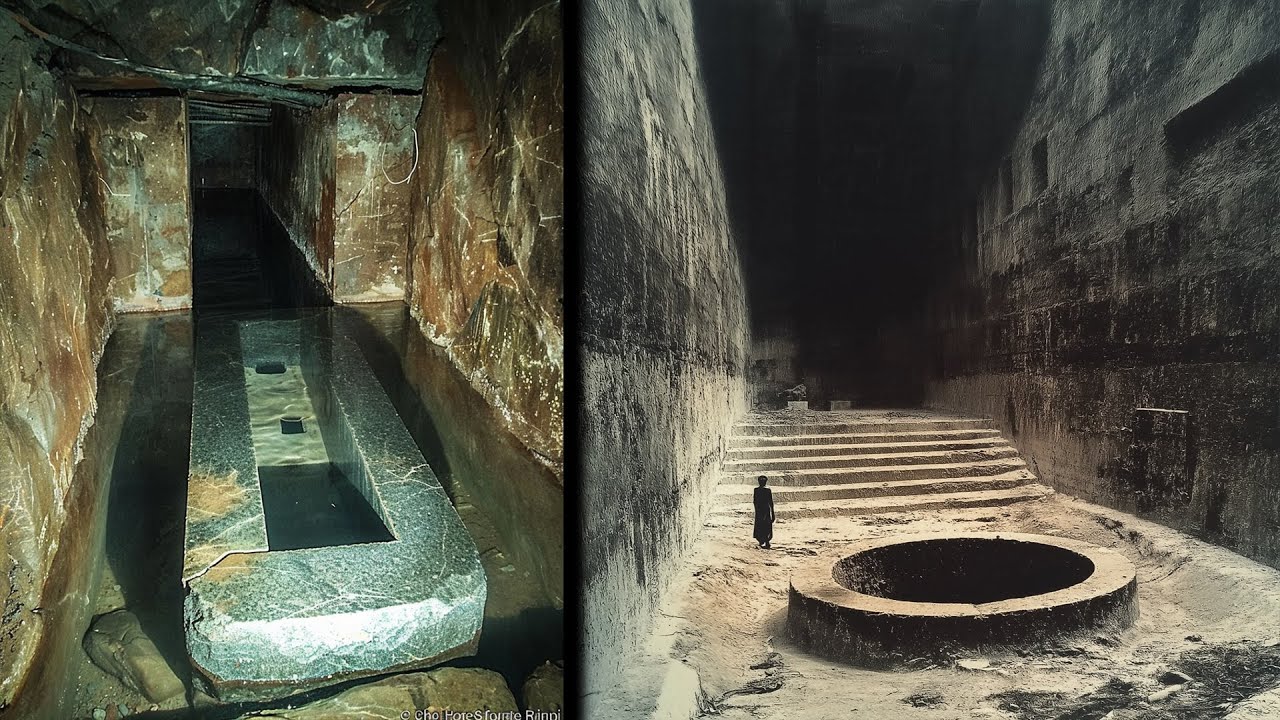
The sands of time often obscure the grandest achievements of humanity, leaving us with fragmented histories and prevailing narratives that rarely tell the whole story. In the realm of ancient civilizations, particularly those predating the dynastic Egyptians, a compelling body of evidence suggests a technological prowess and sophistication far beyond our current understanding. This investigation delves into the enigmatic world of pre-Egyptian megastructures, colossal edifices that challenge conventional timelines and hint at a lost era of advanced knowledge.
ÍNDICE DEL EXPEDIENTE
- The Osireion and Beyond: Evidence of a Lost Civilization
- Architectural Anomalies: Precision and Power
- Astronomical Alignments: Celestial Blueprints
- Technological Implications: Beyond Hammers and Chisels
- The Great Flood Theory: A Precursor to Modern Civilizations?
- Expert Analysis and Skepticism: Bridging the Divide
- Investigator's Verdict: Re-evaluating History
- The Investigator's Archive
- Frequently Asked Questions
- Your Mission: Field Assignment
The Osireion and Beyond: Evidence of a Lost Civilization
The concept of an advanced civilization flourishing before the established dynastic periods of ancient Egypt is not merely speculative; it is a hypothesis supported by enigmatic sites like the Osireion, Zawyet el Aryan, and the Serapeum of Saqqara. These locations present architectural and engineering feats that defy conventional explanations. The precision with which massive stone blocks were quarried, transported, and fitted together suggests a profound understanding of physics, mathematics, and engineering, far surpassing the tools and techniques typically attributed to the era.
Some theorists propose that these structures weren't merely monuments but served advanced purposes, possibly as power plants or sophisticated astronomical observatories. The granite sarcophagi in the Serapeum, for instance, exhibit a mechanical precision that leads many to question their function as mere burial chambers. As one commenter aptly put it, quote-style, ">I don't believe for a minute that the Serapeum of Saqqara boxes are burial chambers nor sarcophagi. Admittedly, it's just a gut feeling on my part, but it feels like there's something more going on here than burial chambers. It's too plain and undecorated and just looks utilitarian more than anything else." This sentiment is echoed by many who find the conventional narrative of tombs for dead pharaohs, constructed with rudimentary tools, insufficient to explain the monumental scale and precision of these ancient wonders.
Recommended Gear for Investigation
| Product | Description | Buy |
|---|---|---|
| The Big Book of Paranormal: 300 Mystical and Frightening Tales From Around the World | An excellent choice to complement your research on this topic. | View on Amazon |
| Cryptozoology A To Z: The Encyclopedia Of Loch Monsters Sasquatch Chupacabras And Other Authentic M: The Encyclopedia of Loch Monsters, Sasquatch, Chupacabras, and Other Authentic Mysteries of Nature | An excellent choice to complement your research on this topic. | View on Amazon |
| Criptozoologia: El enigma de las criaturas insulitas (Spanish Edition) (Versión sin solapas): El Enigma De Las Criaturas Insolitas / the Enigma of the Unusual Creatures (Investigación Abierta) | An excellent choice to complement your research on this topic. | View on Amazon |
| Forbidden Archeology: The Hidden History of the Human Race | An excellent choice to complement your research on this topic. | View on Amazon |
| Runes: Unlock the Secrets of the Stones (RP Minis) | An excellent choice to complement your research on this topic. | View on Amazon |
| The H. P. Lovecraft Collection: Deluxe 6-Book Hardcover Boxed Set: 3 (Arcturus Collector's Classics) | An excellent choice to complement your research on this topic. | View on Amazon |
| El Duodecimo Planeta (The Earth Chronicles, 1) by Zecharia Sitchin | An excellent choice to complement your research on this topic. | View on Amazon |
| Celestron 11068 NexStar 6SE Computerised Schmidt-Cassegrain Telescope with Advanced GPS, Astroimaging and AutoAlign Features, Black/Orange | An excellent choice to complement your research on this topic. | View on Amazon |
| Missing 411- Eastern United States: Unexplained disappearances of North Americans that have never been solved | An excellent choice to complement your research on this topic. | View on Amazon |
| Ghost-Hunting For Dummies [Idioma Inglés] | An excellent choice to complement your research on this topic. | View on Amazon |
Architectural Anomalies: Precision and Power
The construction of sites like the Great Pyramid of Giza showcases an almost unbelievable level of accuracy. Its alignment with the cardinal directions is remarkable, and the precision in cutting and fitting colossal stone blocks, some weighing many tons, has long puzzled archaeologists and engineers. The use of copper chisels and primitive tools, as commonly taught, seems increasingly improbable when faced with the evidence. The sheer scale of these projects implies not only advanced engineering but also a highly organized society capable of mobilizing vast resources and labor forces.
A carpenter with decades of experience starkly pointed this out: quote-style, ">I've been a carpenter for 30 plus years, and I've cut many different materials in those years. I assure anyone watching this piece, the people who've tried convincing us these materials were cut with coper chisels only puts on full display their total lack of real world experience cutting anything othere than paper!! This was not done with a chisel period full stop!" This practical perspective underscores the disconnect between the proposed methods and the tangible reality of the structures themselves. The granite, rich in quartz, further fuels speculation. As noted by another observer, quote-style, ">Granite is full of quartz. Quartz produces electricity when subjected to pressure. We might have finally understood how the machine was powered." This points towards potential energy generation, transforming these ancient sites from simple tombs into complex machines of antiquity.
Astronomical Alignments: Celestial Blueprints
The deliberate alignment of ancient structures with celestial bodies is a recurring theme across various cultures. The hypothesized alignment of the Giza pyramids with Orion's Belt is perhaps the most famous example, suggesting a sophisticated understanding of astronomy and cosmology. This knowledge would have been crucial for timekeeping, agricultural cycles, and possibly even spiritual practices. The ability to map the stars with such precision and translate that knowledge into monumental architecture implies a civilization with deep scientific insights.
The concept that these structures were meticulously planned, not as mere religious sites but as functional devices, is gaining traction. The idea of the pyramids as power plants, as suggested by some viewers, aligns with the theory of advanced technological understanding. This perspective challenges the traditional view of ancient Egyptians as solely builders of tombs, pushing us toward a more complex picture of their capabilities and knowledge base. The precision in architectural design isn't just about aesthetics; it's about function, as suggested by the idea that "The title of the video should really be 'Pre-Egyptian Engineering and Electrical Generation - The Great Pyramids' or something that reflected the content better."
Technological Implications: Beyond Hammers and Chisels
The prevailing narrative often asserts that these megastructures were built using simple tools like hammers and chisels. However, the sheer number of colossal blocks, the precision of their cuts, and the immense weight involved make this explanation difficult to accept for many. Theories involving advanced technology, sound manipulation, or unknown energy sources are frequently discussed in communities dedicated to exploring these anomalies. The possibility of a civilization possessing technology comparable to, or even exceeding, our own cannot be dismissed lightly.
The notion that "the narrative we were taught in school is totally incorrect at every level" resonates with many who question established historical accounts. This skepticism is a crucial driver for exploring alternative hypotheses. The structures' internal designs, often described as looking like "a machine," further bolster the idea that their purpose extended far beyond religious or funerary rites. The resonance experienced within these structures, like the echoing snap of fingers described by a visitor, suggests acoustic properties that might have played a functional role, perhaps in energy generation or communication.
The Great Flood Theory: A Precursor to Modern Civilizations?
Many theories posit that these advanced civilizations existed before a cataclysmic event, such as the Great Flood, which reshaped the planet and wiped out much of human knowledge. According to this perspective, the remnants of these ancient societies, including their monumental structures, are the only tangible evidence left of their existence. The incredible longevity attributed to people before the flood, often cited as 600-900 years, would have allowed for the development and transmission of sophisticated knowledge over many generations, supporting the construction of such massive projects.
This theory suggests that our current understanding of history is incomplete, missing a crucial chapter of advanced human civilization. The Sahara Desert, for instance, was not always arid; evidence points to a time when it was a lush jungle, capable of supporting large populations and complex societies. This environmental context is vital for understanding how such civilizations could have thrived and undertaken ambitious building projects. The question, quote-style, ">Why is it that people just can't say 'we simply do not know'?" highlights the frustration with historical certainties that seem to ignore abundant anomalies.
Expert Analysis and Skepticism: Bridging the Divide
While fringe theories abound, the rigorous work of engineers and researchers outside the traditional Egyptological circles has begun to shed new light on these ancient marvels. Their methodologies, focusing on physics, engineering principles, and a willingness to consider unconventional explanations, often provide more compelling insights than explanations rooted in dogma. The observation that quote-style, ">The work of engineers taking an interest in the great pyramid has done more to advance archeology on the topic than so called Egyptologists" points to a potential schism in how these ancient sites are studied.
Skepticism is a vital tool in any investigation, but it should not become a barrier to considering all available evidence. The persistent anomalies presented by these megastructures demand further inquiry. As one viewer noted, quote-style, ">This channel challenges my skepticism and makes me intrigued and full of questions." This intellectual curiosity is precisely what drives paranormal and historical research forward, pushing the boundaries of accepted knowledge and encouraging a re-evaluation of our past.
Investigator's Verdict: Re-evaluating History
The evidence surrounding pre-Egyptian megastructures strongly suggests that our current historical timeline and understanding of ancient capabilities are incomplete. The precision engineering, astronomical knowledge, and sheer scale of these constructions point towards a civilization possessing advanced technology and a profound understanding of the natural world. While definitive answers remain elusive, the persistent anomalies compel us to question established narratives and remain open to the possibility of lost chapters in human history.
The Investigator's Archive
For those seeking to delve deeper into the mysteries of ancient civilizations and unexplained phenomena, a curated selection of resources can illuminate the path. Understanding the methodologies and findings of various researchers is crucial for forming a comprehensive perspective.
The eBook "Pre-Historic Megastructures" by Universe Inside You is a prime example, offering a detailed look at over 30 remarkable sites. Such comprehensive works are invaluable for anyone serious about investigating these topics. Furthermore, documentaries and academic papers that challenge conventional thinking often spark critical debate and encourage further research into areas often overlooked by mainstream academia. Exploring the mysteries of ancient civilizations is a journey that benefits from diverse sources and perspectives.
Frequently Asked Questions
Q1: What is the main argument against the pyramids being tombs?
A1: The primary arguments include the incredible precision of construction, the lack of significant burial artifacts in many chambers, the use of vastly superior materials and techniques implied by the stonework, and alternative theories suggesting functions like power generation or astronomical observation.
Q2: How could such advanced technology have existed so long ago?
A2: Theories propose a highly advanced pre-diluvian civilization that either predates known history or existed concurrently with early civilizations, possessing knowledge lost to time. Some also suggest extraterrestrial influence, though evidence for this remains speculative.
Q3: What is the significance of astronomical alignments in these structures?
A3: These alignments suggest a deep understanding of celestial mechanics, used for timekeeping, navigation, agricultural planning, and possibly spiritual or energetic purposes. They indicate a level of scientific sophistication far beyond what is typically attributed to ancient peoples.
Q4: Could water have played a role in constructing these megastructures?
A4: Some theories suggest advanced hydraulic engineering, possibly involving water rams or other devices, to move massive stones or even generate power. The presence of ancient water systems and the historical existence of lush environments in currently arid regions support these ideas.
Q5: Why is it difficult to find definitive proof of these advanced ancient civilizations?
A5: Cataclysmic events like the Great Flood could have destroyed much evidence. Furthermore, prevailing historical narratives may resist or suppress findings that contradict established timelines and theories, making it challenging for alternative interpretations to gain mainstream acceptance.
Your Mission: Field Assignment
The greatest mystery is not always in the monumental structures themselves, but in our willingness to question the accepted truth. Your mission, should you choose to accept it, is to examine your own assumptions about history. Seek out the anomalies, question the narratives, and explore the evidence with an open, analytical mind. The past is not as settled as it appears; it is a landscape ripe for re-investigation.
What are your thoughts on these pre-Egyptian megastructures? Have you encountered similar anomalies in your own research or travels? Share your experiences and theories in the comments below. Your insights are crucial to piecing together this historical puzzle.
If this investigation has sparked your curiosity, help us spread the word. Share this post on your social media channels and join the conversation. Let's challenge the ordinary and uncover the extraordinary together.
For more in-depth analysis and exclusive content, follow us on our social media platforms and subscribe to our channels. Stay vigilant.
Investigator's Note: True paranormal research doesn't fund itself. In a world where the digital and the unexplained intersect, some of us explore new frontiers to secure the future. Do you dare to be part of the vanguard? Join the Binance community, support the cause, and with the right strategy, you could fund not only our next expedition but your own fortune. The next great discovery could be just a click away.

No hay comentarios.:
Publicar un comentario