

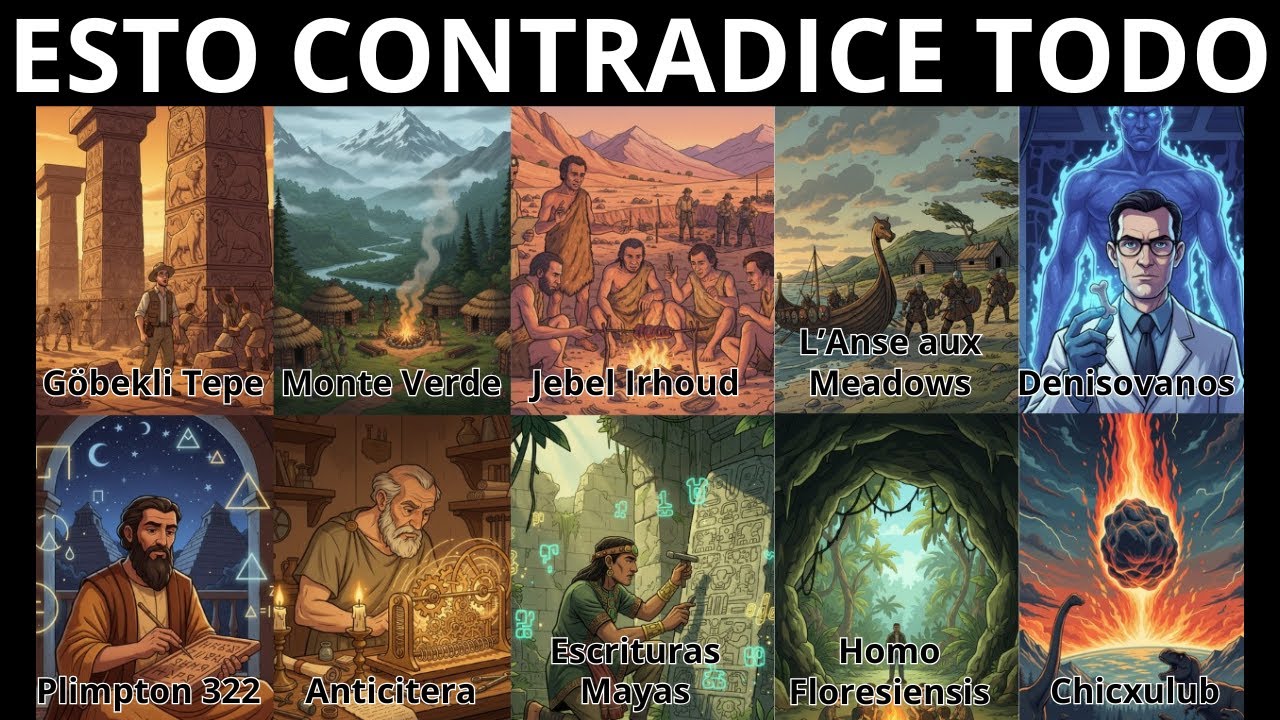
For centuries, we've accepted a singular version of history as fact. Yet, the tapestry of our past is far more intricate and mysterious than commonly portrayed. Numerous discoveries have surfaced, presenting undeniable evidence that clashes with the established historical narrative. These aren't mere speculative theories; they are verified facts and rigorous studies that compel us to question what we thought we knew about human civilization, ancient technologies, and our very origins. Join me, Alejandro Quintero Ruiz, as we delve into the unsettling realm of historical anomalies.
This investigation aims to dissect these anomalies, separating verifiable evidence from speculation, and to understand why these findings continue to perplex mainstream archaeology and history. Prepare to confront the possibility that our educational frameworks have been built on an incomplete, or perhaps even deliberately altered, foundation.
EXPEDIENTE INDEX
- Göbekli Tepe: The Impossible Temple
- Early American Settlements: Rewriting History
- Enigmas of Human Evolution
- The Chicxulub Impactor: Where Is the Evidence?
- Ancient Civilizations and Technological Prowess
- Babylonian Tablets and Historical Discrepancies
- The Concept of Previous Humanities
- Researcher's Verdict
- The Researcher's Archive
- Protocol: Analyzing Historical Anomalies
- Frequently Asked Questions
- Your Field Mission
Göbekli Tepe: The Impossible Temple
Our journey begins with Göbekli Tepe, a site that fundamentally disrupts our understanding of early human capabilities. Located in southeastern Turkey, this megalithic complex predates Stonehenge by approximately 6,000 years and the Egyptian pyramids by about 7,000 years. Its construction, featuring massive carved stone pillars arranged in circles, points to a level of social organization, engineering skill, and abstract thought previously believed to be impossible for hunter-gatherer societies of that era (circa 9600-8200 BCE).
Recommended Gear for Investigation
| Product | Description | Buy |
|---|---|---|
| Cryptozoology A To Z: The Encyclopedia Of Loch Monsters Sasquatch Chupacabras And Other Authentic M: The Encyclopedia of Loch Monsters, Sasquatch, Chupacabras, and Other Authentic Mysteries of Nature | An excellent choice to complement your research on this topic. | View on Amazon |
| The Big Book of Paranormal: 300 Mystical and Frightening Tales From Around the World | An excellent choice to complement your research on this topic. | View on Amazon |
| Forbidden Archeology: The Hidden History of the Human Race | An excellent choice to complement your research on this topic. | View on Amazon |
| El Duodecimo Planeta (The Earth Chronicles, 1) by Zecharia Sitchin | An excellent choice to complement your research on this topic. | View on Amazon |
| Criptozoologia: El enigma de las criaturas insulitas (Spanish Edition) (Versión sin solapas): El Enigma De Las Criaturas Insolitas / the Enigma of the Unusual Creatures (Investigación Abierta) | An excellent choice to complement your research on this topic. | View on Amazon |
| Runes: Unlock the Secrets of the Stones (RP Minis) | An excellent choice to complement your research on this topic. | View on Amazon |
| The H. P. Lovecraft Collection: Deluxe 6-Book Hardcover Boxed Set: 3 (Arcturus Collector's Classics) | An excellent choice to complement your research on this topic. | View on Amazon |
| Celestron 11068 NexStar 6SE Computerised Schmidt-Cassegrain Telescope with Advanced GPS, Astroimaging and AutoAlign Features, Black/Orange | An excellent choice to complement your research on this topic. | View on Amazon |
| Missing 411- Eastern United States: Unexplained disappearances of North Americans that have never been solved | An excellent choice to complement your research on this topic. | View on Amazon |
| Ghost-Hunting For Dummies [Idioma Inglés] | An excellent choice to complement your research on this topic. | View on Amazon |
The sheer scale and precision of Göbekli Tepe suggest a society with a sophisticated belief system and the ability to mobilize significant labor without the benefit of agriculture, metallurgy, or the wheel, all of which were thought to have developed much later. This raises critical questions: Who were these people? What drove them to build such a monumental structure, and for what purpose? The implications suggest that the Neolithic Revolution may not have been as linear or as recent as we've been taught.
"The implications suggest that the Neolithic Revolution may not have been as linear or as recent as we've been taught."
This finding alone forces a re-evaluation of our timeline for complex human societal development. It’s a stark reminder that our archaeological record is a continuous work in progress, and some of its most significant chapters might be written in stone, literally, from epochs we barely comprehend.
Early American Settlements: Rewriting History
The conventional narrative places the first significant human presence in the Americas around 13,000 years ago, associated with the Clovis culture. However, numerous sites present evidence that challenges this timeline drastically. Discoveries in locations like Monte Verde, Chile, suggest human occupation as early as 14,500 years ago, while other sites hint at even earlier arrivals. Some controversial findings, such as purported tools or fossil remains associated with human activity, suggest a potential presence tens of thousands of years prior.
These discrepancies are not mere academic quibbles. They impact our understanding of human migration patterns, the adaptability of our species, and the timelines of technological and cultural development across continents. The debate often centers on the interpretation of evidence: are these genuine signs of early human activity, or natural geological formations misinterpreted? The resistance to accepting earlier dates stems from the need to reconcile these findings with established migration models, particularly the Bering Land Bridge theory.
Some viewers pointed this out directly: "Confuses arriving with discovering. The Norse perhaps arrived first, but did not discover America for Europe." This highlights a crucial distinction – arrival versus the impact and recognition of arrival in the broader historical context. Regardless, the evidence of earlier presence demands a more nuanced historical account.
Enigmas of Human Evolution
Our understanding of human evolution is often presented as a neat, linear progression from ape-like ancestors to modern Homo sapiens. However, the fossil record reveals a far more complex and branching evolutionary tree. The existence of multiple hominin species coexisting, such as Homo neanderthalensis and Homo sapiens, or the mysterious Denisovans, suggests that human evolution was not a simple march of progress but a dynamic interplay of different lineages.
The discovery of species like Homo floresiensis, the diminutive "Hobbit" of Indonesia, or Homo naledi in South Africa, further complicates the picture. These finds demonstrate evolutionary pathways and adaptations that were not predicted by earlier models. The lack of definitive explanations for the disappearance of these related hominin species leaves significant gaps in our ancestral narrative. It raises questions about competition, interbreeding, environmental pressures, and perhaps even unknown factors that shaped our lineage.
Without a doubt, the history we learned might be incomplete. This is the moment to understand why so many discoveries contradict everything we thought we knew.
The continuous discovery of new hominin fossils underscores the tentative nature of our current evolutionary models. As one comment eloquently put it: "With a bit of common sense, it's obvious we are not the first civilization. Despite the knowledge we have, we are not capable of doing what civilizations supposedly did, which were unable to make a simple steel tool. But unfortunately, we are indoctrinated with a history based on beliefs bordering more on fantasy than reality." This sentiment resonates deeply within the investigation of historical anomalies.
The Chicxulub Impactor: Where Is the Evidence?
The theory of a massive asteroid impact at Chicxulub, Mexico, being the cause of the Cretaceous–Paleogene extinction event, is a cornerstone of modern paleontology. This impact is widely accepted to have wiped out the non-avian dinosaurs 66 million years ago. However, some critical questions persist regarding the physical evidence.
A key point of contention, echoed by viewers, is the definitive location and nature of the impactor itself: "Chicxulub: I think the main evidence is missing, WHERE IS THAT ASTEROID OF SUCH DIMENSION?, did it disintegrate?, was it disintegrated?; is it really its trace?" While impact craters and geological markers like iridium layers exist, the actual physical remains of an asteroid of that magnitude are not readily apparent. Explanations range from disintegration upon atmospheric entry to subsequent geological processes obscuring or destroying the evidence over millions of years. Yet, the absence of a clear, singular "smoking gun" leaves room for continued scientific inquiry and public skepticism.
Ancient Civilizations and Technological Prowess
The narrative of technological progression often depicts early civilizations as rudimentary, gradually developing complexity over millennia. However, artifacts and structures found worldwide hint at a more advanced technological understanding than previously acknowledged. From the precision stonework of Incan fortresses to the alleged Antikythera mechanism, an ancient analog computer, these discoveries challenge the linear progression model.
When we look at ancient sites, we see capabilities that seem almost out of place for their supposed technological level. This leads to speculation about lost technologies or civilizations possessing knowledge far beyond what is commonly accepted. This aligns with sentiments expressed online: "It’s sad that only the ancient technology of some sites on the planet is valued. All over the world, there are places that should be respected and are rich in history." It suggests a potential bias in how we interpret and value ancient achievements, possibly overlooking sophisticated contributions from diverse cultures.
Babylonian Tablets and Historical Discrepancies
The historical record, particularly concerning ancient Mesopotamian civilizations like Babylon, is often pieced together from fragmented textual evidence, such as cuneiform tablets. These tablets contain invaluable information about laws, astronomy, mathematics, and daily life. However, their interpretation can be complex, and discrepancies can arise when compared against broader historical or archaeological findings.
One viewer raised a pertinent question regarding the provenance of artifacts: "So, Babylon and Iraq are within the USA? Otherwise, why would a Babylonian tablet be in a museum? Wouldn't it be stolen!!" This highlights the complexities of artifact acquisition, museum curation, and the potential for historical narratives to be influenced by geopolitical factors or the availability of evidence. It prompts us to consider the integrity of the historical record and the methods by which artifacts reach public display.
The Concept of Previous Humanities
The idea that our current civilization might not be the first on Earth is a recurring theme in discussions of historical anomalies. Geological evidence suggests the Earth is billions of years old, while the recorded history of human civilization spans only a few thousand years. This vast temporal discrepancy leads many to speculate about the possibility of earlier, advanced civilizations that rose and fell long before our own.
The "Hydroplate Theory," for example, posits a catastrophic global flood that reshaped the Earth, implying that remnants of previous civilizations could be buried deep within geological strata. Astronomical cycles, geological records of mass extinctions, and the sheer improbability of a linear, uninterrupted technological ascent over billions of years fuel these hypotheses. As one comment suggests: "It’s simple, the Earth has been proven to be 4 billion years old. Do you know how many times human history fits into that time? It’s easy, leaving 3 billion years for the formation of the Earth, in one billion years, about 100,000 times fit, assuming 10,000 years of known history or so." This perspective emphasizes the immense timescale involved and the statistical likelihood of multiple cycles of civilization.
Researcher's Verdict
Examining these 10 findings requires a rigorous, evidence-based approach. While some anomalies can be explained by gaps in our knowledge, incomplete data, or misinterpretations, others persist as genuine challenges to the status quo. Sites like Göbekli Tepe are not fringe theories; they are archaeological realities that force a re-calibration of our historical timelines. The debate around early American settlements and human evolution highlights the dynamic nature of scientific discovery, where established paradigms are constantly tested and refined.
My analysis suggests that while outright claims of lost super-civilizations often veer into unsubstantiated speculation, the historical record is undeniably more complex and contain more mysteries than our standard curricula allow. The evidence compels us to acknowledge that our understanding of the past is perpetually evolving. The notion of "historical facts" often represents the current consensus, which is subject to change as new evidence emerges. The key is to maintain an open yet critical mind, separating verifiable anomalies from pure conjecture.
The Researcher's Archive
For those seeking to deepen their understanding of historical anomalies and related fields, I recommend the following resources:
- Books: "Fingerprints of the Gods" by Graham Hancock, which explores controversial theories about ancient civilizations.
- Documentaries: Series like "Ancient Aliens" (while often speculative, it raises many pertinent questions) and more scientifically grounded documentaries on archaeological discoveries.
- Academic Journals: Publications focusing on archaeology, anthropology, and paleontology often feature studies on newly discovered sites and revise existing theories. Accessing academic databases can unearth rigorous research on these topics.
- Online Forums and Communities: Dedicated platforms where researchers and enthusiasts discuss evidence and theories related to historical enigmas. Engaging with these communities can provide diverse perspectives and point towards further avenues of research. Explore related topics in our Forbidden Archaeology archives.
For those interested in the tools of the trade, reliable equipment is essential for serious investigation:
Equipment Recommended for Investigation
Effective investigation, whether historical or paranormal, often relies on the right tools to document and analyze phenomena. For capturing fleeting evidence and ensuring the veracity of findings, consider the following:
- High-Resolution Cameras: Essential for documenting sites, artifacts, and potential anomalies with clarity.
- Audio Recorders: Crucial for capturing ambient sounds or potential Electronic Voice Phenomena (EVPs) during site investigations. Look for devices with good noise reduction capabilities.
- EMF Meters: While controversial in some contexts, these can help detect unusual energy fluctuations at historically significant or supposedly anomalous sites.
- Geological Survey Tools: For amateur archaeologists or on-site researchers, basic tools for soil analysis or detecting subsurface anomalies can be invaluable.
Protocol: Analyzing Historical Anomalies
- Initial Documentation: Thoroughly record all available information about the anomaly – location, date of discovery, associated artifacts, and initial reports.
- Cross-Referencing: Compare the anomaly with established historical, archaeological, and scientific databases. Identify points of conflict and corroboration.
- Source Verification: Investigate the credibility of the sources reporting the anomaly. Are they peer-reviewed studies, reputable news outlets, or speculative publications?
- Expert Consultation: Where possible, consult with experts in relevant fields (archaeology, geology, paleontology) to gain professional insights.
- Physical Evidence Analysis: If physical evidence exists, assess its authenticity. Consider dating methods, material composition, and context. Be wary of hoaxes or natural formations misinterpreted as anomalous.
- Contextualization: Understand the broader historical and environmental context in which the anomaly was found. Does it fit within known patterns, or does it necessitate a paradigm shift?
- Formulate Hypothesis: Based on the evidence, develop a testable hypothesis. Acknowledge alternative explanations, including natural phenomena, misinterpretation, or genuine historical puzzles.
- Peer Review (Informal): Discuss findings with other researchers or within trusted online communities to gather feedback and identify potential overlooked aspects.
Frequently Asked Questions
-
What is the significance of Göbekli Tepe?
Göbekli Tepe is significant because it predates Stonehenge and the Egyptian pyramids by thousands of years, showcasing advanced construction and organization in a hunter-gatherer society, challenging established timelines for human civilization.
-
Are there credible findings that suggest earlier human presence in the Americas?
Yes, sites like Monte Verde and other disputed findings suggest human occupation in the Americas potentially tens of thousands of years earlier than the widely accepted Clovis culture timeline.
-
Why is the Chicxulub impactor's evidence questioned?
The question isn't about the impact itself, but the definitive physical evidence of the asteroid of massive dimension, which is not readily apparent, leading to ongoing scientific inquiry.
-
Is it possible that multiple advanced civilizations existed before ours?
Given the Earth's vast age and the gaps in our historical and geological records, the possibility of earlier civilizations, while speculative, is considered by many researchers exploring historical anomalies within our Criptozoología section.
Your Field Mission:
The next time you encounter a historical "fact" presented in textbooks or documentaries, pause. Ask yourself: What evidence supports this? What anomalies might exist just beyond the accepted narrative? Your mission is to cultivate a critical eye and an open mind. Seek out these challenging findings, examine the evidence yourself, and contribute to the ongoing investigation into our true past. Share your own documented anomalies and rigorous analyses in the comments below – let's build a more complete picture together.
What are your thoughts on these historical contradictions? Have you encountered other findings that challenge conventional wisdom? Share your experiences and theories in the comments. If you found this investigation illuminating, please share it across your social networks to help spread awareness. Don't forget to subscribe for more deep dives into the unexplained.
Investigator's Note: True paranormal research doesn't fund itself. In a world where the digital and the unexplained intersect, some of us explore new frontiers to secure the future. Do you dare to be part of the vanguard? Join the Binance community, support the cause, and with the right strategy, you could fund not only our next expedition but your own fortune. The next great discovery could be just a click away.

No hay comentarios.:
Publicar un comentario