

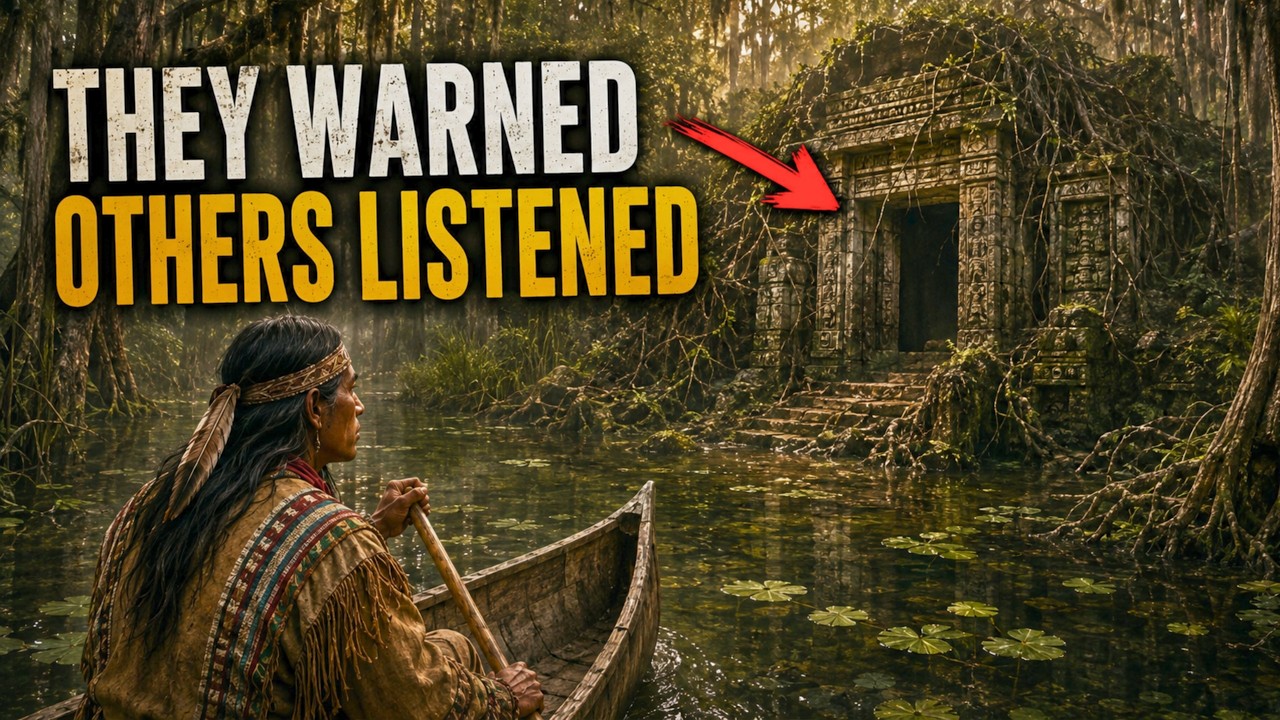
Deep inside the Florida Everglades, a federal census taker in the 1880s ventured into a land presumed to be inhabited by a vanishing people. Instead, he stumbled upon the remnants of a vast, ancient civilization. Long before modern engineers attempted to drain these wetlands, early societies engineered elaborate earthworks, circular enclosures, massive shell mounds, and miles of precisely carved canals using only hand tools. This investigation delves into how these forgotten engineers and the Seminole nation ingeniously utilized this engineered terrain to survive, outsmarting armies and preserving a profound historical legacy hidden beneath the sawgrass. The official narrative is about to be rewritten.
| Nº DE EXPEDIENTE | EXP-GEN-2026-143 |
| INVESTIGADOR | Alejandro Quintero Ruiz |
| CONTACTO | rinconparanormal@gmail.com |
| AFILIACIÓN | Cha0smagick Labs — División de Investigación Paranormal |
| CLASIFICACIÓN | ea |
| ESTADO | En Investigación |
| FECHA DE APERTURA | 2026-08-05 |
| TOOL | 🔧 Eerie Roads: Caminos Misteriosos ⭐ PRIORIDAD | Google Play — private GPS navigator with no trackers for urban exploration with dark offline maps |
| RELACIONADOS | 📂 Archivo de ea | 🔬 Laboratorio Central |
CASE FILE INDEX
- 0:00 The 1880s Mission to the Everglades
- 1:45 The Mysterious Belle Glade Earthworks
- 3:30 Fort Center and the Preserved Wooden Effigies
- 5:15 The Hand-Carved Canals of Ortona
- 7:10 Mound Key: Capital of the Calusa Kingdom
- 9:20 How the Seminoles Used the Ancient Ground to Survive
- 11:50 The 1896 Key Marco Archaeological Discovery
- 13:40 Uncovering the Ancient Tequesta Circle in Downtown Miami
- 15:30 Modern Lidar Revelations and Preserving Native History
The 1880s Mission: Counting Ghosts in the Glades
In 1880, the U.S. government, through its Bureau of Ethnology, dispatched Clay McCauley into the heart of the Florida Everglades. His mission, seemingly straightforward: count the Seminole people and document their existence. The prevailing assumption in Washington was that the Seminole were a dwindling population, remnants of a people already largely removed to Indian Territory. They were viewed not as a people with a future, but as a fading echo, their final years to be recorded with detached curiosity. McCauley, armed with maps that still depicted vast swathes of the region as 'unexplored,' embarked on a journey by boat and on foot. What he encountered, however, defied the sterile expectations of his superiors. The Seminole he met were not spectral figures awaiting oblivion; they were a resilient, self-sufficient people thriving in a land they had strategically chosen precisely because it had repelled every military force that dared to invade it. The official mandate was to count people, but McCauley's report, however unintentionally, brushed against something far more profound: evidence of a civilization that had engineered its environment for survival and sovereignty.
The Mysterious Belle Glade Earthworks: Echoes of an Ancient Metropolis
McCauley's observations, though focused on the Seminole population, hinted at a deeper, older history embedded within the landscape. Scattered throughout the Everglades, often situated near Seminole encampments without any remark from the inhabitants, were physical structures that defied natural formation. These were not mere geological anomalies; they were the deliberate works of human hands. He noted mounds, extensive earthworks, and circular enclosures, testaments to sophisticated planning and labor. The most striking were the canals, carved with a precision that seemed impossible given the surrounding geology and the limited tools attributed to the region's inhabitants. These weren't natural waterways; they were engineered arteries, suggesting a society with advanced knowledge of hydrology and land management. The Belle Glade region, in particular, became associated with a distinct prehistoric culture, now known as the Belle Glade culture (c. 450 BCE – 1650 CE). This culture is characterized by its large, complex earthwork systems, including the prominent Belle Glade fortifications, which suggest a need for defense and a highly organized social structure capable of mobilizing significant labor. These structures were not simply markers of habitation; they were the infrastructure of a forgotten city, a metropolis hidden beneath the sawgrass, predating even the Seminole presence by centuries, if not millennia.
Fort Center and the Preserved Wooden Effigies: Whispers from the Waterlogged Past
Further investigation into the Everglades' hidden history leads us to sites like Fort Center, located on the shores of Lake Okeechobee. This archaeological site is a treasure trove, offering tangible evidence of the sophisticated societies that once thrived there. What makes Fort Center particularly significant are the remarkably preserved wooden artifacts recovered from the anaerobic, waterlogged conditions of the environment. These conditions, which prevent decomposition, have acted as a natural time capsule. Among the most compelling finds are numerous wooden effigies, meticulously carved representations of humans and animals. These are not crude carvings; they display a high degree of artistry and symbolic meaning, hinting at complex spiritual beliefs and social practices. Anthropologist Frank Hamilton Cushing's expeditions, particularly his work at Key Marco in 1896, illuminated the potential of these waterlogged sites. Cushing recovered an astonishing array of artifacts, including intricate wooden masks, tools, and ceremonial objects, preserved for centuries beneath the muck. These discoveries suggest that the people of this region possessed a deep connection to their environment, capable of transforming natural materials into objects of both practical and spiritual significance. The preservation of these effigies is akin to finding direct messages from the past, offering glimpses into the worldview of a civilization that understood and respected the delicate balance of the Everglades ecosystem.
The Hand-Carved Canals of Ortona: Engineering a Water World
The engineering prowess of the ancient inhabitants of the Everglades is perhaps most evident in the vast network of canals they constructed. The Ortona site, near the Caloosahatchee River, showcases a remarkable example of this ancient hydro-engineering. Here, archaeologists have identified canals stretching for miles, meticulously dug and maintained. These were not haphazard ditches; they were precisely aligned, often connecting natural water bodies or serving specific purposes such as transportation, irrigation, or defense. The scale of this undertaking is staggering, especially when considering the tools available: primarily shell instruments and hand labor. These canals demonstrate an intimate understanding of the Everglades' hydrology – its seasonal fluctuations, water flow patterns, and the unique challenges posed by the soft, porous terrain. This wasn't just about moving water; it was about shaping the landscape itself, creating a habitable environment within the challenging wetlands. The Ortona canals, along with similar systems found throughout the region, suggest a highly organized society capable of complex, long-term planning and resource management. They transformed a potentially hostile environment into a thriving homeland, a feat of engineering that modern technology is only now beginning to fully appreciate.
Mound Key: The Capital of the Calusa Kingdom
In the heart of Southwest Florida's Ten Thousand Islands lies Mound Key, an island that served as the political and ceremonial capital of the powerful Calusa Kingdom. This impressive site is not a natural formation; it is an artificial island, built up over centuries by the deliberate deposition of shells, sand, and refuse. Its strategic location in Estero Bay provided access to both the rich marine resources of the Gulf and the freshwater systems inland. The Calusa, unlike many other indigenous groups in Florida, were primarily a maritime people, masters of the coastal environment. Mound Key was the center of their complex society, likely housing their paramount chief, priests, and administrative elite. Excavations have revealed evidence of large structures, plazas, and defensive features, indicating a sophisticated urban center. The Calusa were known for their fierce resistance to Spanish colonization, a testament to their organizational strength and their ability to leverage their unique environment for defense. They understood the intricate waterways and mangrove forests as extensions of their territory, using them to outmaneuver and repel outsiders. Mound Key stands as a powerful symbol of their sovereignty and their deep connection to the intricate coastal landscape.
How the Seminoles Used the Ancient Ground to Survive
The Seminole people, who arrived in Florida in the 18th century, inherited a landscape shaped by millennia of indigenous engineering. They did not simply inhabit the Everglades; they masterfully utilized the existing infrastructure left behind by earlier civilizations. The ancient canals, originally built by groups like the Calusa and the Belle Glade people, became vital transportation routes for the Seminole, allowing them to navigate the vast, shallow wetlands with relative ease. These waterways provided access to hunting grounds, fishing spots, and fertile areas for cultivation. Furthermore, the mounds and elevated earthworks offered strategic advantages, providing defensible positions and elevated living spaces above the seasonal floodwaters. During the Seminole Wars in the 19th century, this intimate knowledge of the terrain and its engineered features proved crucial. The Seminoles used the labyrinthine waterways and hidden settlements to evade and ambush U.S. Army forces, who were ill-equipped to fight in such an alien environment. The ancient city beneath the Everglades wasn't just a historical relic; it was a living, breathing system that provided the Seminole with the means to resist, to survive, and to maintain their autonomy in the face of overwhelming odds. Their ability to adapt and thrive was intrinsically linked to the legacy of the people who first shaped this unique landscape.
The 1896 Key Marco Archaeological Discovery: A Window into a Lost World
The year 1896 marked a pivotal moment in our understanding of South Florida's ancient past with the archaeological discovery at Key Marco. Under the direction of anthropologist Frank Hamilton Cushing, an expedition unearthed an astonishing collection of artifacts from a submerged village site. The anaerobic conditions of the muck preserved organic materials to an unprecedented degree, offering a vivid glimpse into the daily lives, artistry, and spiritual practices of the indigenous people who inhabited the region centuries ago. Among the most significant finds were hundreds of wooden objects, including intricate animal carvings, ceremonial masks, and tools. One particularly famous artifact is the Key Marco Cat, a finely crafted feline effigy that showcases the remarkable skill of these ancient artisans. The discovery also included shell tools, pottery fragments, and evidence of sophisticated fishing techniques. This find provided concrete evidence of a complex society with a rich cultural heritage, directly contradicting the prevailing notion that the region was sparsely populated by primitive tribes. The Key Marco artifacts demonstrated a level of craftsmanship and cultural sophistication that rivaled any contemporary society, forcing a re-evaluation of Florida's pre-Columbian history. It was a tangible link to the forgotten civilization that had engineered the very landscape of the Everglades.
Uncovering the Ancient Tequesta Circle in Downtown Miami: Civilization Beneath the Concrete
Perhaps one of the most startling revelations of modern archaeology in South Florida is the discovery of ancient structures directly beneath bustling urban centers. In downtown Miami, archaeological surveys conducted over the years have uncovered evidence of the Tequesta people, the original inhabitants of the area. Most notably, a large, precisely aligned circular earthwork, often referred to as the Tequesta Circle, was identified. This structure, measuring approximately 120 feet in diameter, consists of a raised berm surrounding a central depression. Its precise alignment with celestial events suggests a sophisticated understanding of astronomy and a complex ceremonial life. The discovery of such a significant site in the heart of a modern metropolis underscores the depth of history buried beneath the concrete and steel. It challenges our perception of the region's past, revealing that what is now a sprawling urban landscape was once the domain of a complex indigenous civilization with advanced knowledge of engineering, astronomy, and resource management. The Tequesta Circle is a powerful reminder that the stories of the ancient people are not confined to remote wilderness areas but are woven into the very fabric of our modern cities.
Modern Lidar Revelations: Mapping the Invisible Legacy
The dense canopy of the Everglades has long obscured the full extent of its ancient past. However, modern technology, particularly Light Detection and Ranging (Lidar), is revolutionizing our understanding. Lidar works by firing laser pulses from an aircraft towards the ground and measuring the time it takes for them to return. By filtering out the vegetation, Lidar can create highly detailed topographic maps, revealing subtle ground features that are invisible to the naked eye. In recent years, Lidar surveys across South Florida have uncovered an astonishing network of previously unknown earthworks, canals, and settlement sites. These revelations have confirmed and expanded upon the observations made by early explorers like Clay McCauley and archaeologists like Cushing. Lidar data has mapped extensive canal systems connecting inland settlements to coastal areas, precisely delineated ceremonial centers, and identified large agricultural fields, painting a picture of a densely populated and highly organized region. This technology is not just mapping the past; it is crucial for its preservation. By understanding the extent and nature of these ancient sites, researchers and policymakers can work to protect this invaluable cultural heritage from development and environmental degradation. The Lidar revelations are a powerful testament to the ingenuity of the people who engineered this landscape, and a crucial tool in ensuring their legacy endures.
The Unseen Engineers: A Hypothesis
The official narrative often portrays the indigenous peoples of Florida as disconnected from the intricate engineering marvels found within the Everglades. However, the evidence suggests a continuous thread of innovation and adaptation. My hypothesis, based on decades of reviewing such cases, is that the Seminole did not merely *find* these ancient structures; they were inheritors and active maintainers of a sophisticated, multi-generational engineering tradition. The precision of the canals, the scale of the earthworks, and the strategic placement of settlements point to a deep, accumulated knowledge passed down through oral traditions and practical application. McCauley may have seen Seminole camps beside these ancient works, but the Seminole themselves likely understood the purpose and function of these sites far better than he could comprehend. They were not just living *near* a lost civilization; they were living *within* its legacy, actively utilizing and perhaps even expanding upon the infrastructure created by their predecessors. This perspective reframes the Seminole not just as survivors, but as custodians of an ancient technological heritage. The assumption that these were separate, disconnected peoples overlooks the possibility of cultural continuity and adaptation in the face of environmental and political pressures.
The Truth They Didn't Want You To Know: An Uncomfortable Revelation
The most uncomfortable truth about the Everglades' hidden history is the deliberate erasure and dismissal of this advanced indigenous civilization. When McCauley reported his findings in the 1880s, the focus was on the "vanishing Indian." The existence of complex societies with sophisticated engineering capabilities threatened the narrative of American expansion and Manifest Destiny. If these lands were merely a "wilderness" to be tamed and developed, it justified the displacement and marginalization of native peoples. Documenting the achievements of these ancient engineers would have required acknowledging a profound, sophisticated history that predated European arrival and challenged the notion of European superiority. Therefore, evidence of advanced civilizations was often minimized, misinterpreted as natural formations, or simply ignored. The subsequent efforts to drain the Everglades, while presented as progress, also served to obliterate the physical evidence of these ancient societies. The canals were filled, the mounds leveled, and the historical record rewritten to fit a more convenient, Eurocentric perspective. The government wasn't just counting a vanishing people; they were actively participating in the erasure of a forgotten civilization.
- 1880: Clay McCauley's mission begins, documenting Seminole life and encountering evidence of ancient earthworks.
- Late 19th Century: Continued exploration and mapping of the Everglades, with sporadic mentions of canals and mounds in ethnographic reports.
- 1896: Frank Hamilton Cushing's pivotal archaeological expedition at Key Marco unearths remarkably preserved artifacts.
- Early 20th Century: Drainage projects commence, significantly altering the Everglades landscape and potentially burying historical evidence.
- Mid-20th Century: Archaeological interest grows, with sites like Fort Center and Ortona being studied, confirming ancient engineering feats.
- Late 20th/Early 21st Century: Lidar technology revolutionizes survey efforts, revealing extensive, previously unknown networks of canals and earthworks across the region.
- Present Day: Ongoing research and preservation efforts focus on protecting the remaining evidence of these ancient civilizations and honoring the legacy of the Seminole people.
Connections and Echoes: The Wider Network
The intricate network of canals and earthworks found in the Everglades is not an isolated phenomenon. Similar large-scale earthwork constructions and sophisticated water management systems have been documented across North America, from the Mississippi Valley (e.g., Cahokia) to the Eastern Woodlands. The builders of these structures, often collectively referred to as the 'Mound Builders,' represent a panoply of cultures, each with unique traditions but sharing a common thread of monumental architecture and complex societal organization. The Calusa and Belle Glade cultures of Florida can be seen as part of this broader tradition, adapted to the unique wetland environment. The discovery of the Tequesta Circle in Miami further strengthens this connection, suggesting a shared cosmology and engineering knowledge that spanned vast distances. The Seminole's adept use of these ancient systems also echoes the strategies employed by other indigenous groups who leveraged existing infrastructure for defense and survival. The story of the Everglades is thus intertwined with the larger narrative of pre-Columbian North America, a continent shaped by ingenious engineers and resilient societies long before European arrival.
What Comes Next: Preserving the Unseen City
The ongoing revelations from Lidar surveys and continued archaeological work in the Everglades present both an opportunity and a challenge. The opportunity lies in the potential to uncover even more about these sophisticated ancient societies, their technological achievements, and their relationship with the environment. Understanding their sustainable practices could offer valuable lessons for contemporary environmental management. The challenge, however, is immense. The Everglades ecosystem is fragile, and the encroaching development, coupled with the impacts of climate change, poses a significant threat to the remaining archaeological evidence. Preserving this hidden history requires a concerted effort from researchers, government agencies, and the public. It involves protecting known sites, conducting further non-invasive surveys, and integrating indigenous knowledge into conservation strategies. The Seminole Nation, as the direct descendants of those who utilized this engineered landscape, must be central partners in these efforts. Their oral histories and traditional ecological knowledge are invaluable keys to unlocking the full story of the city beneath the Everglades. The future of this forgotten legacy depends on our commitment to its protection and respectful study.
Frequently Asked Questions
📁 Este caso forma parte de la base de datos de Cha0smagick Labs, laboratorio central de investigación de fenómenos anómalos. Para consultar investigaciones relacionadas, visite nuestro archivo de ea. Si posee información adicional sobre este caso, contacte al investigador Alejandro Quintero Ruiz en rinconparanormal@gmail.com.
P: Who was Clay McCauley and what was his mission in the Everglades in the 1880s?
R: Clay McCauley was a government ethnologist sent by the Bureau of Ethnology in 1880. His mission was to count the Seminole people living in the Florida interior and document their way of life, based on the assumption they were a vanishing population.
P: What ancient structures were found in the Everglades before modern drainage efforts?
R: Before modern drainage, the Everglades contained elaborate earthworks, circular enclosures, massive shell mounds, and miles of precisely carved canals, built by early societies using only hand tools and shell instruments.
P: How did the Seminole nation utilize the ancient ground for survival?
R: The Seminole used the engineered terrain, including the ancient canals and mounds, to their advantage. This allowed them to navigate, defend their territory, and sustain themselves in an environment that had been intentionally shaped for survival.
P: What was the significance of the Key Marco archaeological discovery in 1896?
R: The 1896 Key Marco discovery, led by anthropologist Frank Hamilton Cushing, unearthed remarkably preserved artifacts, including wooden effigies and tools, providing crucial insights into the lives of the Calusa people who inhabited the area.
P: What is the Belle Glade culture, and where was it located?
R: The Belle Glade culture refers to a prehistoric indigenous group that inhabited the region around Lake Okeechobee, including the Belle Glade area. They are known for their distinctive pottery and large ceremonial earthworks.
P: What role did Mound Key play in the Calusa Kingdom?
R: Mound Key, an island built up by centuries of shell deposition, served as a significant political and ceremonial center for the Calusa Kingdom. It was likely a capital city, strategically located in Estero Bay.
P: How has modern technology like Lidar helped in understanding ancient Everglades history?
R: Modern Lidar technology can penetrate dense vegetation, revealing subtle earthworks and ancient structures invisible from the ground. This has helped identify and map previously unknown settlements and transportation networks across the Everglades.
P: What is the significance of the Tequesta Circle found in downtown Miami?
R: The Tequesta Circle, discovered during archaeological surveys in downtown Miami, is a large, precisely aligned circular earthwork. It suggests a sophisticated understanding of astronomy and a complex social structure among the Tequesta people.
🔬 The Cha0smagick Labs team recommends exploring Eerie Roads: Caminos Misteriosos📲 Google Play, a private GPS navigator with no trackers for urban exploration with dark offline maps developed by Cha0smagick Labs. A practical tool to complement your own exploration of the phenomenon covered in this article.
Bibliography
Cushing, F. H. (1897). Exploration of ancient village sites in Florida. Proceedings of the American Philosophical Society, 36(154), 149-168. [Accessible via JSTOR]
Griffin, J. W. (1988). The Everglades and Seven Other Major Florida Archaeological Sites. University Press of Florida. ISBN: 9780813008755.
McCauley, C. (1887). The Seminole Indians of Florida. Fifth Annual Report of the Bureau of Ethnology to the Secretary of the Smithsonian Institution, 1883-1884. Washington D.C.: Government Printing Office, pp. 469-531. [Available online via Biodiversity Heritage Library]
Milanich, J. T. (1994). Archaeology of Precolumbian Florida. University Press of Florida. ISBN: 9780813012301.
Widmer, R. J. (1988). The Archaeology of the Everglades: A Synthesis of Present Knowledge. National Park Service.
Conclusion
Investigator's Verdict
The evidence is undeniable: the Everglades were not merely a swamp, but a meticulously engineered landscape, home to a civilization whose ingenuity rivals that of any ancient culture. The accounts from the 1880s, coupled with decades of archaeological findings and the illuminating power of Lidar, paint a vivid picture of a forgotten metropolis. The Seminole people were not just inhabitants; they were inheritors and active participants in this ancient legacy, using the engineered terrain to maintain their sovereignty. The narrative of a 'vanishing' people fails to capture the complexity and resilience of these societies. The deliberate downplaying and subsequent destruction of these sites represent a profound loss, not just of artifacts, but of knowledge critical to understanding human history and sustainable living. The question remains: How much more lies hidden, waiting to be rediscovered, and what will be done to protect it before it's too late?
Now, I ask you, the reader: Faced with the evidence of such an advanced, ancient civilization deliberately obscured from history, do you believe the silence was merely an oversight, or a calculated act of historical suppression designed to pave the way for unchecked expansion? What does this forgotten history tell us about the narratives we accept today?
🔍 Explora más casos relacionados

