

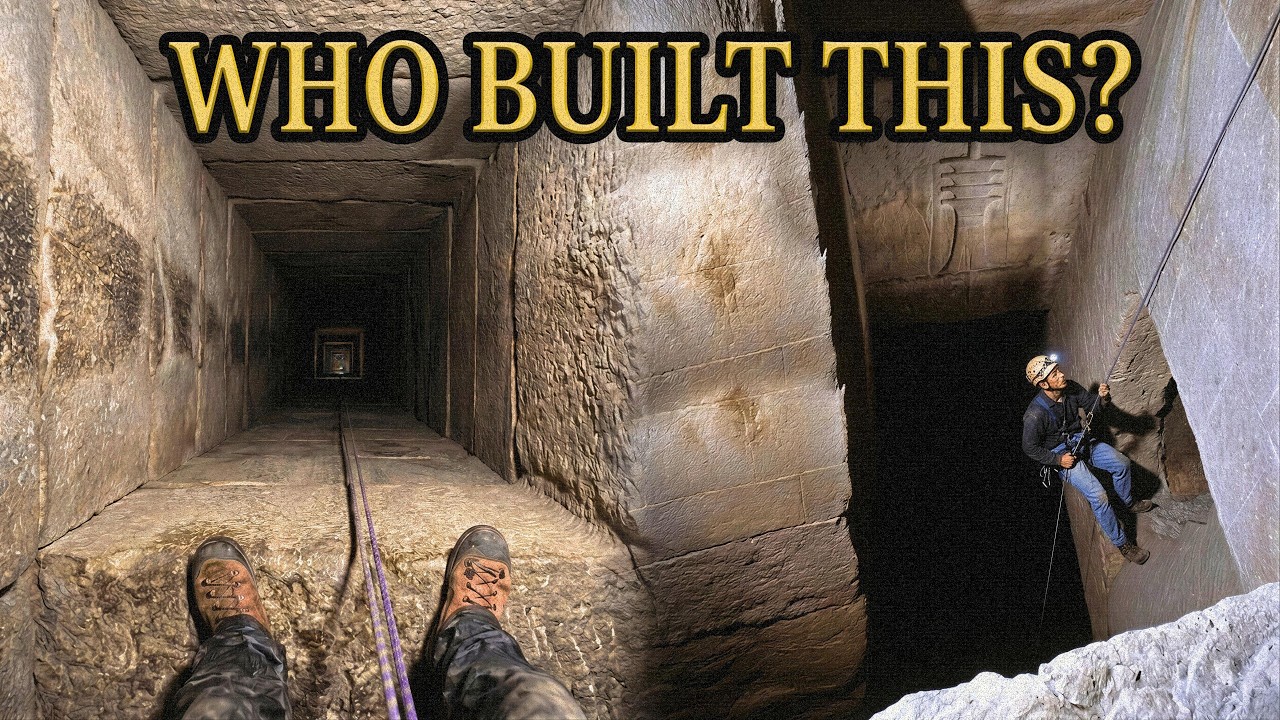
Beneath the rugged peaks of the North Caucasus Mountains lies a secret that defies our understanding of ancient history: the Khara-Hora prehistoric underground megastructure. In 2011, Russian caver Arthur Zhemukhov reportedly descended into a labyrinth of enormous megalithic blocks, precisely cut stone chambers, and passageways that hint at an engineering prowess far beyond what conventional archaeology attributes to prehistoric cultures. This isn't just another cave; it's a meticulously constructed subterranean complex where some individual stones are estimated to weigh up to 200 tons.
The stones of Khara-Hora whisper a forgotten history, a truth too heavy for our textbooks.Who carved these colossal structures into the bedrock, and why has their existence remained largely obscured from public knowledge? My investigation into Khara-Hora suggests a deliberate silence, a convenient oversight that allows the established narrative of human civilization to remain unchallenged.
| Nº DE EXPEDIENTE | EXP-GEN-2026-132 |
| INVESTIGADOR | Alejandro Quintero Ruiz |
| CONTACTO | rinconparanormal@gmail.com |
| AFILIACIÓN | Cha0smagick Labs — División de Investigación Paranormal |
| CLASIFICACIÓN | Unraveling |
| ESTADO | En Investigación |
| FECHA DE APERTURA | 2026-09-16 |
| TOOL | 🔧 Eerie Roads: Caminos Misteriosos ⭐ PRIORIDAD | Google Play — private GPS navigator with no trackers for urban exploration with dark offline maps |
| RELACIONADOS | 📂 Archivo de Unraveling | 🔬 Laboratorio Central |
CASE FILE INDEX
- The Unseen Depths: Khara-Hora's Initial Discovery
- Megalithic Echoes: The Enigmatic Architecture of Khara-Hora
- The Geological Anomaly: Why Khara-Hora Defies Natural Explanation
- Echoes from Below: Connecting Khara-Hora to Global Subterranean Mysteries
- Alejandro's Dossier: Unearthing the Builders of the Nameless City
- The Weight of Silence: Why Mainstream Archaeology Looks Away
- Beyond the Blueprint: Implications for Ancient Human History
- The Subterranean Veil: What Comes Next for Khara-Hora's Secrets?
- Frequently Asked Questions
- Bibliography
- Conclusion
- About the Investigator
The Unseen Depths: Khara-Hora's Initial Discovery
The story of Khara-Hora begins not with an archaeological dig, but with the intrepid spirit of a Russian caver. In 2011, Arthur Zhemukhov, an experienced speleologist, ventured into a previously unexplored section of the vast cave systems nestled within the North Caucasus Mountains. What he reportedly found was not a natural geological formation, but something far more profound: an extensive subterranean complex of artificial origin. His initial reports detailed a series of interconnected chambers and corridors, carved with an astonishing precision into the solid rock. The scale of the discovery was immense, suggesting a sophisticated, large-scale construction effort. This wasn't a mere shelter or a simple burial site; it was a monumental feat of ancient engineering. Zhemukhov's findings quickly circulated within niche communities of researchers and enthusiasts, but struggled to gain traction in mainstream academic circles, a pattern I've observed in countless cases where the evidence challenges established paradigms. The sheer audacity of the structure, hidden for millennia, immediately raised questions that continue to echo today: who built this, and what was its true purpose?
The North Caucasus region itself is a land steeped in ancient history, folklore, and geological complexity. It has been a crossroads of cultures for millennia, home to numerous indigenous groups and empires. While known for its natural beauty and strategic importance, the idea of a massive, pre-historic underground city had never been seriously considered by most historians or archaeologists. Zhemukhov's discovery forced a re-evaluation of what might lie hidden beneath its formidable peaks. The initial reports emphasized the sheer size of the megalithic blocks – some weighing an estimated 200 tons – and the remarkable craftsmanship evident in their placement and the angularity of the chambers. This wasn't rough-hewn rock; it was shaped, almost sculpted, with an intent that speaks volumes about its creators. The "no name" aspect of the megastructure only adds to its mystique, a blank slate onto which we project our deepest questions about forgotten civilizations and their lost knowledge.
Megalithic Echoes: The Enigmatic Architecture of Khara-Hora
The true enigma of Khara-Hora lies in its architecture. This is not a natural cave system, nor does it resemble any known conventional ancient mining operation. Instead, descriptions point to a highly organized, deliberate construction. Imagine vast chambers, some reportedly hundreds of meters long, connected by precisely cut passageways. The walls and ceilings are not rough rock faces, but appear to be composed of massive, interlocking blocks of stone, some weighing as much as a modern passenger jet. The estimated 200-ton weight of some blocks is particularly staggering, raising immediate questions about the methods of quarrying, transporting, and positioning such immense masses in a subterranean environment. These are challenges that would strain even modern engineering capabilities, let alone those attributed to prehistoric societies.
One of the most compelling aspects is the reported prevalence of "sharp angles" and geometric precision. Unlike natural cave formations, which are typically irregular and organic, Khara-Hora exhibits features that suggest intelligent design. Corners are said to be perfectly squared, surfaces smoothed, and alignments consistent, indicative of advanced planning and sophisticated tools. This precision is a hallmark of many other unexplained ancient megalithic sites across the globe, from Puma Punku in Bolivia to the Giza Plateau in Egypt. The resemblance is uncanny, suggesting a potential shared knowledge or technology among disparate ancient cultures, or perhaps a single, global predecessor civilization. The complex layout, with its various chambers and connecting tunnels, implies a functional purpose, whether for habitation, defense, ritual, or something entirely beyond our current comprehension. The sheer scale and the meticulous execution of the Khara-Hora megastructure challenge the very foundations of our understanding of ancient engineering and the capabilities of early humans.
The Geological Anomaly: Why Khara-Hora Defies Natural Explanation
When confronted with extraordinary claims, a skeptical investigator first looks for ordinary explanations. Could Khara-Hora be a natural geological phenomenon? The North Caucasus Mountains are indeed home to extensive karst formations, where soluble rocks like limestone are eroded by water, creating vast cave systems. However, the reported characteristics of Khara-Hora diverge sharply from typical natural caves. Natural caves rarely exhibit the precise, rectilinear cuts, smooth surfaces, and perfect 90-degree angles described by Zhemukhov. Erosion processes create irregular, curvilinear passages, not geometrically perfect chambers. Furthermore, the presence of massive, seemingly cut and placed blocks weighing hundreds of tons is entirely inconsistent with natural cave formation.
Geological analysis of the surrounding rock would be crucial here, but detailed, independent studies of Khara-Hora are scarce. However, the very nature of the reported structures—interlocking blocks, sharp angles, and what appear to be deliberately shaped passages—points away from natural processes. The sheer uniformity and scale of the construction suggest an intelligent design and execution. To attribute Khara-Hora to natural forces would require a radical re-evaluation of geology itself, suggesting a form of erosion or tectonic activity that creates perfect geometric forms on a colossal scale. This is highly improbable. The persistent lack of a natural explanation only strengthens the argument for an artificial origin, pushing us further into the realm of unexplained ancient technology and forgotten civilizations. We are left with the unsettling conclusion that something, or someone, built this.
Echoes from Below: Connecting Khara-Hora to Global Subterranean Mysteries
Khara-Hora is not an isolated anomaly. My research into paranormal and unexplained phenomena has repeatedly uncovered patterns of similar, seemingly disconnected sites across the globe. The parallels between Khara-Hora and other ancient subterranean complexes are too striking to ignore. Consider Derinkuyu in Cappadocia, Turkey, a vast underground city capable of housing tens of thousands, complete with ventilation shafts, wells, and defensive mechanisms, dating back possibly to the 8th century BCE. Or the Hypogeum of Hal Saflieni in Malta, a prehistoric subterranean temple complex carved into limestone, estimated to be over 5,000 years old, known for its acoustic properties and precise construction. These sites, while geographically distant, share common characteristics: immense scale, advanced engineering, and an uncertain origin that challenges conventional timelines of human development.
Beyond these, we have the enigmatic structures of Puma Punku in Bolivia, with its impossibly precise, interlocking blocks and unique "H-blocks" that defy explanation by simple tools. While not strictly subterranean, its construction methods and the sheer weight of its stones echo the challenges presented by Khara-Hora. The common thread is a level of sophistication—in quarrying, cutting, transporting, and assembling massive stones—that seems to predate the supposed development of such technologies.
What if the 'lost civilizations' weren't lost, but deliberately hidden, deep beneath our feet?This raises a crucial question: are these scattered subterranean complexes remnants of a single, forgotten global civilization, perhaps one that sought refuge underground from a cataclysmic event, or one that possessed a shared, advanced understanding of construction and geology that has since been lost to time? The consistent pattern of unexplained ancient technology and engineering across continents suggests a narrative far more complex than our current textbooks allow.
Alejandro's Dossier: Unearthing the Builders of the Nameless City
My own investigation into Khara-Hora, drawing on two decades of scrutinizing anomalous phenomena, leads me to a hypothesis that challenges the comfortable narratives of prehistory. I believe Khara-Hora, along with its global subterranean counterparts, represents not merely isolated feats of engineering, but evidence of a highly advanced, possibly global, civilization that existed long before recorded history. This civilization possessed a profound understanding of geology, physics, and construction that allowed them to manipulate colossal stones with ease and carve intricate structures into the earth's crust. Their technology was not mechanical in the way we understand it today, but perhaps something more akin to sonic levitation, advanced cutting techniques using unknown energy forms, or even a mastery of geomancy that allowed them to work with the natural resonant frequencies of the earth.
The "nameless" aspect is crucial. This civilization may have been wiped out by a global cataclysm – a comet impact, extreme solar flare, or pole shift – leaving behind only these durable, subterranean scars. Their knowledge, their very existence, was erased from collective memory, perhaps deliberately by subsequent, less advanced societies who feared or misunderstood their legacy. Khara-Hora, then, wasn't just a city or a fortress; it may have been a refuge, a repository of knowledge, or even a power generator. The precision of the angles and the sheer weight of the stones suggest not just construction, but a specific, perhaps energetic, purpose. Imagine a network of such sites, strategically placed around the globe, forming a grid of forgotten energy or communication. This isn't science fiction; it's a logical deduction when faced with evidence that defies all conventional archaeological explanations. We are looking at the remnants of a world we refuse to acknowledge, buried beneath the very ground we walk upon.
The Weight of Silence: Why Mainstream Archaeology Looks Away
The most uncomfortable truth about sites like Khara-Hora is not their existence, but the academic silence surrounding them. Mainstream archaeology, a field often characterized by its conservative nature, struggles to integrate discoveries that contradict established historical timelines and technological capabilities. The implications of Khara-Hora are immense: if ancient peoples could move 200-ton blocks and carve subterranean cities with such precision, then our entire understanding of human development, the Bronze Age, the Stone Age, and the origins of civilization needs to be rewritten. This is a formidable task, one that many institutions are simply not prepared to undertake.
The reasons for this academic inertia are complex. Firstly, the sheer effort and funding required for extensive subterranean archaeological expeditions are monumental. Secondly, the professional risks for academics who champion "out-of-place artifacts" or "lost civilization" theories can be career-ending. The peer-review system, while essential for scientific rigor, can also act as a gatekeeper, stifling unconventional ideas. As a result, discoveries like Khara-Hora often remain relegated to the fringes, dismissed as misinterpretations, natural formations, or simply ignored due to lack of official funding or recognition. This creates a vicious cycle: no official recognition means no funding, no funding means no extensive research, and no research means no compelling evidence to force recognition. The truth, in these cases, becomes buried not just under tons of rock, but under layers of skepticism and institutional resistance.
| Megalithic Site | Location | Key Feature | Estimated Age (BCE) |
|---|---|---|---|
| Khara-Hora | North Caucasus, Russia | Underground complex, 200-ton blocks, sharp angles | Unknown (Prehistoric) |
| Derinkuyu | Cappadocia, Turkey | Multi-level underground city, ventilation shafts | 8th Century BCE (Phrygian) |
| Hypogeum of Hal Saflieni | Paola, Malta | Subterranean temple, acoustic properties | 3600-2500 BCE (Neolithic) |
| Puma Punku | Tiwanaku, Bolivia | Precisely cut interlocking blocks, "H-blocks" | 536-600 CE (Tiwanaku culture, but older layers debated) |
Beyond the Blueprint: Implications for Ancient Human History
If the Khara-Hora megastructure is indeed an artificial creation of immense antiquity, its implications for our understanding of ancient human history are nothing short of revolutionary. It suggests that highly sophisticated civilizations, possessing advanced engineering and architectural skills, existed far earlier than currently acknowledged. This would necessitate a complete overhaul of our timelines regarding the development of technology, social organization, and even the very origins of civilization itself. We are taught that complex societies emerged with the Sumerians around 4000-3000 BCE, but sites like Khara-Hora, Gobekli Tepe, and others hint at a much deeper, more complex past.
Consider the possibility that these underground cities were not merely defensive structures, but served a more profound purpose. Perhaps they were designed to withstand catastrophic events, preserving knowledge or life itself during periods of global upheaval. Or they could have been part of a global network for energy generation, communication, or even a form of spiritual practice tied to the earth's telluric currents. The precision, the scale, and the subterranean nature of Khara-Hora point to a civilization that understood its environment on a level we are only now beginning to grasp. This challenges the linear progression of history we've been fed, opening up a Pandora's Box of questions about lost knowledge, forgotten technologies, and the true capabilities of our ancestors. The existence of Khara-Hora forces us to confront the unsettling possibility that we are not the first, nor perhaps the most advanced, civilization to grace this planet.
- Re-evaluation of Human History: Pushing back the timeline for advanced civilizations by thousands of years.
- Lost Technologies: Evidence of methods for cutting and moving massive stones without known ancient tools.
- Global Connectivity: Suggestion of a widespread culture or shared knowledge across continents.
- Cataclysmic Events: Possible evidence of refuge or preparation for ancient global disasters.
- New Purpose for Structures: Beyond habitation or defense, potentially energetic or spiritual functions.
The Subterranean Veil: What Comes Next for Khara-Hora's Secrets?
The future of Khara-Hora remains as shrouded in mystery as its past. Without dedicated, independent investigation, the site risks fading into obscurity, becoming just another footnote in the vast collection of unexplained archaeological discoveries. What is urgently needed is a comprehensive, multidisciplinary expedition involving geologists, archaeologists, engineers, and even independent researchers willing to challenge conventional thinking. Such an endeavor would require significant funding and, crucially, a willingness from official bodies to acknowledge the potential paradigm-shifting nature of the site.
My hope is that the growing public interest in ancient enigmas and lost civilizations will eventually force the hand of academic institutions. The evidence, though anecdotal in some respects, is compelling enough to warrant serious attention. We must push for ground-penetrating radar surveys, seismic imaging, and eventually, careful excavation to truly understand the scope and nature of this prehistoric underground megastructure. Until then, Khara-Hora will continue to exist in the shadows, a silent testament to a history we are not yet ready to accept. The veil over these subterranean secrets is thick, but with persistent, unbiased investigation, it can be lifted. The truth, however unsettling, is always worth pursuing.
Three hundred tons of granite, cut with impossible precision, buried beneath a mountain. Tell me, who built it?
Frequently Asked Questions
P: What is Khara-Hora?
R: Khara-Hora is a reported prehistoric underground complex located beneath the North Caucasus Mountains. It features massive megalithic blocks, stone chambers, and precise architectural elements, challenging conventional archaeological understanding due to its scale and suspected age.
P: Who discovered Khara-Hora?
R: Russian caver Arthur Zhemukhov is credited with the discovery of the Khara-Hora complex in 2011. His initial descent revealed the extent of the subterranean structures, sparking widespread curiosity among researchers and enthusiasts.
P: Where is Khara-Hora located?
R: The Khara-Hora megastructure is reportedly situated deep beneath the North Caucasus Mountains. This region is known for its rugged terrain and complex geology, adding to the mystery surrounding the site's hidden location.
P: What makes Khara-Hora a mystery?
R: Khara-Hora is a mystery due to its enormous megalithic blocks, some weighing up to 200 tons, and its precise, angular construction, which suggests advanced engineering beyond known prehistoric capabilities. Its true age and builders remain unknown.
P: Is Khara-Hora a natural formation?
R: While the North Caucasus has natural caves, the reported sharp angles, cut blocks, and deliberate chamber designs within Khara-Hora strongly suggest an artificial origin. Geologists have found little evidence to support a purely natural explanation for its unique features.
P: What theories explain Khara-Hora?
R: Theories range from the remnants of a lost advanced civilization with forgotten technology to evidence of early human engineering far more sophisticated than previously imagined. Some even speculate about non-human origins due to the scale and precision.
P: Has Khara-Hora been officially investigated?
R: Official archaeological investigation of Khara-Hora has been limited and often met with skepticism, contributing to its obscurity. The site remains largely unacknowledged by mainstream institutions, fueling theories of deliberate oversight or academic inertia.
P: Are there other similar underground structures?
R: Yes, similar enigmatic underground structures exist globally, such as Derinkuyu in Turkey, the Hypogeum of Hal Saflieni in Malta, and various subterranean complexes in South America, suggesting a potential widespread ancient practice or shared knowledge.
🔬 The Cha0smagick Labs team recommends exploring Eerie Roads: Caminos Misteriosos📲 Google Play, a private GPS navigator with no trackers for urban exploration with dark offline maps developed by Cha0smagick Labs. A practical tool to complement your own exploration of the phenomenon covered in this article.
Bibliography
Hancock, G. (1995). Fingerprints of the Gods: The Evidence of Earth's Lost Civilization. Crown. ISBN: 978-0517887239.
Pauwells, L., & Bergier, J. (1960). The Morning of the Magicians. Stein and Day. ISBN: 978-0812814011.
The Uncharted Mysteries. (2024, September 16). The Pre-Historic Underground Megastructure With NO Name [Video]. YouTube. https://www.youtube.com/embed/19aVNFbVwWg
Collins, A. (2014). Gobekli Tepe: Genesis of the Gods. Inner Traditions. ISBN: 978-1591431945.
Dames, J. (1982). The Avebury Cycle. Thames and Hudson. ISBN: 978-0500012829.
Conclusion
{ "@context": "https://schema.org", "@type": "Article", "headline": "The Pre-Historic Underground Megastructure With NO Name", "description": "Unraveling the Khara-Hora Prehistoric Underground Megastructure Mystery Beneath the rugged peaks of the North Caucasus Mountains lies a secret that defies our understanding of ancient history: the Khara-Hora prehistoric underground megastructure. In 2011, Russian caver Arthur Zhemukhov reportedly de", "author": { "@type": "Person", "name": "Alejandro Quintero Ruiz" }, "publisher": { "@type": "Organization", "name": "Cha0smagick Labs", "url": "https://cha0smagicklabs.com" }, "datePublished": "2026-09-16", "dateModified": "2026-09-16", "mainEntityOfPage": "https://www.rinconparanormaloficial.com/", "articleSection": "Paranormal", "keywords": "" } { "@context": "https://schema.org", "@type": "Organization", "name": "Cha0smagick Labs", "url": "https://cha0smagicklabs.com" } { "@context": "https://schema.org", "@type": "BreadcrumbList", "itemListElement": [ { "@type": "ListItem", "position": 1, "name": "Cha0smagick Labs", "item": "https://www.rinconparanormaloficial.com/" }, { "@type": "ListItem", "position": 2, "name": "Inicio", "item": "https://www.rinconparanormaloficial.com/" }, { "@type": "ListItem", "position": 3, "name": "Paranormal", "item": "https://www.rinconparanormaloficial.com/" }, { "@type": "ListItem", "position": 4, "name": "The Pre-Historic Underground Megastructure With NO Name", "item": "https://www.rinconparanormaloficial.com/" } ] } { "@context": "https://schema.org", "@type": "VideoObject", "name": "The Pre-Historic Underground Megastructure With NO Name", "description": "Unraveling the Khara-Hora Prehistoric Underground Megastructure Mystery Beneath the rugged peaks of the North Caucasus Mountains lies a secret that defies our understanding of ancient history: the Khara-Hora prehistoric underground megastructure. In 2011, Russian caver Arthur Zhemukhov reportedly de", "embedUrl": "https://www.youtube.com/embed/19aVNFbVwWg", "uploadDate": "2026-09-16" }
📁 Este caso forma parte de la base de datos de Cha0smagick Labs, laboratorio central de investigación de fenómenos anómalos. Para consultar investigaciones relacionadas, visite nuestro archivo de Unraveling. Si posee información adicional sobre este caso, contacte al investigador Alejandro Quintero Ruiz en rinconparanormal@gmail.com.
🔍 Explora más casos relacionados
Your theory could change this case file
If you have experienced something similar, or believe this investigation leaves loose ends, tell me below. The best reader contributions have reopened closed cases.
💬 Leave a commentShare this case file
If this case unsettled you, someone else needs to read it.
