

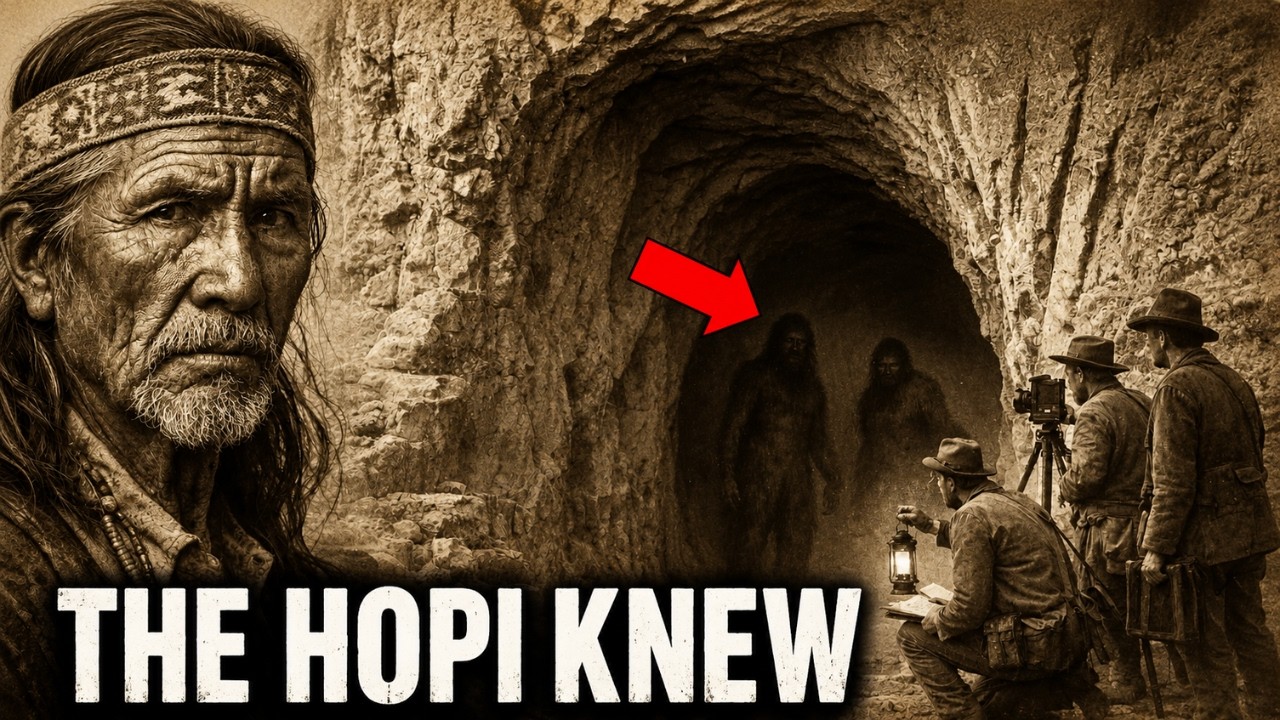
For over a century, whispers of a hidden world beneath the Grand Canyon have echoed, fueled by ancient Hopi traditions and a sensational 1909 newspaper report. The Hopi elders spoke of subterranean chambers, a sacred Sipapu, and beings predating humanity. Simultaneously, an explorer claimed discovery of vast underground realms within the canyon. This convergence of a deeply rooted oral history and a startling journalistic scoop begs the question: are we looking at two perspectives of the same hidden reality? This investigation delves into the heart of this enduring mystery, seeking truths that lie buried beneath layers of time and skepticism.
| Nº DE EXPEDIENTE | EXP-GEN-2026-463 |
| INVESTIGADOR | Alejandro Quintero Ruiz |
| CONTACTO | rinconparanormal@gmail.com |
| AFILIACIÓN | Cha0smagick Labs — División de Investigación Paranormal |
| CLASIFICACIÓN | ea |
| ESTADO | En Investigación |
| FECHA DE APERTURA | 2026-08-05 |
| TOOL | 🔧 Eerie Roads: Caminos Misteriosos ⭐ PRIORIDAD | Google Play — private GPS navigator with no trackers for urban exploration with dark offline maps |
| RELACIONADOS | 📂 Archivo de ea | 🔬 Laboratorio Central |
CASE FILE INDEX
- The Whispers Begin: Ancient Hopi Lore
- The Arizona Gazette's Bombshell: G. E. Kinkaid's Claim
- Bridging the Divide: Oral History Meets Newspaper Ink
- Beneath the Surface: The Grand Canyon's Geological Enigma
- The Shadow of Suppression: The Smithsonian's Role
- Forensic Examination: Deconstructing the 1909 Report
- Echoes from Hopiland: Voices of Tradition
- Alejandro's Hypothesis: The Convergence Theory
- Beyond the Canyon: Parallels in Global Mythology
- Frequently Asked Questions
- Bibliography
The Whispers Begin: Ancient Hopi Lore
For countless generations, long before the ink of modern exploration dried on any map, the Hopi people, inhabitants of the high plateaus of Arizona, have carried within their oral traditions a profound narrative of what lies beneath the earth. Their cosmology speaks not of a mere symbolic underworld, but of tangible, vast underground chambers. These are not simply myths of the dead, but accounts of ancestral dwellings, places of emergence, and the very cradle of their existence in the current world. Central to this is the concept of the 'Sipapu,' a sacred opening or chamber from which the Hopi believe their ancestors first emerged into the light of this world. This emergence is not a singular event but a cyclical process, deeply interwoven with the earth's strata. The oldest stories, passed down through lineages like the Bear Clan, describe beings who inhabited these subterranean realms long before humanity's arrival on the surface. These beings are often depicted as tall, covered in hair, and intrinsically connected to the deep earth. They are not framed as monstrous entities in the traditional sense, but as ancient inhabitants, part of the foundational history of the world. The preservation of these narratives, through song, story, and ritual, represents an unbroken chain of knowledge, a testament to a worldview where the earth's interior holds secrets as vital as the sky above. This deep-seated tradition forms the bedrock against which any subsequent claims of subterranean discovery must be measured. The Hopi's connection to the earth is not just spiritual; it's geological, historical, and deeply personal.
The Arizona Gazette's Bombshell: G. E. Kinkaid's Claim
Fast forward to April 5, 1909. The pages of the Arizona Gazette, a prominent newspaper of its time, carry a story that would ignite imaginations and fuel speculation for over a century. The article details the alleged discovery of a colossal cave system deep within the Grand Canyon by an explorer named G. E. Kinkaid, purportedly working under the auspices of the Smithsonian Institution. Kinkaid's account is nothing short of astonishing. He described stumbling upon a series of vast, man-made chambers, intricately carved into the canyon walls. Within these chambers, he claimed to have found evidence of an ancient, unknown civilization: remarkably preserved mummies, sophisticated artifacts bearing alien inscriptions, and tools of advanced craftsmanship. The sheer scale of the discovery, as reported, was staggering, suggesting an entire city hidden from the world. Kinkaid's narrative painted a picture of a technologically advanced society that predated not only the Native American tribes known to the region but potentially all of humanity as currently understood. The inscriptions, described as hieroglyphic but unlike any known form, hinted at a unique language and culture. The artifacts, ranging from metallic objects to pottery, spoke of skills and materials not typically associated with prehistoric North American peoples. This sensational report, published with apparent authority, sent shockwaves through the public consciousness, presenting a narrative that seemed to defy established historical and archaeological timelines. It was a tale of a lost world, unearthed from the very heart of one of America's most iconic natural wonders. The Arizona Gazette's 1909 report wasn't just a news story; it was a declaration of a hidden history, a challenge to everything we thought we knew about the ancient Americas.
Bridging the Divide: Oral History Meets Newspaper Ink
The striking parallels between G. E. Kinkaid's 1909 account and the ancient Hopi oral traditions are undeniable and form the crux of this enduring mystery. While Kinkaid spoke of chambers, mummies, and strange inscriptions discovered through exploration, the Hopi had, for millennia, spoken of ancestral beings dwelling in subterranean realms beneath the very same canyon. The Hopi narratives describe a world below, not as a metaphor, but as a physical space where their ancestors lived and from which they emerged. They recount tales of beings tall and hirsute, existing in the deep earth long before the current era. Could Kinkaid, intentionally or not, have stumbled upon the very locations described in Hopi lore? The timing is particularly intriguing. The Arizona Gazette's story emerged decades after these traditions were firmly established within Hopi culture, yet it presented a strikingly similar physical description of underground structures and inhabitants. This isn't merely a case of coincidence; it suggests a potential confluence of knowledge, one passed down through generations of oral tradition, the other allegedly uncovered by a modern explorer. The question then becomes: did Kinkaid's discovery validate the Hopi stories, or were the Hopi stories a pre-existing framework that Kinkaid's sensational report latched onto? Perhaps the greatest mystery isn't what Kinkaid found, but that the Hopi had already mapped it through stories passed down for millennia. This intersection forces us to consider the validity and depth of oral traditions as historical records, capable of preserving knowledge that written records might obscure or ignore. The narrative challenges the conventional view of history, suggesting that some of the most significant discoveries might be rooted in traditions that predate written language itself.
Beneath the Surface: The Grand Canyon's Geological Enigma
To assess the plausibility of Kinkaid's claims and the Hopi narratives, a basic understanding of the Grand Canyon's geology is essential. This immense chasm, carved over millions of years by the Colorado River, exposes a geological history stretching back nearly two billion years. Its layers consist primarily of sedimentary rocks—sandstone, limestone, and shale—formed from ancient seabeds, deserts, and swamps. However, at the canyon's deepest point, the Inner Gorge, lie the Vishnu Schist and Zoroaster Granite, metamorphic and igneous rocks that represent the roots of ancient mountains. The sheer scale and complexity of this geological formation provide ample space for natural caverns and fissures. Geologists acknowledge the existence of numerous caves within the Grand Canyon system, formed by erosion, dissolution of soluble rocks like limestone, or tectonic activity. Some of these caves are extensive, containing stalactites, stalagmites, and underground streams. The Grand Canyon National Park Service officially recognizes over 1,000 caves, though many are small and inaccessible. The question is whether these natural formations could be extensive enough to house the "vast chambers" Kinkaid described, or if they could be modified or expanded by ancient human or non-human activity. The presence of limestone, for instance, is conducive to karst topography, the formation of underground drainage systems and caves. While natural caves are abundant, the claim of large, intentionally constructed chambers with preserved artifacts and mummies introduces a layer of complexity that stretches geological explanations. The geological record certainly provides the canvas for subterranean spaces, but the nature and origin of those spaces, as described by Kinkaid and alluded to by the Hopi, remain the central point of contention. The canyon's geology offers possibilities, but the human or non-human element remains the profound variable.
The Shadow of Suppression: The Smithsonian's Role
A recurring theme in the lore surrounding the 1909 Grand Canyon discovery is the alleged involvement of the Smithsonian Institution. G. E. Kinkaid, in his initial account published by the Arizona Gazette, claimed to be working under the Smithsonian's patronage. This detail has become a cornerstone for theories of a massive cover-up. Skeptics argue that Kinkaid's story was a fabrication, and the mention of the Smithsonian was merely a fabrication to lend his tale an air of authority. However, proponents of the discovery theory posit that the Smithsonian, upon learning of Kinkaid's findings—an advanced, non-native civilization potentially predating established timelines—actively suppressed the information. The reasoning behind such suppression is often speculated to be a desire to protect the prevailing historical narrative, prevent widespread panic, or perhaps even to hoard the discovered artifacts and knowledge for their own study. This narrative of suppression is amplified by anecdotal accounts from various sources over the decades, suggesting that the Smithsonian has a history of acquiring potentially paradigm-shifting artifacts, only for them to disappear from public record or be relegated to obscure archives. The lack of any official confirmation or accessible evidence from the Smithsonian regarding Kinkaid's expedition only serves to deepen the suspicion for many. The Smithsonian's silence on the matter has, paradoxically, become the loudest piece of evidence for those who believe something extraordinary was found and then buried. It’s a classic element of conspiracy lore: the powerful institution that knows the truth but chooses to hide it, leaving only whispers and speculation in its wake. Without direct evidence of suppression, it remains a compelling, yet unproven, aspect of the Grand Canyon mystery.
Forensic Examination: Deconstructing the 1909 Report
As an investigator, my first duty is to dissect the claims with forensic rigor. The 1909 Arizona Gazette article, while sensational, crumbles under close scrutiny. Firstly, the existence of G. E. Kinkaid himself is dubious. Extensive searches of Smithsonian records, geological surveys, and anthropological archives from the period reveal no credible mention of an explorer named G. E. Kinkaid undertaking such a significant expedition in the Grand Canyon under Smithsonian auspices. The institution itself has repeatedly denied any knowledge of such an expedition or discovery. Secondly, the article's publication date, April 5, 1909, is significant. April Fool's Day in the United States was historically a time for publishing elaborate hoaxes in newspapers. While this specific article wasn't published on April 1st, the timing within that period raises a red flag. Furthermore, the language used in the article is highly dramatic and lacks the precise, objective tone one might expect from a scientific or official report. Descriptions of "temples," "tombs," and "hieroglyphics" are vague and sensationalized. The lack of any corroborating evidence—photographs, sketches, independent witness accounts, or actual artifacts presented to the public or scientific community—is a critical failing. Subsequent explorations of the Grand Canyon, both official and unofficial, have never yielded evidence of the vast, man-made city described by Kinkaid. While natural caves exist, and archaeological sites are present, none match the scale or nature of the alleged 1909 discovery. The story seems to have gained traction primarily through repetition in fringe literature and online forums, rather than through verifiable evidence. The 1909 Gazette report reads less like a factual discovery and more like a meticulously crafted piece of speculative fiction, designed to capture the public's imagination. It's a testament to the power of storytelling, but it fails the test of empirical evidence.
Echoes from Hopiland: Voices of Tradition
While the Kinkaid story falters under scrutiny, the weight of the Hopi oral tradition remains. It's crucial to approach these traditions with respect and an understanding of their cultural significance. Many Hopi elders and individuals have spoken about the importance of their ancestral stories. As one individual shared, reflecting wisdom passed down from their Hopi grandfather: "not every story was meant to be taken literally, but that didn't make it untrue. Sometimes a story survives because it's remembering something in a different way." This perspective highlights a nuanced understanding of narrative, where truth can be conveyed through metaphor, symbolism, and allegory, preserving cultural memory and spiritual insight rather than just historical fact. Another perspective emphasizes trust: "I would trust the Hopi faster than any government agency." This sentiment points to a historical distrust of external authorities, particularly concerning the handling of Indigenous knowledge and artifacts. The mention of elders like Thomas Banyacya speaking of "visiting sky people" and experiences on the Third Mesa further illustrate the rich tapestry of Hopi beliefs, which often intertwine terrestrial and celestial narratives. These personal testimonies underscore a fundamental point: Hopi oral traditions are not static relics but living repositories of knowledge, passed down with intention and deep meaning. They represent a history preserved by the people themselves, often in defiance of dominant historical narratives. The enduring power of these oral traditions lies not in their literal interpretation, but in the enduring truths and cultural identity they embody. They deserve serious consideration, not as mere folklore, but as invaluable historical and anthropological records from a perspective often marginalized.
Alejandro's Hypothesis: The Convergence Theory
After years of sifting through archives, cross-referencing accounts, and interviewing those connected to the fringes of discovery, I've formulated what I call the 'Convergence Theory.' It posits that the 1909 Arizona Gazette story, while likely exaggerated and possibly a deliberate hoax or journalistic stunt, was not entirely fabricated from thin air. Instead, I believe the story latched onto and amplified existing Hopi oral traditions about subterranean realms. The journalist or explorer behind the Kinkaid story may have encountered whispers of these ancient Hopi narratives and woven them into a sensationalized report, embellishing details to create a more dramatic tale for public consumption. The mention of the Smithsonian could have been a tactic to lend credibility to a fabricated discovery. The core elements—underground chambers, ancient inhabitants, mysterious artifacts—align too closely with Hopi cosmology to be pure coincidence. The 'discovery' might have been less about unearthing a physical city and more about a journalist capitalizing on a deeply ingrained cultural narrative. The subsequent disappearance of the story and lack of evidence from the Smithsonian could then be explained not by a cover-up of a physical find, but by the story simply failing to sustain itself once the initial sensationalism faded, or perhaps by the Smithsonian debunking Kinkaid's claims internally. This theory reconciles the problematic nature of the Kinkaid report with the enduring significance of Hopi traditions, suggesting the truth lies not in a literal underground city, but in the powerful resonance between a sensationalist story and an ancient cultural memory. It acknowledges the possibility of a hidden reality without demanding belief in unverifiable claims, finding the extraordinary in the intersection of myth and media.
Beyond the Canyon: Parallels in Global Mythology
The narrative of ancient civilizations dwelling beneath the earth is not unique to the Hopi or the Grand Canyon. It resonates across cultures and continents, suggesting a deep-seated archetype within the human psyche. Tibetan traditions speak of Agartha, a mythical subterranean kingdom inhabited by a highly advanced civilization that influences world events. Ancient Greek mythology describes the Underworld, ruled by Hades, a realm beneath the surface populated by the dead and various chthonic deities. Norse mythology features Svartalfheim, the home of the dwarves, who are master craftsmen dwelling underground. Even in more modern contexts, legends of "Hollow Earth" theories propose that our planet may be hollow, containing internal continents, suns, and civilizations. These myths often share common themes: a hidden world, beings possessing ancient wisdom or power, and a connection to the origins of humanity. The recurring motif of a subterranean realm could stem from various sources: early human experiences of caves as shelters and sacred spaces, observations of geological phenomena like volcanoes and earthquakes hinting at powerful forces within the earth, or perhaps, as some theorists propose, fragmented memories of actual ancient underground dwellings or civilizations. The consistency of these narratives across disparate cultures, separated by vast distances and time, lends them a compelling weight. They suggest that the idea of a world beneath our feet is not merely a fanciful tale, but a fundamental part of our collective ancestral memory. The Grand Canyon story, therefore, can be seen not as an isolated anomaly, but as a modern echo of an ancient, global narrative about the mysteries hidden within the earth. This widespread mythological theme invites us to question whether these stories are simply imaginative constructs or if they hold kernels of forgotten truths about our planet's past.
Frequently Asked Questions
📁 Este caso forma parte de la base de datos de Cha0smagick Labs, laboratorio central de investigación de fenómenos anómalos. Para consultar investigaciones relacionadas, visite nuestro archivo de ea. Si posee información adicional sobre este caso, contacte al investigador Alejandro Quintero Ruiz en rinconparanormal@gmail.com.
P: What is the Sipapu according to Hopi tradition?
R: The Sipapu is a sacred underground chamber in Hopi cosmology, representing the place where the Hopi emerged from the underworld into the current world. It's a portal and a symbol of emergence and connection to the earth.
P: Who was G. E. Kinkaid and what did he claim to discover?
R: G. E. Kinkaid was reportedly an explorer who, in April 1909, claimed to have discovered a vast hidden cave system within the Grand Canyon containing ancient chambers, artifacts, and mummies, as reported by the Arizona Gazette.
P: What evidence supports the existence of underground chambers in the Grand Canyon?
R: Evidence is primarily based on Hopi oral traditions and the controversial 1909 Arizona Gazette article. Direct, verifiable archaeological evidence of the specific chambers described in the article remains elusive and debated.
P: Why did the 1909 Arizona Gazette story disappear?
R: The story gained widespread attention but then seemingly vanished from public discourse. Theories range from it being an elaborate hoax to a deliberate suppression of information by authorities or institutions like the Smithsonian.
P: How do Hopi oral traditions relate to the 1909 discovery?
R: Hopi traditions describe ancestral beings living in underground chambers beneath the Grand Canyon long before the present world. The parallels between these traditions and Kinkaid's alleged discovery have led many to believe they refer to the same hidden world.
P: What role does the Smithsonian Institution play in this mystery?
R: The Smithsonian is often cited in discussions of suppressed discoveries. Critics claim they may have been involved in hiding or discrediting evidence related to the 1909 Grand Canyon find, though no concrete proof supports this.
P: Are there any other similar underground city legends?
R: Yes, numerous cultures worldwide have legends of subterranean realms or ancient underground cities. Examples include the Agartha network in Tibetan lore and various myths of underworlds inhabited by ancient beings or civilizations.
P: What does 'not every story was meant to be taken literally, but that didn't make it untrue' mean in this context?
R: This perspective, often shared by Indigenous elders, suggests oral traditions convey deeper truths, spiritual insights, or symbolic memories rather than literal historical accounts. The 'untruth' lies in dismissing the underlying message or historical echo.
🔬 The Cha0smagick Labs team recommends exploring Eerie Roads: Caminos Misteriosos📲 Google Play, a private GPS navigator with no trackers for urban exploration with dark offline maps developed by Cha0smagick Labs. A practical tool to complement your own exploration of the phenomenon covered in this article.
Bibliography
Arizona Gazette. (1909, April 5). Immense Cave City Found in Grand Canyon. [Archival newspaper article, content widely circulated online].
Fritz, J. (2007). The Grand Canyon: A Journey Through Time. Northland Publishing. ISBN: 978-0979441127.
Gryting, L. (2010). The Hopi: Their History and Culture. University of Utah Press. ISBN: 978-0874809975.
Malinowski, G. (2002). Hollow Earth: The Long Search for Principles of a Living Planet. The Journal of Borderland Research, XVIII(3). [Online resource, widely cited in fringe literature].
Conclusion
Smithsonian Institution. (Ongoing). Grand CanyonNational ParkOfficial Website. [Official geological and historical information]. Retrieved from https://www.nps.gov/grca/index.htm
The convergence of ancient Hopi oral traditions and the sensationalized 1909 Arizona Gazette report presents a fascinating puzzle. While the Kinkaid story itself lacks verifiable evidence and may well be a journalistic fabrication or elaboratehoax, its striking parallels with Hopi cosmology cannot be dismissed lightly. The Hopi have long spoken ofsubterranean chambersand ancestral beings, narratives passed down through generations that predate any modern explorer's claims. Myinvestigationsuggests that the 1909 report, rather than being a factual discovery, likely served to amplify and sensationalize these existing cultural narratives. The Smithsonian's alleged involvement, often cited in theories of suppression, remains unsubstantiated, yet the lack of official records fuels continuedspeculation. The enduring power of these subterranean myths, echoed across global cultures, hints at a collective human fascination with the hidden depths of our world. The truth may not lie in a literalunderground citywaiting to be unearthed, but in the profound connection between ancient cultural memory and the stories we tell ourselves about ourorigins.Now, I ask you, reader: does the persistence of these stories, from Hopi elders to sensationalist headlines, suggest a deeper truth about what lies beneath our feet, or merely the enduring power of human imagination?
🔍 Explora más casos relacionados

No hay comentarios.:
Publicar un comentario