

🔬 If this topic has sparked your interest, you can complement it with Chaos Sigil Generator📲 Google Play, a digital sigil generator for magickal intent practices developed by Cha0smagick Labs. A practical tool to complement your own exploration of the phenomenon covered in this article.
The Essex Witch Bottle, discovered in 2004, was sealed and hidden within a 17th-century hearth. This isn't just folklore; these are real objects found by excavators, builders, and inspectors, objects that defy easy explanation and continue to unsettle researchers today. Some artifacts contain biological material and were deliberately hidden, suggesting they were never meant to be found again.
| Nº DE EXPEDIENTE | EXP-GEN-2026-143 |
| INVESTIGADOR | Alejandro Quintero Ruiz |
| CONTACTO | rinconparanormal@gmail.com |
| AFILIACIÓN | Cha0smagick Labs — División de Investigación Paranormal |
| CLASIFICACIÓN | Artifact |
| ESTADO | En Investigación |
| FECHA DE APERTURA | 2026-07-18 |
| TOOL | 🔧 Chaos Sigil Generator | Google Play — digital sigil generator for magickal intent practices |
| RELACIONADOS | 📂 Archivo de Artifact | 🔬 Laboratorio Central |
CASE FILE INDEX
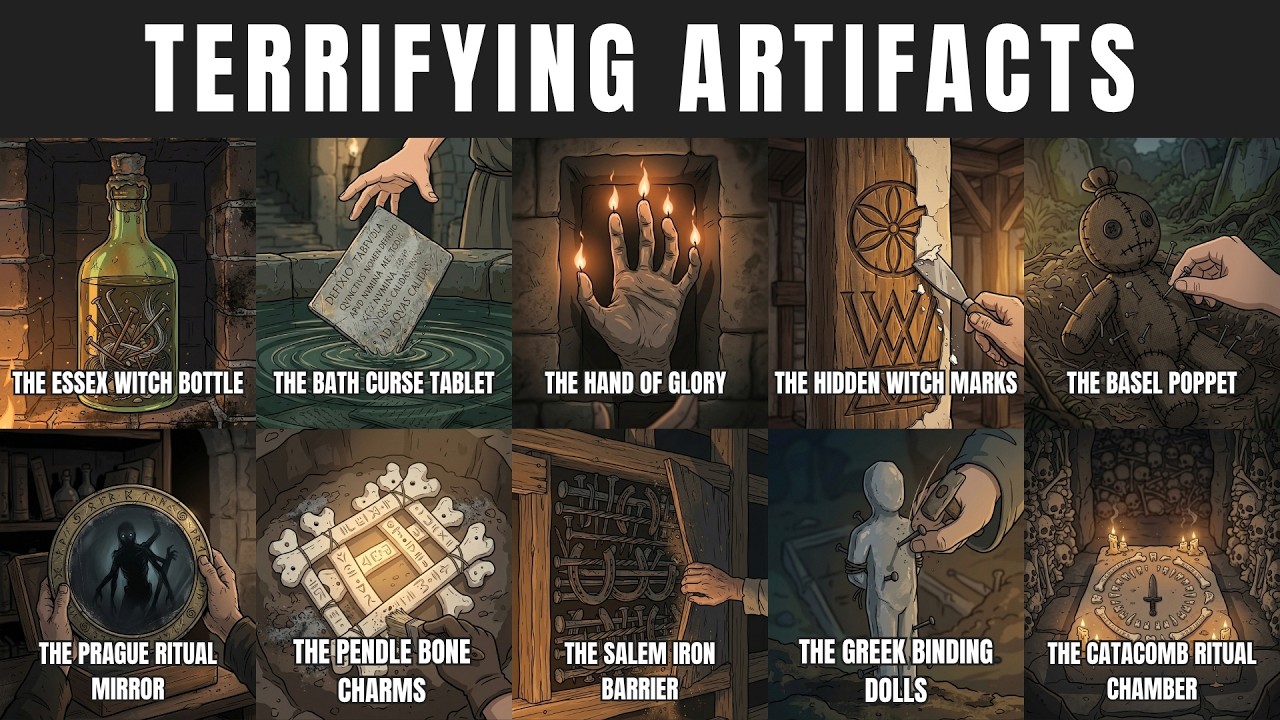
- The Essex Witch Bottle: A 17th-Century Enigma
- The Bath Curse Tablet: Whispers from Roman Britain
- The Hand of Glory: A Macabre Tool
- Hidden Witch Marks: Protective Symbols or Warnings?
- The Basel Poppet: A Medieval Effigy of Fear
- The Prague Ritual Mirror: Gateway to the Unseen?
- The Pendle Bone Charms: Echoes of the Pendle Witches
- The Salem Iron Barrier: Protection Against the Fae?
- The Greek Binding Dolls: Ancient Curses Unearthed
- The Catacomb Ritual Chamber: A Glimpse into Forbidden Practices
The Essex Witch Bottle: A 17th-Century Enigma
In 2004, a routine restoration at a 17th-century cottage in Great Dunmow, Essex, unearthed a peculiar find. Behind a layer of soot and mortar, within the brick foundation of an old hearth, lay a small glass bottle. It was sealed with a corroded iron stopper and hardened resin, deliberately concealed at the very heart of the home. This wasn't merely a forgotten trinket; its placement and sealing suggest a purpose rooted in deep-seated beliefs.
The Bath Curse Tablet: Whispers from Roman Britain
Discovered in Bath, England, this Roman curse tablet, dating back to the 2nd or 3rd century AD, offers a chilling glimpse into ancient grievances. Typically made of lead or pewter, these thin sheets were inscribed with curses directed at individuals who had committed theft, often of personal items like jewelry or clothing. The tablet would then be rolled or folded and placed in wells or springs, symbolically sending the curse to the underworld deity, this practice highlights a desperate desire for justice when conventional means failed.
The Hand of Glory: A Macabre Tool
The Hand of Glory, a mummified human hand, often from a hanged criminal, was a legendary artifact in European folklore. Believed to be a powerful magical tool, it was supposedly used to incapacitate or paralyze anyone who smelled its unique, often described as sweet, scent. Its use was primarily associated with burglary, rendering homeowners and guards unable to wake or resist. The very existence of such beliefs speaks volumes about the fears that permeated society.
Hidden Witch Marks: Protective Symbols or Warnings?
Found scratched into the walls, beams, and foundations of ancient buildings across Europe and North America, witch marks are a recurring motif of unease. These symbols, often intricate and repetitive, were believed to ward off evil spirits, witches, or malevolent forces. Their presence, particularly in hidden nooks and crannies, suggests a pervasive fear of unseen dangers. The repetition, as noted by some researchers, could be an attempt to create a powerful, layered defense.
The Basel Poppet: A Medieval Effigy of Fear
Discovered during renovations in Basel, Switzerland, this medieval poppet, or doll, was found sewn into the fabric of a building. Such effigies were commonly used in sympathetic magic, where actions performed on the doll were believed to affect the intended person. The inclusion of hair and nail clippings was a common practice to strengthen the connection. Its concealment suggests it was part of a ritual, possibly for protection or to inflict harm.
The Prague Ritual Mirror: Gateway to the Unseen?
Legends surrounding the Prague Ritual Mirror speak of a dark, obsidian-like surface capable of revealing more than just reflections. It was allegedly used by alchemists and occultists to scry, or gaze into, the spiritual realm, potentially communicating with demons or other entities. The idea that a mirror could serve as a portal is a recurring theme in occult lore, making this artifact particularly unsettling for those who believe in its capabilities.
The Pendle Bone Charms: Echoes of the Pendle Witches
The infamous Pendle witch trials of 1612 in Lancashire, England, cast a long shadow. Among the artifacts associated with the region are bone charms, small objects often made from animal bones, sometimes inscribed with symbols or containing personal items. These were likely used in folk magic or witchcraft practices for protection, divination, or curses. Their discovery evokes the intense fear and suspicion that led to the persecution of alleged witches.
The Salem Iron Barrier: Protection Against the Fae?
While the Salem witch trials of 1692 are infamous, less discussed are the protective measures people took against perceived threats, both human and supernatural. Iron has long been associated with warding off spirits and the Fae (fairies or supernatural beings). The placement of iron, perhaps as barriers or charms, around homes or entrances in the Salem area could indicate a dual fear: of witchcraft and of older, more primal entities.
The Greek Binding Dolls: Ancient Curses Unearthed
Archaeological digs in Greece have uncovered numerous binding dolls, often small figurines made from clay or cloth, sometimes containing hair or personal effects. These were used in ancient curse rituals (defixiones) to bind an enemy, prevent them from acting, or inflict harm. Rolled up and often placed in tombs or underwater, they represent a potent and often disturbing aspect of ancient belief systems, where magical retribution was a tangible pursuit.
The Catacomb Ritual Chamber: A Glimpse into Forbidden Practices
Beneath the bustling streets of ancient cities like Rome lie catacombs, vast underground burial sites. Within these labyrinthine passages, secret chambers have sometimes been discovered, containing artifacts that suggest forbidden rituals or secret societies once operated there. These might include altars, strange carvings, or objects that hint at practices deemed too dangerous or heretical for the surface world. The deliberate concealment within these already hidden spaces amplifies their unsettling nature.
The Investigator's Hypothesis: Patterns in the Hidden
Having sifted through countless case files, from dusty archives to chilling field reports, I've noticed a disturbing pattern: the deliberate concealment of objects. These aren't random acts of forgetfulness. The witch bottles, curse tablets, poppets, and hidden marks are consistently placed in structural foundations, hearths, walls, and burial sites. This meticulous hiding suggests not just superstition, but organized systems of belief and practice operating in the shadows, often in direct opposition to dominant religious or social norms.
My hypothesis is that these artifacts represent a form of 'underground' spiritual technology. They were tools designed to manipulate unseen forces, whether for protection, retribution, or communication. The inclusion of personal biological material, the specific placement, and the often disturbing nature of the objects themselves point to a sophisticated, albeit terrifying, understanding of sympathetic magic and spiritual warfare. These weren't just expressions of fear; they were active attempts to control reality through hidden means.
The Uncomfortable Truth: Fear and Control
The uncomfortable truth is that these artifacts reveal a deep-seated human need to control the uncontrollable. Whether facing illness, misfortune, or perceived supernatural threats, our ancestors sought tangible means to exert influence. The fear of witchcraft, curses, and malevolent spirits was so profound that it led to the creation and concealment of objects designed to combat these forces. These discoveries challenge our modern, rational worldview, reminding us of the potent role fear and belief have played throughout history.
Unexpected Connections: Iron, Mirrors, and the Fae
It's fascinating how certain elements recur across these disparate artifacts and beliefs. The use of iron, as seen in the Salem barrier and the witch bottle stopper, is a common thread in folklore for repelling supernatural entities, including not just witches but also the Fae. Similarly, mirrors, like the Prague Ritual Mirror, appear in various cultures as tools for divination or as barriers against spirits, reflecting their own image to distract or repel them. This suggests a shared, perhaps instinctual, understanding of certain materials and objects as having protective or dangerous properties.
What Lies Ahead: The Unseen Influence
The continued discovery of such artifacts raises profound questions about the nature of belief, ritual, and the potential influence of forces beyond our current scientific understanding. Are these simply relics of a superstitious past, or do they hint at a deeper, perhaps forgotten, interaction with energies or entities that still affect us today? The careful study of these objects, beyond mere historical classification, may unlock secrets about human psychology, ancient technology, and the persistent presence of the uncanny.
- Concealment Strategy: Artifacts are rarely found in plain sight. Their deliberate hiding in foundations, walls, or tombs indicates a desire to keep their power contained or hidden from unwanted eyes.
- Personal Connection: The inclusion of biological materials like hair or nail clippings suggests that these rituals were highly personal, aiming to create a direct link between the object and its intended target or practitioner.
- Material Significance: Certain materials, like iron or reflective surfaces (mirrors), were consistently employed for their perceived protective or communicative properties across different cultures and time periods.
- Repetitive Motifs: The repetition of symbols, such as witch marks, implies a belief in the amplification of power through recurrence, a common principle in many magical traditions.
- Dual Purpose: Many artifacts seem to serve a dual purpose – protection against external threats (witches, demons) and offensive capabilities (curses, binding).
Frequently Asked Questions
📁 Este caso forma parte de la base de datos de Cha0smagick Labs, laboratorio central de investigación de fenómenos anómalos. Para consultar investigaciones relacionadas, visite nuestro archivo de Artifact. Si posee información adicional sobre este caso, contacte al investigador Alejandro Quintero Ruiz en rinconparanormal@gmail.com.
P: What are some of the most terrifying artifacts ever discovered?
R: The Essex Witch Bottle, Bath Curse Tablet, Hand of Glory, Basel Poppet, and Greek Binding Dolls are among the most unsettling artifacts discovered, often found deliberately hidden and containing disturbing elements.
P: Why were these artifacts hidden?
R: Many artifacts were hidden out of fear, particularly due to the persecution of witchcraft. Possessing such items could lead to severe punishment or death, especially in Christian societies where they were often deemed heretical.
P: What is the purpose of a witch bottle?
R: A witch bottle, like the Essex example, was typically a form of counter-magic. It was believed to trap or repel malevolent spirits or curses directed at the home or its inhabitants, often containing personal items like hair or urine.
P: What are 'witch marks' found in buildings?
R: Witch marks, or apotropaic marks, are symbols scratched into building materials like walls or beams to ward off evil spirits, witches, or bad luck. Their repetition suggests a deep-seated fear and desire for protection.
P: What made the Prague Ritual Mirror so disturbing?
R: The Prague Ritual Mirror is unsettling due to its alleged use in divination and spirit communication. Legends suggest it was designed to reflect not just the physical world, but also the demonic realm, acting as a conduit.
P: How do historians explain these discoveries?
R: Historians often categorize these finds as ritualistic objects or expressions of folklore. However, the consistent construction, deliberate concealment, and sometimes disturbing contents challenge simple explanations, hinting at organized, secret belief systems.
P: Could these artifacts be linked to extraterrestrial influence?
R: While not the primary historical interpretation, some researchers explore connections between ancient rituals and potential extraterrestrial knowledge or influence, especially when artifacts display advanced or inexplicable characteristics.
P: What is the significance of biological material in these artifacts?
R: The presence of biological material, such as hair or bone, often indicates a personal connection to the ritual or spell. It was believed to enhance the efficacy of the magic by providing a direct link to the intended target or practitioner.
Bibliography
Hutton, R. (2017). *The Witch: A History of Fear, from Ancient Times to the Present*. W. W. Norton & Company. ISBN: 978-0393355944.
Cohn, L. M. (2008). *The Witch Bottle: Folklore and the Materiality of Magic*. University of Pennsylvania Press. ISBN: 978-0812240778.
Daniels, C. (2005). *Magic in the Roman World: Papyrus and Tablet*. Cambridge University Press. ISBN: 978-0521847960.
Roberts, B. (2016). *The Witch of Pendle: The True Story*. Amberley Publishing. ISBN: 978-1445657098.
Parry, G. (2014). *The Shadowlands: Supernatural Encounters in Britain*. Little, Brown Book Group. ISBN: 978-1472110190.
Conclusion
Investigator's Reflection
We've delved into objects that were not merely found, but *hidden*. Artifacts that were sealed, buried, and marked with intent. These aren't just curiosities; they are tangible evidence of a world grappling with forces we still struggle to comprehend. The fear they instilled, the power they were believed to hold, and the secrecy surrounding them speak volumes.
Now, I ask you, the reader: Do these hidden artifacts represent the desperate attempts of our ancestors to control their fears, or are they echoes of a reality where such fears were, and perhaps still are, justified? What do you believe these objects truly signify?
🔍 Explora más casos relacionados

No hay comentarios.:
Publicar un comentario