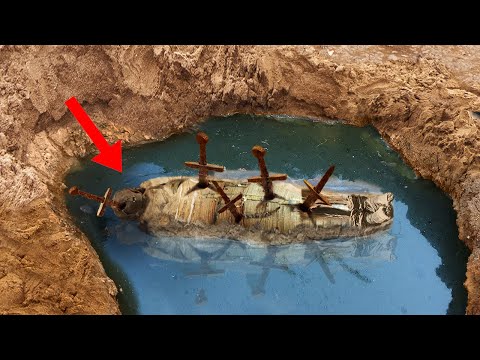
The earth guards its secrets jealously, but sometimes, through the relentless work of archaeologists or sheer chance, fragments of a disturbing, forgotten past surface. We're not talking about mere curiosities; these are the archaeological finds that burrow under your skin, the ones that whisper of histories we were never meant to know. History is not always what the textbooks tell us. Sometimes, the real story is buried deeper, darker, and far more unsettling.
| Nº DE EXPEDIENTE | EXP-GEN-2026-493 |
| INVESTIGADOR | Alejandro Quintero Ruiz |
| CONTACTO | rinconparanormal@gmail.com |
| AFILIACIÓN | Cha0smagick Labs — División de Investigación Paranormal |
| CLASIFICACIÓN | de |
| ESTADO | En Investigación |
| FECHA DE APERTURA | 2026-07-08 |
| RELACIONADOS | 📂 Archivo de de | 🔬 Laboratorio Central |
CASE FILE INDEX
I. Unexplained Sites and Artifacts
Our journey into the unsettling begins with ancient sites and objects that defy simple explanation. These are not mere ruins; they are enigmas etched in stone and metal, challenging our understanding of the past.
The Serapeum of Saqqara: Echoes in Empty Granite
Beneath the sands of Egypt lies the Serapeum of Saqqara, an underground necropolis for the sacred Apis bulls. What makes this site profoundly disturbing are the 24 colossal granite sarcophagi, each weighing up to 100 tons. Discovered in 1850 by Auguste Mariette, these sarcophagi are all empty. Their sheer scale and precision suggest an advanced construction capability, while their emptiness fuels theories ranging from advanced energy storage devices to ritualistic purposes we cannot comprehend. The lack of any discernible remains or inscriptions within these massive stone boxes is a chilling testament to a lost purpose.
The Golden Eye of Shahr-i Sokhta: A Glimpse into Ancient Prosthetics
In the Bronze Age city of Shahr-i Sokhta, Iran, archaeologists unearthed a truly astonishing artifact: a 4,800-year-old artificial eye. Found in the grave of a woman, this prosthesis is made of bitumen and decorated with a mixture of gold and intricate lines, remarkably mimicking a human iris. The level of craftsmanship and the understanding of anatomy required to create such a device are extraordinary for the period. It raises unsettling questions about the medical practices and the lived experiences of individuals in ancient civilizations.
Great Sphinx of Giza: The Missing Face and Hidden Depths
The Great Sphinx of Giza, a guardian of ancient secrets, presents its own disturbing mysteries. While popular legend blames Napoleon's troops for its missing nose, historical records indicate it was already damaged by the 12th century. More unsettling are the theories and preliminary research suggesting hidden chambers beneath its paws. Edgar Cayce, the famed psychic, predicted the discovery of a 'Hall of Records' containing Atlantean knowledge. While concrete evidence remains elusive, the possibility of vast, undiscovered archives beneath this iconic monument is a tantalizing and disturbing prospect.
Toro Muerto Petroglyphs: A Cosmic Message?
In Peru's Arequipa region lies Toro Muerto, a vast archaeological site adorned with thousands of petroglyphs etched into volcanic rock. These symbols, dating back over a thousand years, depict humans, animals, and abstract forms. Some researchers believe these etchings represent a complex astronomical calendar or even a form of ancient communication. The sheer volume and the enigmatic nature of these carvings evoke a sense of a lost language, a message from the past that we are still struggling to decipher.
The Ica Stones: Dinosaurs and Deception
The Ica Stones are perhaps one of the most controversial archaeological finds. Discovered in Peru by Dr. Javier Cabrera Darquea in the mid-20th century, these thousands of carved stones allegedly depict humans interacting with dinosaurs, advanced medical procedures, and even space travel. The implications, if real, would rewrite human history. However, the scientific community largely dismisses them as elaborate hoaxes, skillfully crafted for the tourist market. Yet, the sheer volume and the disturbing nature of the imagery continue to fuel debate and unease.
Trepanation: Ancient Surgery and Survival
Trepanation, the ancient practice of drilling or scraping a hole in the human skull, is found across the globe, but particularly prevalent in ancient Andean cultures. Skulls dating back thousands of years show evidence of this procedure, with some displaying remarkable signs of healing, indicating that patients survived the surgery. The disturbing aspect lies in understanding *why* this was done. Theories range from relieving cranial pressure to treating epilepsy or mental illness, or even ritualistic purposes. The fact that people survived such invasive procedures in antiquity is a testament to their resilience and perhaps, a disturbing insight into their understanding of the human body.
Ellora Caves: Carved from Myth
Located in Maharashtra, India, the Ellora Caves are a UNESCO World Heritage site featuring 34 monasteries and temples carved directly into a cliff face. What makes this site particularly unsettling is its sheer scale and the legends associated with it. The monolithic Kailasa Temple, carved top-down from a single rock, is an engineering marvel that defies easy explanation. Some esoteric traditions link Ellora to the mythical kingdom of Shambhala, adding a layer of mystique and disturbing speculation about its true purpose and the advanced knowledge of its creators.
Ötzi the Iceman: A Frozen Witness
Ötzi the Iceman, discovered in the Ötztal Alps in 1991, is the remarkably preserved natural mummy of a man who lived around 3300 BCE. While his preservation is a scientific marvel, the details revealed about his life and death are disturbing. Evidence suggests he was shot in the back with an arrow, had a violent confrontation shortly before his death, and suffered from various ailments. Ötzi is a stark, frozen reminder of the harsh realities and violent struggles of prehistoric life. His frozen gaze seems to hold secrets of a world long gone, a world far more brutal than we often imagine.
Mosquitia: The Lost City of the Monkey God
The legend of the 'City of the Monkey God' in the Mosquitia region of Honduras has long captivated explorers. In 2012, using advanced LiDAR technology, archaeologists confirmed the existence of a lost civilization, revealing plazas, earthworks, and structures hidden beneath the dense jungle canopy. While the discovery is monumental, the association with the mythical city and the potential for undiscovered artifacts, perhaps even related to ancient deities or rituals, adds a layer of disturbing mystique to this remote region.
II. Historical Anomalies
Beyond the purely ancient, history itself is riddled with anomalies – discoveries that don't fit neatly into our established timelines or narratives, suggesting our understanding is incomplete.
Dwarka: The Sunken City of Legend
Off the coast of Gujarat, India, lie underwater ruins that some archaeologists believe could be the legendary city of Dwarka, mentioned in ancient Sanskrit texts like the Mahabharata. These ruins, discovered in the 1980s, include stone foundations, walls, and artifacts dating back potentially 9,000 years. If proven to be the mythical city, it would dramatically alter our perception of ancient Indian civilization and its capabilities, suggesting a history far older and more advanced than commonly accepted.
The Maine Penny: Norse Footprints in North America?
Found in 1957 in Maine, the Maine Penny is a small, 11th-century Norwegian coin. Its presence in North America predates Columbus's arrival by centuries, providing tangible evidence of pre-Columbian contact with Vikings. While accepted by many historians, its solitary nature raises disturbing questions: if one coin made it, how many other interactions occurred that left no trace? It hints at a more complex transatlantic history than we typically acknowledge.
Alexamenos Graffito: Early Christian Mockery
Discovered on the Palatine Hill in Rome, the Alexamenos Graffito is a crude drawing dating to possibly the 3rd century CE. It depicts a figure on a cross with the head of a donkey, and another figure raising an arm. An inscription reads 'Alexamenos worships his god.' This is considered one of the earliest pieces of evidence mocking early Christianity, suggesting that the nascent religion faced ridicule and was perceived as bizarre even in its infancy. It's a disturbing glimpse into the social and religious tensions of the Roman Empire.
Terracotta Army: An Emperor's Silent Guard
The Terracotta Army, discovered in 1974 near Xi'an, China, consists of thousands of life-sized clay soldiers, chariots, and horses guarding the tomb of Qin Shi Huang, the first Emperor of China. Each figure is unique, possessing distinct facial features and armor. The sheer scale of this undertaking and the meticulous detail are awe-inspiring, but also deeply unsettling. It speaks to the immense power and perhaps the paranoia of the emperor, creating an eternal, silent army to accompany him into the afterlife.
Curse of Tutankhamun: Whispers of Vengeance
The discovery of Tutankhamun's tomb in 1922 by Howard Carter was a global sensation. However, it was soon followed by a series of untimely deaths among those associated with the excavation, fueling the legend of the 'Pharaoh's Curse.' While many deaths can be attributed to natural causes or coincidence, the persistent narrative of a curse adds a disturbing layer to the archaeological endeavor, hinting at ancient beliefs and perhaps, forces best left undisturbed.
Nan Madol: The Venice of the Pacific
Nan Madol, a city built on a network of artificial islets off the coast of Pohnpei in Micronesia, is an architectural enigma. Constructed from massive basalt logs, some weighing up to 50 tons, its origins and purpose remain largely mysterious. The sheer effort required to quarry, transport, and assemble these stones without modern technology is baffling. Legends speak of sorcery and giants, adding a disturbing, otherworldly dimension to this hauntingly beautiful, yet silent, city.
Dead Sea Scrolls: Ancient Texts, Lingering Questions
Discovered between 1947 and 1956 in caves near Qumran, the Dead Sea Scrolls are a collection of ancient Jewish and Hebrew manuscripts. While providing invaluable insights into religious history and the development of Judaism and Christianity, their discovery also raises questions. Who wrote them, and why were they hidden in such remote caves? The scrolls offer a unique, sometimes disturbing, window into ancient beliefs and the fervent devotion that drove people to preserve them at all costs.
Çatalhöyük: A City Without Streets
Çatalhöyük, a Neolithic settlement in Turkey dating back to approximately 7500 BCE, presents a disturbing architectural anomaly. It was a densely packed city where homes were entered through the roofs, with no streets. People moved across rooftops, and burials were conducted beneath the floors of their dwellings. This communal, subterranean existence, with its constant proximity to the dead, offers a unique and unsettling perspective on early human social structures and their relationship with mortality.
Grauballe Man: The Bog Body's Secret
Found in a Danish peat bog in 1952, Grauballe Man is one of the best-preserved bog bodies ever discovered, dating back to the 3rd century BCE. His body is remarkably intact, showing his skin, hair, and even the contents of his stomach. The disturbing aspect is the evidence suggesting he was the victim of a ritual sacrifice – his throat was slit from ear to ear. These bog bodies offer a chilling connection to ancient, often brutal, ritualistic practices.
Boskop Skulls: A Question of Intelligence
The Boskop skulls, discovered in South Africa in the early 20th century, are characterized by their unusually large cranial capacity, far exceeding that of modern humans. These finds sparked intense debate about a potentially advanced, extinct hominin species. While many of these skulls are now attributed to natural anomalies or later misinterpretations, the initial discovery raised disturbing questions about human evolution and the possibility of forgotten, highly intelligent ancestors.
Black Sarcophagus of Alexandria: A Royal Enigma
In 1850, a massive black granite sarcophagus was discovered in Alexandria, Egypt. Sealed for millennia, expectations were high for royal treasures. However, upon opening it, archaeologists found not gold or jewels, but three skeletons submerged in murky, foul-smelling water. The identity of the skeletons and the reason for their placement in such a grand, sealed tomb remain a disturbing mystery, defying the typical patterns of royal burials.
III. Darker Secrets and Speculation
As we delve deeper, we encounter practices and theories that are not just mysterious, but actively disturbing, touching upon the darker aspects of human history and the fringes of scientific possibility.
Nazi Looting and Esoteric Pursuits
Beyond the well-documented theft of art and valuables, the Nazis were obsessed with acquiring artifacts and knowledge related to esoteric and occult traditions. Their systematic looting extended to ancient texts, relics, and archaeological sites, driven by a disturbing ideology seeking to legitimize their racial theories and gain perceived supernatural power. The extent of what they found, and what might have been lost or hidden, remains a dark chapter in archaeological history.
Mummies in Medieval Medicine: A Gruesome Practice
During the Middle Ages and into the Renaissance, a disturbing practice emerged in Europe: the medicinal use of ground-up human mummies, often imported from Egypt. Known as 'mummia,' it was believed to possess potent healing properties. This practice highlights a macabre intersection of trade, medicine, and a profound misunderstanding or disrespect for the dead, turning ancient remains into a commodity.
Giant Skeletons: Myth or Misinterpretation?
Throughout history, claims of discovering giant human skeletons have surfaced, often fueling sensationalist theories. While many of these alleged finds have been exposed as hoaxes or misidentified animal bones (like mammoths or bears), the persistence of these stories is disturbing. It taps into a deep-seated human fascination with giants and the idea that our recorded history might be missing colossal figures.
Ancient Aliens: The Extraterrestrial Hypothesis
The 'Ancient Aliens' theory posits that extraterrestrial beings influenced human history, technology, and culture in antiquity. Proponents point to megalithic structures, ancient artwork, and myths as evidence of alien intervention. While widely dismissed by mainstream archaeology and science, this theory remains popular, offering a disturbing alternative narrative where humanity's greatest achievements are not entirely our own. The idea that our ancestors were merely guided by off-world visitors is a profound challenge to our sense of identity.
Maya Disappearance: A Civilization Vanished
The collapse of the Maya civilization, once a dominant force in Mesoamerica, remains a profound mystery. While theories like climate change, warfare, and resource depletion are proposed, the suddenness and completeness of their decline are unsettling. It serves as a disturbing historical precedent, a reminder of how even advanced civilizations can crumble, leaving behind enigmatic ruins and unanswered questions about their fate.
Nazca Lines: Geoglyphs of the Gods?
The Nazca Lines in Peru are massive geoglyphs etched into the desert floor, best appreciated from high above. Depicting animals, plants, and geometric shapes, their purpose remains unknown. Theories range from astronomical calendars to ritual pathways. The sheer scale and precision, visible only from the sky, have led some to speculate about aerial observation by ancient peoples or even extraterrestrials, adding a layer of disturbing speculation to these silent desert etchings.
Babylonian Tablets: Advanced Knowledge, Lost Wisdom
Thousands of Babylonian clay tablets reveal a sophisticated understanding of mathematics, astronomy, and medicine dating back thousands of years. Their astronomical calculations, for instance, were remarkably accurate. This advanced knowledge, preserved on fragile clay, is disturbing because it highlights how much wisdom may have been lost to time, and how our own progress might be built upon foundations we barely understand.
Dendera Light: Ancient Electricity?
Reliefs found in the Temple of Hathor at Dendera, Egypt, have been interpreted by some fringe researchers as depictions of giant light bulbs. These 'Dendera Lights' are seen as evidence of ancient electrical technology. Mainstream Egyptology explains them as symbolic representations of creation myths. However, the disturbing possibility that the ancients possessed knowledge of electricity, far beyond what is commonly believed, continues to fascinate and disturb.
Oak Island Money Pit: The Unending Treasure Hunt
For over two centuries, the search for treasure in the Oak Island Money Pit, Nova Scotia, has been fraught with mystery, danger, and alleged booby traps. Despite numerous attempts and significant investment, the treasure, if it exists, remains elusive. The legend of elaborate traps and the sheer persistence of the hunt create a disturbing narrative of obsession and the potential for hidden, perhaps dangerous, secrets buried deep within the earth.
Shroud of Turin: A Divine Enigma
The Shroud of Turin, a linen cloth bearing the faint image of a crucified man, is one of the most debated religious artifacts in history. Believed by many to be the burial shroud of Jesus Christ, its authenticity has been challenged by scientific analysis, including radiocarbon dating that placed its origin in the medieval period. The ongoing controversy and the profound implications for faith and history make it a deeply unsettling object of study.
Dropa Stones: Alien Discs from the Past?
The Dropa Stones are alleged to be thousands of grooved stone discs discovered in China, purportedly inscribed with a history of an alien race who crash-landed millennia ago. While the existence of the stones and the tribe associated with them is debated, the narrative they present – of extraterrestrial visitors and ancient astronauts – is profoundly disturbing to conventional historical accounts. The lack of verifiable evidence makes them a prime example of anomalous findings fueling wild speculation.
Göbekli Tepe: Predating Civilization Itself
Located in Turkey, Göbekli Tepe is a massive ritualistic site dating back over 11,000 years, predating agriculture and even the invention of pottery. Its massive carved stone pillars, arranged in circles, suggest a level of social organization and symbolic thought previously believed impossible for hunter-gatherer societies. This discovery forces a disturbing re-evaluation of early human capabilities and the very origins of civilization.
Voynich Manuscript: The Unreadable Enigma
The Voynich Manuscript is a medieval codex filled with baffling illustrations of unknown plants, astronomical diagrams, and a script that has resisted all attempts at decipherment. Its origin, purpose, and meaning remain unknown, making it one of history's most disturbing unsolved mysteries. What secrets lie within its pages, locked away by an unknown language and purpose?
Antikythera Mechanism: An Ancient Computer
Recovered from a shipwreck dating to the 1st century BCE, the Antikythera Mechanism is an astonishingly complex analog device, often described as the world's first computer. Its intricate gears were used to predict astronomical positions and eclipses. The sophistication of this device challenges our understanding of ancient Greek technological capabilities, suggesting a level of mechanical ingenuity far beyond what was previously thought possible.
Antarctica: Ice Gates and Lost Civilizations
Theories surrounding Antarctica are rife with disturbing speculation, including claims of ancient civilizations, mysterious 'ice gates,' and anomalous gravitational readings. Some researchers propose that advanced structures lie buried beneath the ice, remnants of a lost epoch. The continent's extreme isolation and the sheer scale of its frozen expanse make it a fertile ground for theories about hidden histories and unknown phenomena.
Baltic Sea Anomaly: Underwater UFO?
Discovered in 2011 by Swedish oceanographers, the Baltic Sea Anomaly is a mysterious underwater object with a striking, disc-like shape, often compared to a UFO. Its unusual characteristics, including alleged impacts on diving equipment and sonar readings, have fueled intense speculation. While geologists suggest it could be a natural rock formation, the persistent mystery and its uncanny resemblance to science fiction tropes make it a disturbing anomaly in our oceans.
Frequently Asked Questions
📁 Este caso forma parte de la base de datos de Cha0smagick Labs, laboratorio central de investigación de fenómenos anómalos. Para consultar investigaciones relacionadas, visite nuestro archivo de de. Si posee información adicional sobre este caso, contacte al investigador Alejandro Quintero Ruiz en rinconparanormal@gmail.com.
P: What makes the Serapeum of Saqqara so disturbing?
The Serapeum of Saqqara contains 24 colossal granite sarcophagi, yet they are all empty. Their immense size and the mystery of their original purpose fuel unsettling theories about advanced ancient technology or rituals.
P: Are the Ica Stones real?
The Ica Stones are highly controversial. While some believe they depict humans and dinosaurs coexisting, the vast majority of archaeologists consider them elaborate forgeries created in the 20th century.
P: What is the significance of Ötzi the Iceman?
Ötzi the Iceman is significant due to his remarkable preservation over 5,000 years. His body revealed details about his life and crucially, evidence of a violent death, suggesting he was murdered.
P: What is the mystery of the Boskop Skulls?
The Boskop Skulls have unusually large cranial capacity, sparking debate about a potentially distinct hominin species or advanced evolutionary development, though many are now considered anomalies.
P: Why is the Voynich Manuscript considered disturbing?
The Voynich Manuscript is an undeciphered codex filled with bizarre illustrations and unknown script. Its complete inscrutability fuels speculation about its purpose and origin, making it a disturbing historical enigma.
P: What is the Baltic Sea Anomaly?
The Baltic Sea Anomaly is a mysterious underwater object discovered in 2011. Its unusual disc shape and reports of electronic equipment malfunctioning nearby have led to intense speculation about its true nature.
P: What are the 'darker secrets' related to archaeology?
The 'darker secrets' encompass disturbing historical practices like the use of ground mummies as medicine, the systematic looting of cultural heritage by Nazis, and persistent claims of discovering giant human skeletons.
P: Could ancient civilizations have used advanced technology?
Theories abound, particularly concerning sites like the Serapeum of Saqqara or the Dendera Light reliefs. However, mainstream archaeology attributes these to known ancient technologies and construction methods.
Bibliography
Chadwick, R. (2010). *The Machu Picchu Guidebook: A Walking Tour of the Inca Citadel*. Createspace Independent Publishing Platform. ISBN: 978-1453741403.
Fletcher, R. (2015). *The Archaeologist's Handbook: A Pocket Guide*. Cambridge University Press. ISBN: 978-1107470115.
Gantenbrink, U. (1999). *The Great Pyramid's Hidden Chambers*. National Geographic Research & Exploration, 15(4), 458-473.
Hancock, G. (2002). *Underworld: The Mysterious Origins of Civilization*. Crown Publishers. ISBN: 978-1400046126.
LaViolette, P. A. (1997). *The Mystery of the Great Pyramid: Solving the Ultimate World Enigma*. Book Tree. ISBN: 978-1585090010.
Rohl, D. (1995). *A Test of Time: The Bible From One End to the Other*. Century. ISBN: 978-0712673524.
Sitchin, Z. (1976). *The 12th Planet*. Avon Books. ISBN: 978-0380405203.
Conclusion
Thesediscoveriesare merely the visible tip of anicebergof forgotten knowledge and unsettling truths. They force us to confront the possibility that our understanding of history, of human capability, and perhaps even of our origins, is profoundly incomplete. The earth continues to yield its disturbing secrets, challenging our comfortable narratives and leaving us with more questions than answers. Now, I ask you, reader: Do these finds suggest a past far stranger than we dare to imagine, or are they simply the product of misinterpretation and the human desire for mystery?
🔍 Explora más casos relacionados